
How to Track Net Worth Monthly (and Why Most People Quit by March)
Calculating net worth once is easy. Tracking it monthly is where the habit dies. Here is what to log, how long it should take, and what the number is for.
Published August 6, 2026
Most people calculate their net worth exactly once. It usually happens in January, or after reading something that made them anxious about money. They open a spreadsheet, chase down six balances, subtract what they owe, and stare at the number for a while. Then they close the file and never open it again.
The calculation was never the hard part. The habit is.
This guide covers what to log each month, how long it should take, and — the part almost nobody explains — what the number is actually for once you have it.
Why the Habit Dies
Three things kill monthly net worth tracking, and none of them is laziness.
The gathering takes too long. If updating your number means logging into six institutions, waiting for two of them to text you a code, and remembering which retirement account is at which provider, the update takes forty minutes. Nothing you do once a month survives a forty-minute setup cost. The people who sustain this have their account list written down in one place, in a fixed order, so the update is a pass down a list rather than a scavenger hunt.
The number moves for reasons that have nothing to do with you. If your net worth is mostly invested, a bad month in the market can erase a good month of saving. That is demoralising if you read the total as a scorecard on your behaviour, because it is not one. Your contributions are your behaviour. The market is weather.
There is no question attached to it. A number you look at and feel something about is a mood, not a tool. A number that answers “when do I cross $100,000 at my current rate” is a tool. Most trackers stop at the first and never get to the second, which is why they feel like homework.
What to Log, Exactly
You need two lists and a date. That is the whole schema.
Assets — everything you own that has a balance. Group them by type so the total is readable later:
- Cash: checking, savings, emergency fund, cash management accounts
- Investment: brokerage accounts, index funds, individual holdings
- Retirement: 401(k), IRA, Roth, pension cash value, employer plans from old jobs
- Property: primary residence, land, rental property, at a realistic estimate
- Vehicle: cars, motorcycles, boats, at trade-in value rather than what you paid
- Other: business equity, collectibles, money owed to you that you actually expect back
Liabilities — everything you owe, with the interest rate. The rate matters more than most people log:
- Mortgage balance and rate
- Auto loans
- Credit card balances, each at its own rate
- Student loans, federal and private separately, since the terms differ
- Personal loans, medical debt, anything owed to family
The date of the snapshot. Not “August” — the actual day. Snapshots taken on wildly different days of the month are not comparable, because the timing of a paycheck or a mortgage payment can swing the total by thousands.
Log the interest rate on every debt even though it does not affect the net worth total. It affects what you should do next, and you will not want to look it all up again later.
The Five-Minute Version
Pick a fixed date. The first Saturday of the month works well because it lands after most month-end statements post and it is not competing with a workday.
Then run the same pass every time:
- Open your account list in its fixed order
- Write down each balance without analysing it
- Do the same for every debt
- Save the snapshot
- Look at the change from last month, and say out loud why it moved
Step five is the one people skip, and it is the one that makes the habit stick. “Up $2,100 — I contributed $1,400 and the market did the rest” is a completed thought. “Up $2,100” is a number you will not remember next month.
If this takes more than ten minutes after the second month, your account list is the problem, not your discipline.
What the Number Is Actually For
Here is the shift that makes tracking worth doing: a single net worth figure tells you almost nothing. A series of them tells you your slope — how much you gain in an average month, measured from your own logged history rather than assumed.
Slope is the useful number, because slope projects. If you have six months of snapshots and your average monthly change is $1,800, then a $100,000 target you are $30,000 short of is roughly sixteen months away. That is a date, not a wish. Dates change behaviour in a way that totals do not.
It also makes trade-offs concrete. “Should I put an extra $250 a month toward this?” is unanswerable in the abstract and obvious once you can see that it pulls the crossing date forward by eight months.
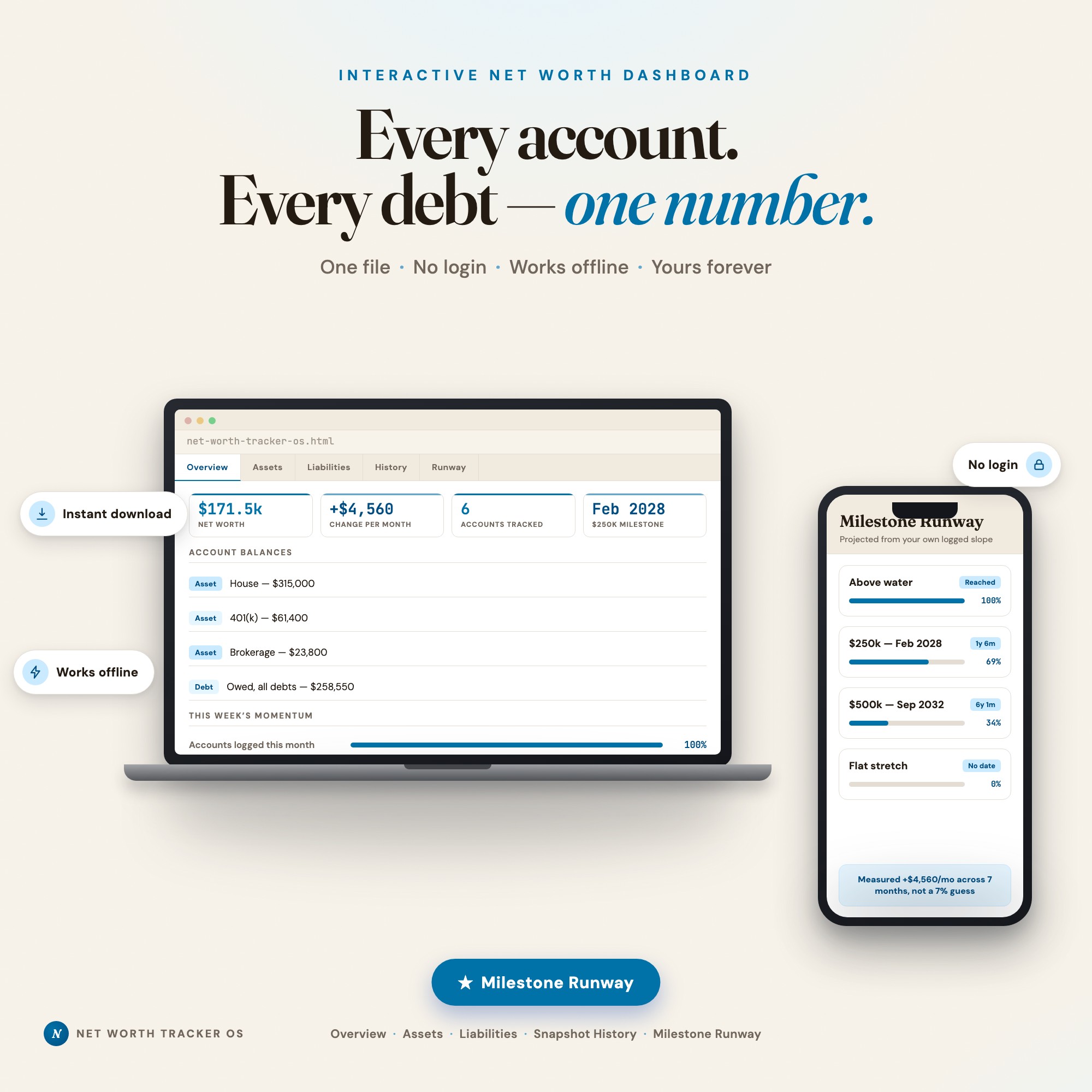
This is the specific reason the Net Worth Tracker Dashboard exists. Its Milestone Runway tab reads the monthly snapshots you have actually logged, fits your real average monthly change, and prints the projected calendar date you cross each milestone you set. A contribution what-if recomputes every date live. Most tools chart where you have been; the projection runs forward from your own measured slope rather than an assumed market return.
On Linked Accounts
Every mainstream net worth tool wants a connection to your bank. It saves typing, and that is a genuine benefit — but it is worth naming what you trade for it.
Aggregator connections mean a third party holds standing access to your financial institutions. They break when a bank changes its login flow, usually silently, and you find out when a balance has been stale for two months. And they tie your history to a company that can be shut down, acquired, or moved behind a subscription — which has already happened to a large, well-loved budgeting product and its users.
Typing ten balances once a month takes five minutes. If you would rather own the file than rent the service, that is the whole cost.
Start With Three Months
Do not try to reconstruct two years of history. It is tedious, the old numbers are approximate, and the exercise usually ends with the file abandoned before the first real snapshot.
Log this month. Log next month. Log the one after that. Three snapshots is enough to see a slope, and a slope is enough to project a date. That is the point at which the habit stops feeling like admin and starts answering questions — and that is the point at which people keep doing it.
Frequently asked questions
- How often should I actually update my net worth?
- Once a month, on a fixed date. Weekly is noise — market movement swamps your contributions at that interval, so you end up reacting to volatility you did not cause. Quarterly is too sparse to catch a trend before it becomes a problem. Monthly on the same date each time is the interval where your own behaviour is the visible signal.
- Should I include my house and car in net worth?
- Include them, but log the mortgage and auto loan as liabilities in the same snapshot. The common mistake is counting the asset and forgetting the debt, which inflates the number and makes it useless. If you want a cleaner read on liquid progress, keep property in the total but watch your investment and cash accounts as a separate line.
- What net worth number should I be at for my age?
- Age-based benchmarks are the least useful comparison available to you, because they ignore income, cost of living, student debt, and when you started. The only comparison that predicts anything is your own number last month. If the slope is positive and you know why, the benchmark is irrelevant.
- Is it bad if my net worth goes down some months?
- No, and expecting otherwise is why people quit. Markets fall, cars depreciate, and some months you spend more than you earn. What matters is the direction across six to twelve snapshots, not any single one. A tracker that only feels good when the line goes up is a tracker you will abandon in the first bad quarter.
- Do I need to link my bank accounts to track net worth?
- No. Account linking exists to save you typing, and it costs you a standing connection between your financial institutions and a third-party aggregator. Typing six to ten balances once a month takes about five minutes. That is the entire trade.
- What does the Net Worth Tracker Dashboard cost?
- One-time purchase of $24 on Etsy. No subscription and no login. It runs as a single file in your browser and your figures never leave your computer.
Ready-made dashboards
Skip setup — grab an interactive dashboard built for this exact workflow.
ListingResearchOS Shop
All dashboards — one-time purchase, yours forever
Single HTML files. No subscriptions. No login. Works offline in any browser.
Browse all dashboards →