Kids Birthday Party Games at Home: 10 Easy Indoor Ideas
Kids birthday party games at home: ten easy indoor games, how to play each, the ages they suit, and how to run short rounds so the party stays happy.
Published October 8, 2026
A birthday party at home runs on a few good games, a bit of food and a happy birthday child. You do not need a big space or a box of props. This guide lists ten games that fit in a living room, explains how to play each in a few sentences, and suggests the ages each one suits. Those age bands are our own suggestions, so adjust them for your own group. After the list you will find tips on running games so they stay fun, which matters as much as which game you pick. For the full plan around the games, see how to plan a kids birthday party and the kids birthday party hub.
Before You Start: Choosing Games That Work Indoors
Look for games that need little room, few supplies and a rule you can explain in one breath. Mix the energy: one active game, one calm game, then something in between. Have the supplies ready before the guests arrive, and think about who will be running each game so you are not doing everything yourself.
Small objects need extra care. Uninflated or broken latex balloons are a choking and suffocation risk for children under 8; keep them away from young children and pick up broken pieces right away. Small parts are a choking hazard for children under 3, and hard candy and popcorn for children under 4, so supervise closely or skip them if young children are present.
Ten Kids Birthday Party Games to Play at Home
1. Birthday bingo
Give each child a card with pictures or words and call out items in random order. Children mark what they hear, and the first to fill a line calls out. Use pictures for children who cannot read yet, and use small pieces of paper or crayons as markers. Suggested ages: about 4 to 10, with picture cards for the youngest.
2. Trivia
Ask short questions about animals, food, colors, space or your child’s favorite things, and let children answer in teams or on their own. Keep the questions friendly and fun, and aim for ones the group can get right. Suggested ages: about 6 and up. Use a team format so slower readers are not put on the spot.
3. Would you rather
Read out a silly choice, such as “would you rather have a pet giraffe or a pet dinosaur,” and have children go to one side of the room or raise a hand. Ask a few to explain their pick. There is no winner, which keeps it relaxed. Suggested ages: about 5 and up.
4. Who’s most likely to
Read a gentle statement such as “who’s most likely to fall asleep in a tent,” and on three each child points at a friend. Keep the statements kind, and avoid any that might single out a child. It works best when the children already know one another. Suggested ages: about 7 and up.
5. Word scramble
Give each child a sheet of party words with the letters mixed up, such as a jumbled “BALLOON” or “CAKE,” and set a timer. The child who unscrambles the most words wins. For younger players, work in pairs or use shorter words. Suggested ages: about 7 to 12.
6. Word search
Hand out a grid of letters with hidden party words, and let children circle what they find. It is a quiet game that works well after something loud, and it lets shy children join in without the spotlight. Suggested ages: about 6 to 12.
7. A-to-Z challenge
Pick a category, such as animals, foods or things at a party, and give children a few minutes to write one item for each letter of the alphabet. The one with the most completed letters wins. For a group game, call out letters and let children shout answers. Suggested ages: about 7 and up.
8. Pass the present
Wrap a small prize in layers of paper, with a tiny treat or a silly instruction in each layer. Children sit in a circle and pass the parcel while music plays, and when it stops the child holding it unwraps one layer. Whoever unwraps the last layer keeps the prize. Give every layer a treat so nobody is left out, and keep treats large enough not to be a choking hazard for the youngest. Suggested ages: about 3 to 8.
9. Scavenger hunt
Give children a list or a set of picture clues to find around one or two rooms, such as something red, something soft or a spoon. Work alone or in small teams, with a helper alongside younger children. Keep it inside the party space, and set the hiding spots at a height all the children can reach. Suggested ages: about 4 to 12, with pictures and a grown-up partner for the youngest.
10. Draw it blindfolded
One child puts on a blindfold or closes their eyes and draws a simple thing, such as a house or a cat, while the group guesses. The drawings are often funny, which keeps the mood light. Use a big sheet of paper and a thick marker. A parent can stand beside younger children, and children who dislike blindfolds can simply close their eyes. Suggested ages: about 6 and up.
How to Run Games So They Stay Fun
The way you run a game matters as much as which game you choose. A few habits keep the room happy.
- Keep rounds short. Five to ten minutes is a good starting point for many games, and shorter for young children. End a round while the children still want more, then offer a second round if they ask.
- Follow a loud game with a calm one. After a scavenger hunt or a round of pass the present, play a word search or bingo so the children settle before cake. That also helps sensitive children who find noise tiring.
- Explain the rules in one breath. Stand where all the children can see you, say what the game is, how to win and how long it lasts, and then begin.
- Supervise young children closely. For children under 3, stay within arm’s reach and skip small items. Keep latex balloons away from every child under 8.
- Plan for a mix of ages. Pair a younger child with an older helper or a parent, and offer easier versions of the same game.
- Give every player something. Small stickers or treats for all the players reduce disappointment, and rewarding effort rather than just the fastest child keeps things kind.
- Let children opt out. A child who wants to watch, draw or play alone for a while is still having a good time.
A Simple Game Plan for a Two-Hour Party
This is an example, not a schedule you have to follow. It assumes a party of children around the same age.
- Arrival (about 15 minutes): Free play or a coloring table while guests gather.
- Active game (about 15 minutes): A scavenger hunt or pass the present.
- Food (about 25 minutes): Sit-down snack or pizza, with water.
- Calm game (about 15 minutes): Bingo, a word search or a round of would you rather.
- Cake and singing (about 20 minutes).
- Free play and goodbyes (about 30 minutes): Spare game if needed, then favors at the door.
The kids birthday party planner timeline can build a timeline like this around your own start and end times. For menu help, there is also the kids birthday party food calculator.
Where the Printables Fit
If you want these ten games ready to print, the Host Kit in our printable birthday suites includes a PDF of 10 kids’ party games with answer keys, including a bingo set of 30 cards with a caller sheet. You can see the options in the suites section of the hub. Most of the games above can be run with paper, a pencil and a timer, so the kits are a convenience and not a requirement.
A Last Word on Games
You do not need to play all ten. Choose two or three that match your child’s age and mood, keep one in reserve, and let the rest of the party fill with cake, free play and conversation. When the children are happily busy on their own, it is fine to put the game away. For more on the whole day, see the kids birthday party checklist.
Frequently asked questions
- What are good kids birthday party games to play at home?
- Games that need little space and few supplies work well at home. Bingo, trivia, would you rather, who's most likely to, a word scramble, a word search, an A-to-Z challenge, pass the present, a scavenger hunt and a draw-it-blindfolded game all fit in a living room. Pick two or three that suit the ages of your guests and keep the rest as spares.
- What are good indoor games for a child's birthday party?
- Choose a mix of one active game, such as a scavenger hunt, and one calm game, such as bingo or a word search. Indoor games work well when they need no running room and no special equipment. Keep each round short and have a spare game ready in case the children finish early.
- How many games should I plan for a kids party?
- For a party of about two hours, two or three games plus food and cake is a reasonable starting point. Children also want free time to play and talk, so a packed schedule can feel rushed. Keep one extra game in reserve and drop it if the children are busy.
- What games work for a wide mix of ages?
- Games where children play at their own pace, such as a scavenger hunt, pass the present and bingo, work for a mixed group. Pair younger children with an older child or a parent, and give the younger ones simple picture versions. Skip anything that needs reading if the group includes pre-readers.
- How do I keep a loud game from getting out of hand?
- Follow a loud or active game with a calm one, and use short rounds so the energy never builds too far. Set simple ground rules before you start, such as walking indoors, and use a clear signal like a bell to bring the group back. Stay close to the action, especially with young children.
- Do I need prizes for birthday party games?
- Prizes are optional. Small treats, stickers or a turn to pick the next game work as a reward, and giving every child something avoids tears. Some parents prefer to skip competition and play cooperative games instead, which is a fine choice for younger children.
Printable kids’ birthday party suites
Ready-to-print kids’ birthday party suites
Invitation with an RSVP and allergy card, a name and age you type once, favor tags from your guest list, food labels, Party Math and a timeline worked back from the start time, editable on a laptop (it also opens on a phone or tablet). Three kits per theme, with games and a planner in the bigger ones. Digital download, nothing ships.
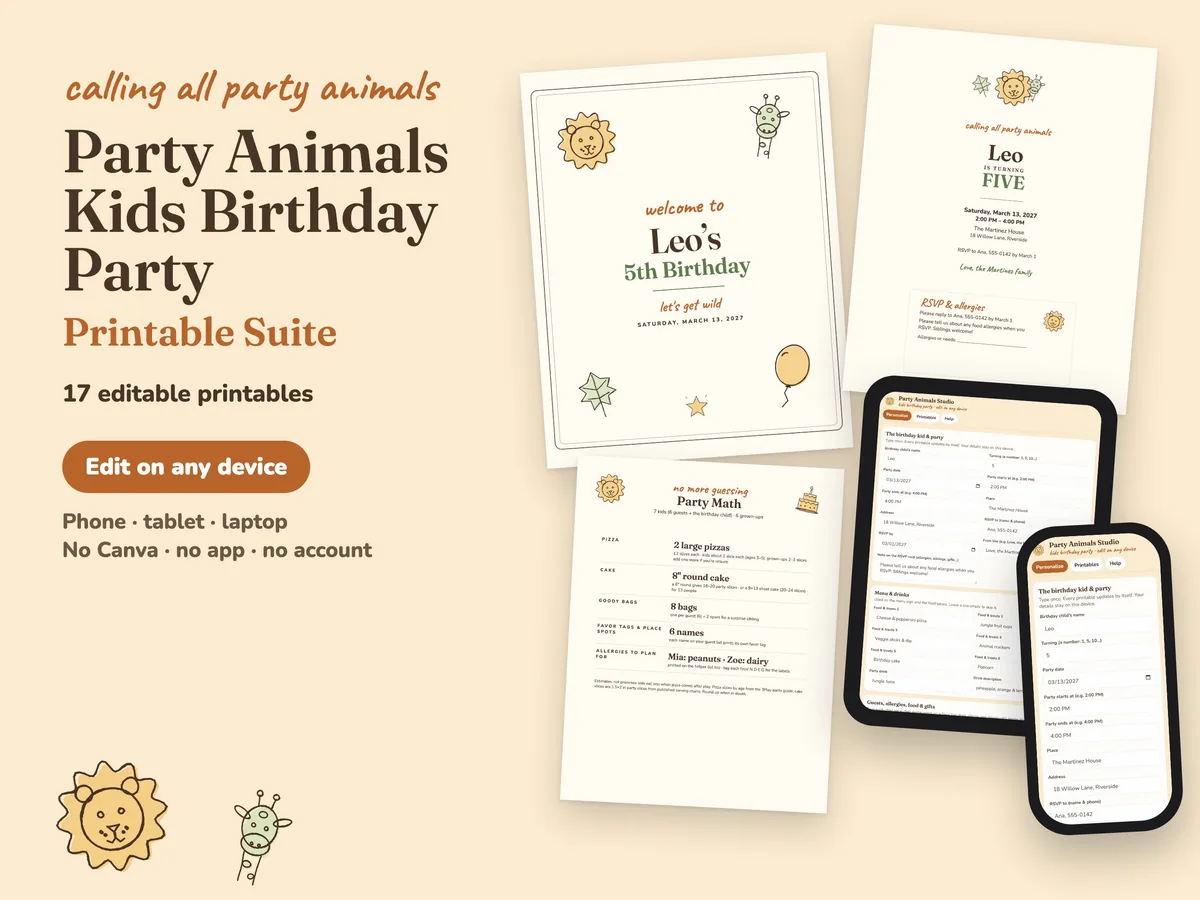
Party Animals
A lion and giraffe in mustard, terracotta and sage. Original art, no licensed characters.
- Printable Suite $11.99 View on Etsy
- Host Kit $18.99 View on Etsy
- Everything Kit $28.99 View on Etsy
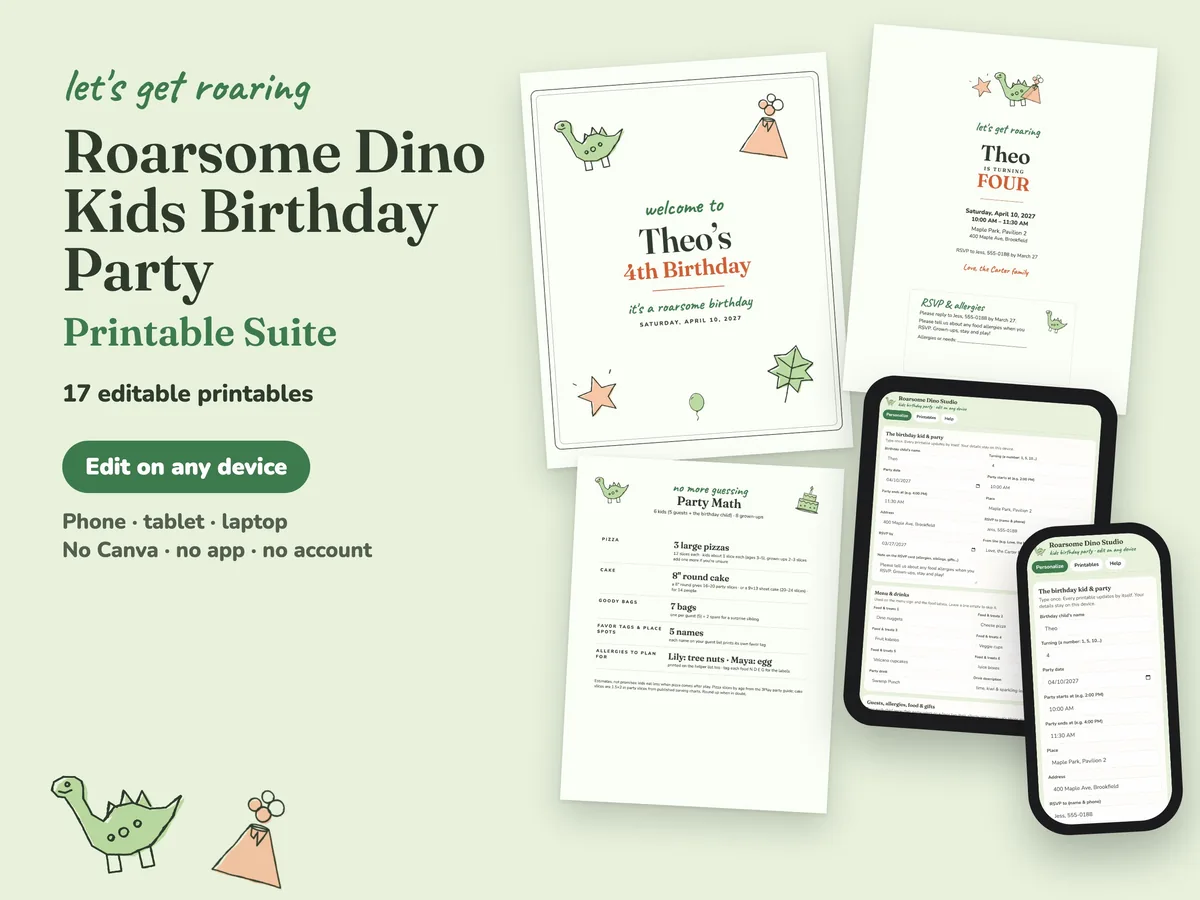
Roarsome Dino
A green dinosaur and a volcano in leaf green and orange. A dinosaur party theme.
- Printable Suite $11.99 View on Etsy
- Host Kit $18.99 View on Etsy
- Everything Kit $28.99 View on Etsy
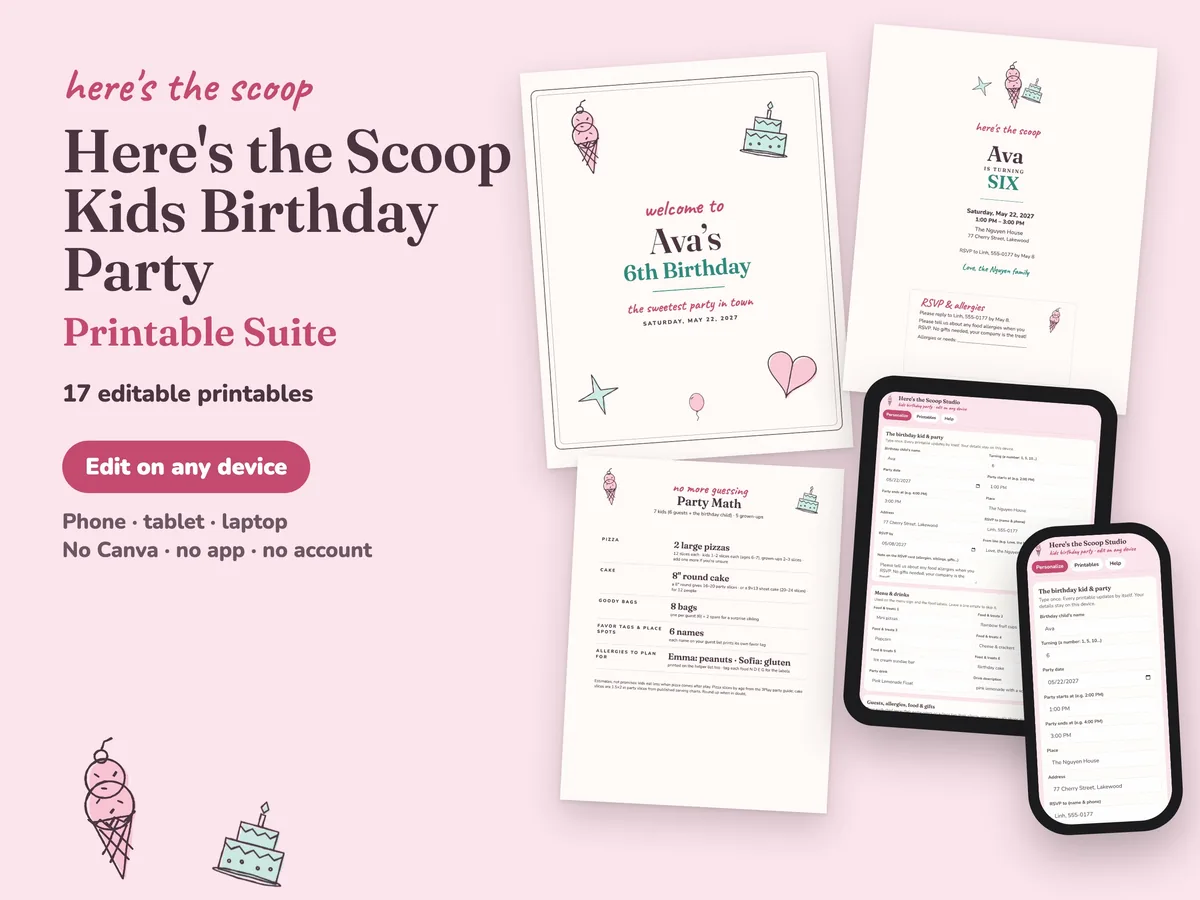
Here’s the Scoop
Ice cream cones and a birthday cake in pink and mint. An ice cream party theme.
- Printable Suite $11.99 View on Etsy
- Host Kit $18.99 View on Etsy
- Everything Kit $28.99 View on Etsy
Kit contents, side by side: compare all three kits.
More planning help: the kids birthday party planning hub has every free tool and guide in one place.