
IBS Food and Symptom Diary Template: What to Log (and App vs Template)
What an IBS food and symptom diary should capture each day, which fields are worth the effort, and how to choose between an app, paper, or a template.
Published October 9, 2026
Most people who start an IBS food diary quit it. The reason is rarely willpower. The diary they picked asked for too much, or too little, or lived in a place that was annoying to open when they felt awful.
This guide covers what a food and symptom diary should actually capture, what to skip, and how to choose between an app, a paper log, and a template. It is general information, not medical advice. If you have IBS symptoms, a clinician or registered dietitian should guide what you test and what you cut.
What the Diary Is For
A diary has one job: to put food, symptoms, and timing in the same place so a pattern can show up. Your memory cannot do this. By Thursday you will not reliably recall what you ate on Monday, and symptoms often lag a meal by hours.
It is also worth being honest about what a diary cannot do. It will not diagnose anything, and it will not prove that one food is a trigger. What it gives you is a record specific enough to take to an appointment, which turns “my stomach is bad a lot” into something a professional can work with.
The Fields Worth Logging
Start with the smallest version that works, then add only what you find yourself wishing you had.
Date and time. Log when you ate, not just which day. Timing is the whole point, because you are looking for what came before a symptom.
What you ate, and about how much. Write the actual food, not “lunch.” Include portion in plain terms: a cup, two slices, a handful. Portion matters because many people tolerate a small amount of a food and not a large one.
Notes on preparation. A few words are enough. Cooked or raw, with garlic or without, restaurant or home. These small details are often where the difference hides.
Symptoms and when they started. Name them: bloating, cramping, pain, nausea, urgency, reflux, fatigue. Add a rough severity on a 0 to 10 scale. The scale does not need to be scientific. It needs to be consistent, so that a 6 means roughly the same thing next week.
Bowel movements. Count them, and record the form. The Bristol Stool Scale is a seven-type chart that describes stool from hard lumps to watery. Using a type number beats words like “normal” or “off,” because it is comparable across days and clinicians already know it.
Context. One line is plenty: poor sleep, stressful day, travel, period, a new medication. Stress and sleep affect gut symptoms for many people, so a diary that only records food can point you at the wrong culprit.
What You Can Skip
Calorie and macro counts, unless a clinician specifically asked for them. Exact weights of everything. Long journal-style entries. Photos of every plate. Each of these makes the diary heavier, and a heavy diary is the one that dies in week two.
Also skip the urge to rate every food as safe or unsafe after one day of data. Write down what happened and leave the interpretation for later.
App, Paper, or Template
There are three realistic options, and each has a real trade-off.
A food diary app. The strengths are speed, reminders, and always having your phone with you. The costs vary by app, so check before you commit: whether your history requires an account, whether features sit behind a subscription, whether you can export your data, and where your health entries are stored. If you search for the best IBS food diary app, you will find lists, but the useful question is not which one ranks first. It is whether you can get your own data back out if you stop using it.
Paper. A notebook is free, private, and works anywhere. The weak point is analysis. Counting how often a symptom followed a particular food across three weeks of handwriting is tedious, so paper tends to be good for logging and poor for spotting patterns.
A template. This can be a printable page, a spreadsheet, or a single-file dashboard. You get a fixed structure so you never have to decide what to record, and you can print it or hand it over. The cost is that a blank spreadsheet only helps if you will maintain it, and a printable page has the same analysis problem as paper.
A decent way to choose: look at the moment you will be filling it in. If that is usually on your phone between meetings, an app or a simple note may win. If you do it at the end of the day at a desk, a structured template works well. If you do not trust anyone with the data, paper or a local file is the safer fit.
Make the Diary Survive Past Week Two
Habit design matters more than the format.
Fill it in at fixed moments. Log right after eating, or do one short entry at the end of each day. Either works. Switching between the two is what causes gaps.
Make a bad day cost less. On a flare-up you will not want to write paragraphs. Keep a minimal mode in mind: food, one symptom, one number. A thin entry on a bad day is far more valuable than a blank one.
Do not backfill from memory. If you missed two days, leave them blank rather than guessing. Invented entries create patterns that are not real.
Keep the wording consistent. Pick one name for each food and symptom and stick with it. If Monday says “stomach ache” and Wednesday says “cramps,” you will struggle to tell later whether those were the same thing. A short personal key at the top of the page, such as what a 3 versus a 7 feels like, takes a minute to write and makes weeks of entries comparable.
Look at it weekly, not hourly. Reading the diary after every meal turns it into a source of anxiety. Pick one time a week to read back, and look for repeats rather than single events.
Reading It Back
When you review, work in this order. First, check that the log is complete enough to trust. Second, look for symptoms that show up repeatedly after the same food or the same kind of meal. Third, check whether those entries share something else, such as a large portion, a stressful day, or poor sleep.
Then write down one or two questions to bring to your clinician or dietitian. A short list of specific observations is much easier to act on than a stack of raw pages, and it keeps you from drawing conclusions the data cannot support.
If you are in a structured low FODMAP process, the diary needs one more column: which FODMAP group you were testing that day. That is a separate topic, covered in the guide on tracking the reintroduction phase.
A Ready-Made Option
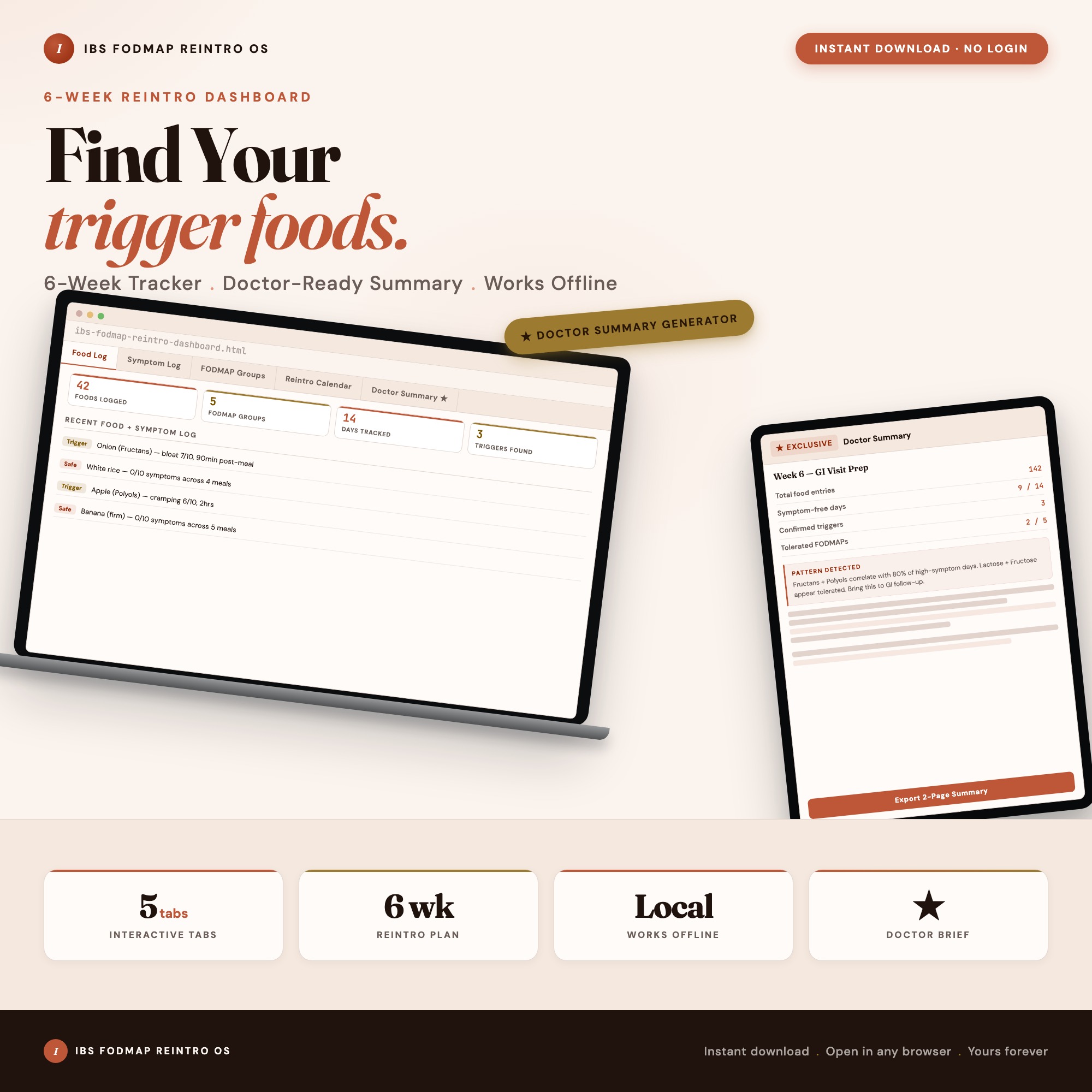
If you want the structure without building it yourself, the IBS FODMAP Reintroduction Dashboard is a single HTML file that opens in your browser. It has a food log with portion, FODMAP group, and notes fields, and a symptom log with the Bristol scale, a gut comfort score, individual 0 to 10 ratings for bloating, cramping, pain, nausea, urgency, reflux, and fatigue, and a bowel event count. It also includes a 42-day calendar view and a doctor summary page. There is no login, and there is a backup export and import so your data is not trapped. It is built around the reintroduction phase, so if you only need a general daily diary, a simple paper log or your own spreadsheet may be all you need.
Whatever you choose, share the results with the clinician or dietitian guiding your care rather than acting on them alone. The best diary is the one you will still be filling in a month from now.
Frequently asked questions
- What should an IBS food diary include at minimum?
- Four things: the date and time, what you ate and roughly how much, what you felt afterward and when it started, and what your bowel movements were like. Everything else is optional. A diary with those four fields filled in every day is more useful than a detailed one you abandon after nine days.
- How long should I keep an IBS food and symptom diary?
- Long enough to see repeats. Many people find that one to two weeks of honest logging shows the obvious patterns, and a dietitian may ask for a longer stretch or a structured protocol. Ask the clinician you are working with how long they want it, because the right length depends on why you are tracking.
- Is an IBS food diary app better than a template?
- Neither is better in general. Apps are quick to open and good at reminders, but they often lock your history behind an account or a subscription. A template gives you a fixed structure you control and can print or hand over. Pick the one you will actually fill in on a bad day.
- What is the Bristol Stool Scale and why log it?
- It is a seven-type chart that describes stool form, from hard separate lumps (type 1) to watery (type 7). Logging a type instead of a vague word like 'normal' or 'bad' gives you and your clinician a consistent way to compare days.
- Can a food diary tell me my trigger foods for certain?
- No. A diary shows patterns and gives you something specific to discuss with a doctor or registered dietitian. Stress, sleep, hormones, and portion size all move symptoms too, so a single bad day after one food proves very little. Treat it as evidence, not a verdict.
- How much does the IBS FODMAP Reintroduction Dashboard cost?
- It is a one-time purchase of $22 on Etsy. No subscription and no login. It runs in your browser and your entries stay on your own device.
Ready-made dashboards
Skip setup — grab an interactive dashboard built for this exact workflow.
ListingResearchOS Shop
All dashboards — one-time purchase, yours forever
Single HTML files. No subscriptions. No login. Works offline in any browser.
Browse all dashboards →