
Twin Feeding Schedule Template: What Parents of Newborn Twins Actually Need to Track
What to track on a twin feeding schedule template beyond time and amount, and why a shared caregiver handoff matters more than the grid itself.
Published September 30, 2026
A twin feeding schedule template sounds simple until you’re the one filling it out one-handed at 3am with a baby on each arm and a partner who just woke up and has no idea what happened in the last two hours. Here’s what actually needs to be on the page, and what a printable grid can’t do that matters more.
1. Track Each Baby Separately, Side by Side
The single biggest failure mode of a shared feeding log is combining both twins into one column. Twins almost never feed in true sync — one wakes first, one finishes a bottle faster, one cluster-feeds while the other sleeps. A usable log needs two columns, consistently color-coded (Twin A, Twin B, or by name), so a glance tells you which baby is due next without re-reading labels.
For each feed, log:
- Time
- Method — breast (and which side), bottle, or pump
- Amount, if bottle-fed
- Duration, if nursing
2. A Live “Time Since Last Feed” Counter Beats a Static Grid
A printable schedule shows you what happened. It doesn’t tell you, right now, that it’s been 2 hours 40 minutes since Twin B’s last feed. At 3am, doing that math from a time-stamped grid is exactly the kind of thing that goes wrong. A counter that updates on its own removes one more thing you have to calculate while sleep-deprived.
3. Sleep and Diapers, Same Side-by-Side Format
Feeding doesn’t happen in isolation — sleep state and diaper counts round out the picture of how each twin is actually doing day to day. Track current sleep state per baby (not just total hours), and diaper counts (wet/dirty) per baby per day. If you’re home with a NICU graduate, these numbers can be clinically relevant at the next pediatrician visit, not just personally reassuring.
4. The Part a Printable Can’t Do: Caregiver Handoff
This is where most feeding-schedule templates fall short for twins specifically. When a partner, grandparent, or night-shift helper takes over, they need a fast answer to: what did each baby just do, what’s likely next, and is there anything unusual to know. Repeating that verbally every few hours, for two babies, adds up to real exhaustion by week two or three.
A proper handoff view needs, per baby: the last several feeds, current sleep state, the next expected event, and a place for free-text notes (“fussier than usual tonight,” “pediatrician said watch weight”). Whoever takes the next shift reads it in ten seconds instead of asking you to explain.
5. Milestones, Tracked Independently
Twins develop on their own timelines even though they share a birthday. First smile, first roll, first laugh — log these per baby, not as a combined “the twins did X,” so each child’s own record stays intact.
How the Dashboard Handles This
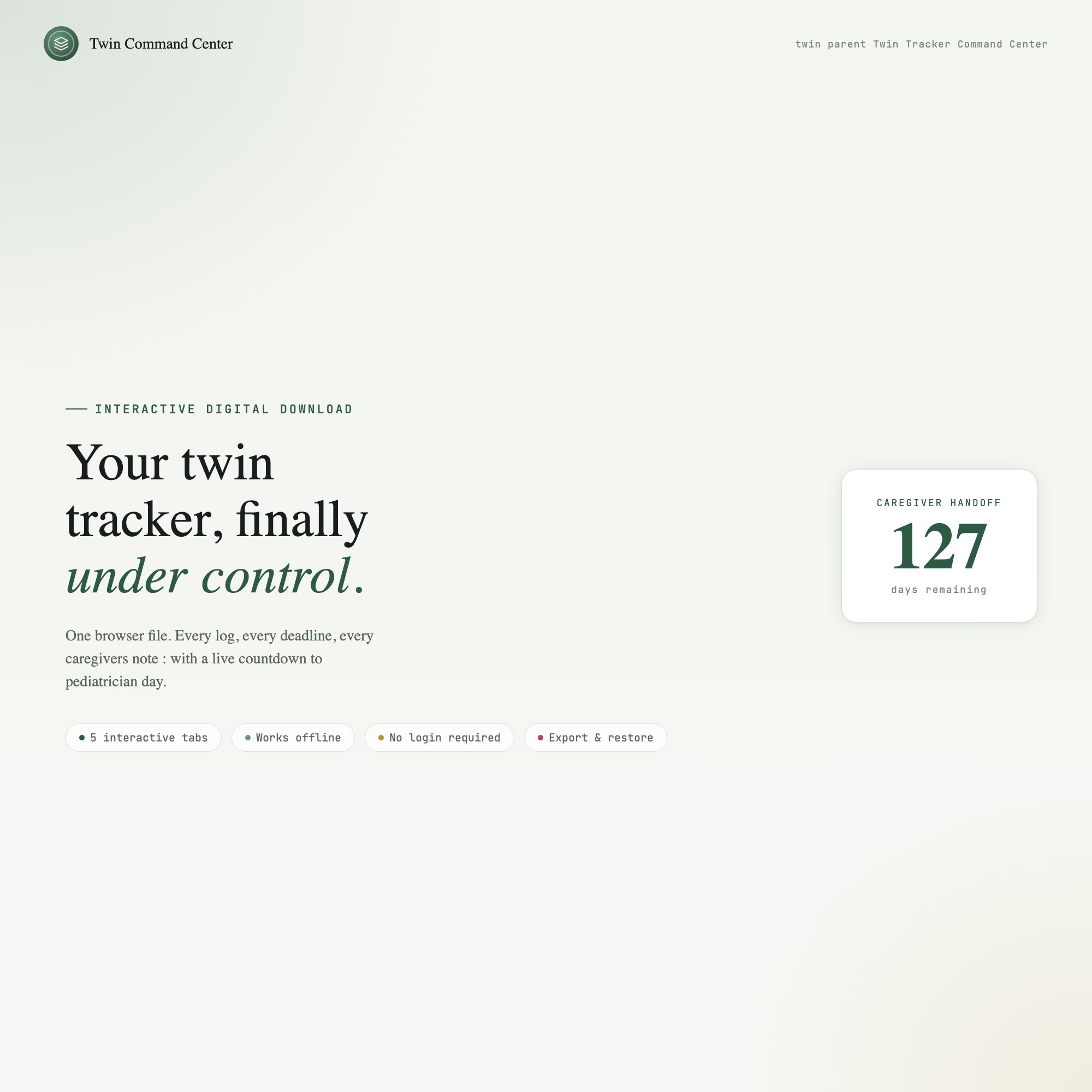
The Twin Newborn Command Center is built around exactly this problem: two-column logging for feeding, sleep, and diapers with each twin color-coded consistently across every tab, live since-last-feed timers, independent milestone tracking, and a dedicated Caregiver Handoff tab — the last several feeds per baby, current sleep state, next expected event, and free-text notes, all on one screen for whoever takes the next shift.
It runs as a single offline file in your browser, so it works one-handed in the dark without needing a signal or a subscription, and nothing about your babies’ data leaves your device.
Frequently asked questions
- What should a twin feeding schedule template track for each baby?
- Time of feed, method (breast, bottle, or pump), amount if bottle-fed, and which side or breast if nursing — tracked separately for each twin, side by side, not combined into one log. Twins rarely feed in sync, and a shared log makes it easy to lose track of which baby just ate.
- How do I keep a twin feeding schedule from getting confused at 3am?
- Color-code each baby consistently across every log — feeding, sleep, diapers — so you're never re-reading initials in the dark. A live 'time since last feed' counter per baby also removes the need to do mental math when you're exhausted.
- Is there a standard feeding schedule for newborn twins?
- No single schedule works for all twins — feeding cues, weight, and whether they're on a NICU-recommended schedule all vary. Most parents track actual feed times and amounts rather than following a fixed template, then watch for their own babies' patterns over the first few weeks.
- What's the hardest part of tracking twin feeds that a printable doesn't solve?
- Caregiver handoffs. A printable schedule tells you what happened; it doesn't summarize the last few hours for whoever is taking the next shift. That verbal explanation at a shift change, repeated every few hours, is exactly what most parents of twins find exhausting by week three.
- How much does the Twin Newborn Command Center cost?
- One-time purchase of $24 on Etsy. No subscription, no login required.
Ready-made dashboards
Skip setup — grab an interactive dashboard built for this exact workflow.
ListingResearchOS Shop
All dashboards — one-time purchase, yours forever
Single HTML files. No subscriptions. No login. Works offline in any browser.
Browse all dashboards →