
Successor Trustee Checklist: What to Track When You're Named Trustee
A successor trustee checklist covering asset inventory, the ledger, beneficiary distributions, and deadlines — plus where to get real legal guidance.
Published September 30, 2026
Being named successor trustee usually means someone handed you a binder, a set of keys, and no actual instructions. There’s no court supervising a revocable living trust the way there is with a probate estate — no docket, no clerk checking your math. That’s exactly why a checklist matters here more than almost anywhere else in estate administration. Check your state’s trustee statute and your own trust document for anything specific to your situation — this is not legal advice.
1. Read the Trust Document First, Completely
Before tracking anything, read the trust instrument itself. It names the trustee (you), lists every beneficiary and their share, and states your specific duties and any restrictions. Note who the co-trustees are, if any, and whether any decisions require joint action.
2. Inventory Every Trust Asset — and Whether It’s Actually Titled Correctly
List every asset that belongs to the trust with its value as of the relevant date (death or incapacity, depending on the trigger). For each one, confirm whether it has actually been retitled into the trust’s name. An unfunded asset — something the settlor meant to put in the trust but never formally retitled — is one of the most common surprises in trust administration, and it can mean the asset has to go through probate after all. Flag these separately; don’t assume the paperwork matches the intent.
3. Keep a Ledger That Separates Principal From Income
Every receipt and disbursement should be tagged as principal or income as you enter it, not sorted out later. Income beneficiaries (who receive trust income during their lifetime) and remainder beneficiaries (who receive principal eventually) often have different interests, and your trust instrument usually treats the two categories differently for accounting purposes. Reconstructing this split a year into administration, under pressure from a beneficiary’s question, is far harder than tagging it correctly from entry one.
4. Track Distributions Against Each Beneficiary’s Actual Share
This is where trustee disputes usually start. It’s not enough to know the total distributed — you need to know what each beneficiary has received against what they’re actually entitled to under the trust’s stated shares. If one sibling received an early distribution for an emergency and another hasn’t received anything yet, that gap needs to be visible and accounted for before the next check is written, not discovered at the final accounting.
5. Watch Your Deadlines
Depending on your state and the trust’s terms, you may owe beneficiaries formal notice within a set window, periodic or annual accountings, and tax filings on the trust’s income. These dates come from your state’s statute and your own trust document — track whatever applies to your situation with a days-remaining count so nothing lapses silently.
6. Be Ready to Produce an Accounting at Any Time
Beneficiaries are generally entitled to request an accounting, and being able to produce one — beginning value, every receipt, every disbursement, every distribution, ending value, and where each beneficiary currently stands — builds trust and heads off disputes before they start.
How the Dashboard Handles This Checklist
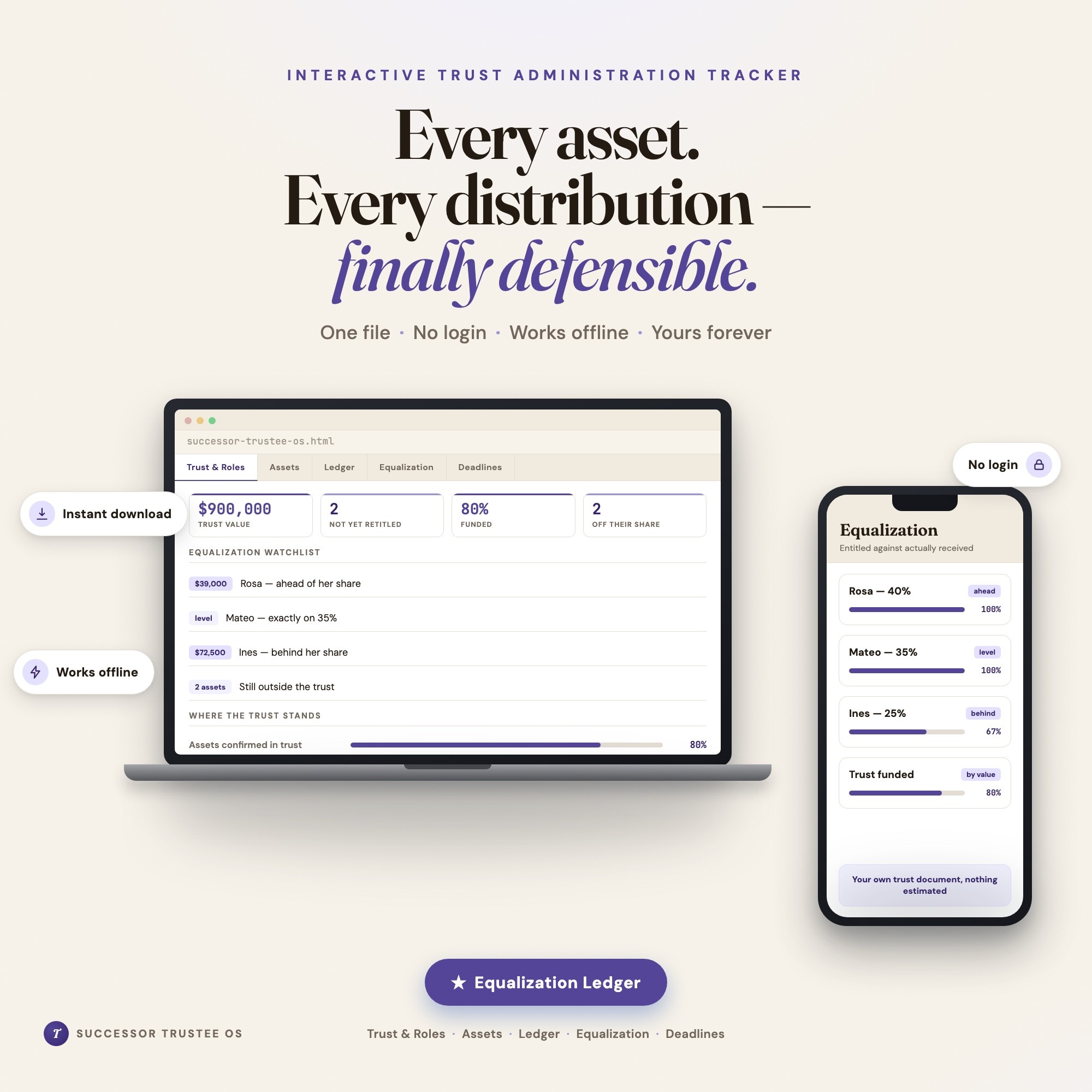
The Successor Trustee & Trust Administration OS organizes all of this in one offline dashboard: trust and beneficiary roles with their shares, an asset inventory that flags anything not yet retitled, a ledger that keeps principal and income apart from the first entry, a Beneficiary Equalization tab showing exactly who is ahead or behind their share and by how much, a duties and deadlines calendar for the dates you enter, and a one-click plain-text accounting summary you can hand to your attorney or paste into your records.
This is a personal administration tracker, not legal advice, a court accounting, or a substitute for the attorney or CPA on the trust — every share percentage, date, and value is one you enter yourself, and anything going to beneficiaries should be reviewed by your own advisors first. It runs as a single file in any browser, with the family’s asset and distribution details staying on your own device.
Get the Successor Trustee & Trust Administration OS on Etsy →
Frequently asked questions
- What is the first thing a successor trustee should do?
- Locate the trust document itself and read it fully — it names you, lists the beneficiaries and their shares, and sets out your specific duties. Then get a copy of the death certificate (or, if the trust became active due to incapacity, the relevant documentation) and consult an attorney or CPA familiar with trust administration in your state before distributing anything.
- What should a successor trustee track throughout administration?
- Five things: every trust asset with its value and whether it has been retitled into the trust, every receipt and disbursement split between principal and income, what each beneficiary has received against their entitled share, any notice or filing deadlines, and a running accounting you can produce for the beneficiaries at any point.
- Why does principal need to stay separate from income in a trust ledger?
- Because income beneficiaries and remainder (principal) beneficiaries often don't want the same thing, and the trust instrument usually treats the two differently. Mixing them in one ledger makes it hard to defend any distribution decision later — keeping the split from the first entry avoids reconstructing it under pressure.
- What happens if one beneficiary is distributed more than another?
- It depends on whether the trust calls for equal shares or specific percentages, and whether the early distribution was an authorized advance. Tracking what each beneficiary has received against their actual entitled share — not just a running list of checks written — is how you catch an imbalance before it becomes a dispute, or a problem you have to unwind.
- How much does the Successor Trustee & Trust Administration OS cost?
- One-time purchase of $28 on Etsy. No subscription, no login required.
Ready-made dashboards
Skip setup — grab an interactive dashboard built for this exact workflow.
ListingResearchOS Shop
All dashboards — one-time purchase, yours forever
Single HTML files. No subscriptions. No login. Works offline in any browser.
Browse all dashboards →