
Photography Business Planner: What Solo Photographers Actually Lose Track Of
It is rarely the shoot. It is the editing queue, the unpaid invoice, and the inquiry that never got answered. Here is the pipeline that catches all three.
Published August 2, 2026
The shoot is the part that goes right.
You show up, you know what you’re doing, the client is happy. What actually costs solo photographers money happens in the weeks on either side of it — and it’s consistently the same three things.
The editing queue that lives nowhere
A booked shoot goes in the calendar. A delivered gallery goes in a folder. The two to six weeks between them exist in no system at all.
So the shoot date passes and the calendar entry now looks complete. The editing backlog — four sessions deep, each with a different turnaround promise — lives entirely in memory. Which is fine until the week you have three shoots and two deliveries due, and one slips.
The client who waited two extra weeks for their gallery rarely complains. They just don’t refer you.
What fixes it: the session record carries its own delivery deadline and status, separate from the shoot date. “Shot” and “delivered” are two different states and a calendar only tracks one of them.
The inquiry that got one reply
Most lost bookings aren’t rejections. They’re inquiries that got a prompt, warm reply — and then nothing, because the photographer assumed the ball was in the client’s court.
Meanwhile the client got busy, or got a faster follow-up from someone else. The inquiry didn’t get declined; it evaporated, and it never appears in any record as a loss because it never made it out of the inbox.
What fixes it: inquiry as an explicit pipeline stage with a follow-up date attached. Not “waiting to hear back” — a date, and a status you have to move.
The second half of a two-part payment
Deposit collected up front, balance due on delivery. The deposit is memorable because it comes with the booking. The balance is due at the exact moment the relationship feels finished — gallery sent, client delighted, job done.
That invoice ages quietly. Chasing it a month later is awkward in a way that chasing it a week later isn’t, so it gets postponed, and postponed.
What fixes it: payment status tracked against delivery status, so a delivered session with a pending balance is visibly wrong rather than invisibly normal.
The pattern underneath all three
Each failure is the same shape: a piece of work in a state that no system represents. Shot-but-not-edited. Inquired-but-not-answered. Delivered-but-not-paid.
Calendars represent events. Folders represent finished work. Neither represents in progress, which is where all the money leaks.
A working setup needs stages, not dates:
- A studio overview — active clients, sessions this month, revenue, pending invoices, in one view
- A client pipeline as a board with inquiry, booked, editing and delivered as explicit stages you advance
- A session log with type, date, location, deadline and delivery status
- Income with paid versus pending, monthly and annual totals
- Gear and prep — checklists and shot-list templates by session type, so prep isn’t re-derived every shoot
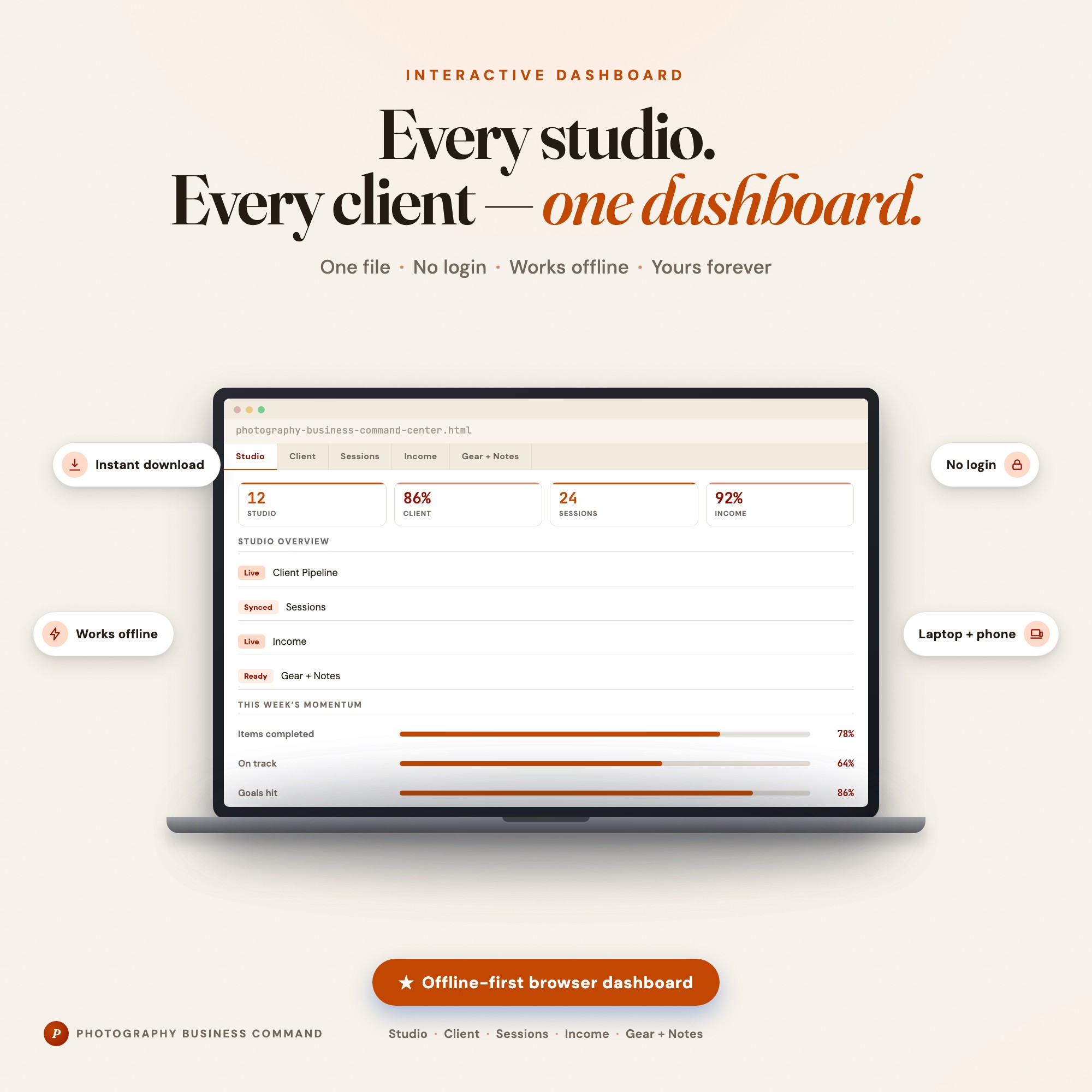
That’s the structure of the Photography Business Command Center. Its pipeline is a click-to-advance board across those four stages, and the sessions and income tabs stay attached to it, so a delivered session with an unpaid balance shows up rather than hiding. It’s offline-first — one browser file, no subscription, no cloud account — which also means client contact details and shoot records never leave your machine.
If you change one thing
Add a delivery deadline to every booked session, separate from the shoot date.
That single field converts your calendar from a record of where you have to be into a record of what you owe people. It’s the smallest change with the biggest effect on whether clients refer you.
Frequently asked questions
- What should a photography business planner track?
- Four things that connect: the client pipeline by stage, sessions with their delivery deadlines, payments with paid and pending status, and gear or shot-list prep per session type. The connection matters more than the individual lists — a booked session with no deadline and no invoice attached is how work goes missing.
- Why do photographers lose track of the editing queue?
- Because a booked shoot lives in the calendar and finished work lives in a delivery folder, but the weeks in between live nowhere. The shoot date passes, the calendar entry looks done, and the editing backlog exists only in memory — which is where deadlines go to be missed.
- How do I stop losing inquiries?
- Give inquiry its own pipeline stage with a follow-up date, rather than leaving it in your inbox. Most lost bookings are not rejections; they are inquiries that got a reply, then nothing, while the photographer assumed the ball was in the client's court.
- What is the most common unpaid-invoice pattern?
- The second half of a two-part payment, on a delivered gallery. The shoot is done, the images are sent, the relationship feels complete, and the balance quietly ages. Tracking pending payments against delivery status is what surfaces it.
- Do I need photography-specific software for this?
- Not necessarily. Dedicated studio-management platforms are excellent and priced accordingly. If you are solo with a manageable client count, the requirement is a connected record of pipeline, sessions, income and prep — the format matters less than whether you will actually maintain it.
Ready-made dashboards
Skip setup — grab an interactive dashboard built for this exact workflow.
ListingResearchOS Shop
All dashboards — one-time purchase, yours forever
Single HTML files. No subscriptions. No login. Works offline in any browser.
Browse all dashboards →