How to Throw a Baby Shower on a Budget
How to throw a baby shower on a budget: set one number, split it by category, and cut cost where guests will not notice. Includes a worked example.
Published October 7, 2026
A baby shower can be warm, funny and memorable for very little money. What makes it expensive is rarely the shower itself; it is the dozens of small purchases made without a total in mind. This guide shows how to set that total first, divide it sensibly, and cut where guests will not notice.
If you want to run your own numbers while you read, the baby shower budget calculator is free and takes under a minute. The rest of the planning is on the baby shower planning hub.
Step 1: Start With One Number
Write down the most you can spend, in total, and do not edit it later. If a group is paying, add up what each co-host can give. Then decide the number of guests. These two numbers give you a per-guest figure, and it is the most useful number in the whole plan: it tells you whether a shower for 40 is realistic or whether 25 would feel better.
A shower for 25 with $500 is $20 a head. The same $500 across 40 guests is $12.50 a head, which means fewer extras and a simpler menu. Neither is wrong, but you should choose it on purpose.
Step 2: Split It by Category
Most of the money goes to seven places: the venue, food and catering, cake and desserts, decor and tableware, favors, games and prizes, and invitations and stationery. Our own planning split for a 25-guest, $500 shower looks like this when every category is used:
| Category | Share | Amount | Per guest |
|---|---|---|---|
| Venue or room rental | 15% | $75.00 | $3.00 |
| Food and catering | 40% | $200.00 | $8.00 |
| Cake and desserts | 10% | $50.00 | $2.00 |
| Decor and tableware | 12% | $60.00 | $2.40 |
| Favors | 8% | $40.00 | $1.60 |
| Games and prizes | 7% | $35.00 | $1.40 |
| Invitations and stationery | 8% | $40.00 | $1.60 |
These percentages are planning estimates we chose, not a survey or a standard. Change them to match your plans. If you host at home and skip the venue, the other six lines share the full $500: food becomes about $235.29 ($9.41 per guest), cake about $58.82, and decor about $70.59.
A smaller example: 20 guests, $300, at home
With no venue, six categories share $300 using the same starting percentages scaled to add up to 100: food and catering is 40 out of 85, about $141.18 or $7.06 a guest; cake and desserts is about $35.29; decor and tableware about $42.35; favors and invitations about $28.24 each; games and prizes about $24.71. Seven dollars a guest is enough for a good spread at an afternoon shower if you keep the menu simple and make a couple of dishes yourself. It is not enough for a catered sit-down lunch, and the calculator will not hide that: if the per-guest food number looks too low against a menu you have actually priced, either raise the total or lower the guest count.
Step 3: Host Where It Is Free
The venue is the first line you can often take to zero. A home, a friend’s home, a park pavilion, a church hall or a community room may cost little or nothing. Check three things before you commit: whether there are enough seats and tables, whether there is a kitchen or cooler space, and whether the room has a clear time limit.
Step 4: Choose the Time of Day to Match the Menu
The time of day decides what you owe your guests. A shower at 12:30 is a lunch, and guests will expect one. A shower at 2:30 pm is cake, a few bites and drinks. A brunch can be a pastry, fruit and coffee spread. Pick the time first, then write the time and the food style on the invitation, for example “Join us from 2 to 4 pm for cake and light bites.” Guests will plan around it.
When you know the headcount and the menu style, the food calculator tells you how much to buy so you do not overspend on leftovers.
Step 5: Spend on Food and Cake, Save on the Rest
Guests remember whether they were fed and whether the cake was good. They do not remember whether the napkins matched. So protect the food line and the cake first, and be strict with the rest.
Food
- Choose dishes that are cheap and look generous: a big fruit platter, a pasta salad, sandwiches cut into quarters, a baked dish for a crowd.
- Make a few things yourself and buy the rest. Mix homemade with store-bought rather than doing either completely.
- Accept offers. A relative who wants to bring a dish is helping you.
- Use one signature drink (a punch or lemonade) plus water, rather than a full bar.
Cake and Desserts
- A sheet cake from a grocery store bakery feeds a crowd for less than a decorated cake, and cupcakes avoid cutting and plates.
- Ask a baking friend if she would make the cake as her gift. Many people love to.
- One dessert plus the cake is enough.
Step 6: Make Decor Do More With Less
Choose one focal point, usually a welcome sign and a banner or balloon cluster at the entry or behind the food table, and one color pair. Add a few jars of flowers, or leaves and branches from the garden. A room with three well-placed features looks planned; a room with thirty small items looks busy and costs more.
Printable signs, food labels and a menu sign are the cheapest way to make a table look finished. A ready-made printable suite lets you type the name, date and menu once and have every sign update to match, then print on cardstock at home.
Step 7: Keep Stationery and Favors Small
A digital invitation or a printable one that you print at home costs a fraction of custom printed cards. Favors can be tiny: a tag on a cookie, a packet of seeds, a single wrapped candy. Many guests would rather have a good slice of cake than a favor. If favors are not in the budget, skip them, and make sure the thank-you notes go out.
Step 8: Games and Prizes for Almost Nothing
Printed games cost the price of paper. For prizes, a small candle, a pack of gourmet tea or a scratch card is plenty. You can also let winners pick from the flowers on the table. The games guide describes ten games and how to run each.
A diaper raffle also works as a gift to the parents. See diaper raffle rules, wording and examples for how to run it.
Where Not to Cut
Do not cut the headcount planning. Running out of food is the one mistake that costs real goodwill. Use a quantity rule rather than a guess, and keep a small reserve of cake. Do not cut the thank-you notes either; they cost a stamp and mean more than any decor.
A Short Plan for a Shower on a Tight Budget
- Fix the total and the guest count.
- Host at home or in a free room.
- Choose an afternoon time and a light menu.
- Ask co-hosts to bring one dish or one item each.
- Print your own signs, labels and invitation.
- Buy one good cake or have a friend make it.
- Run two games with small prizes.
- Write thank-you notes within a couple of weeks.
If you would rather not design the printed items, the printable suites start at $14.99 for the Printable Suite, which covers the invitation, signs, labels, toppers and tags.
Frequently asked questions
- How do I throw a baby shower on a budget?
- Set one total you can afford, host at home or in a free room, serve a smaller menu at a non-meal time of day, make or print decor and stationery yourself, and spend on the two things guests remember most: the food and the cake. Work out the numbers first with a budget calculator, then cut from decor, favors and printed items before you cut the food.
- What is a good budget for a baby shower?
- There is no standard number, because it depends on the guest count, where you live and whether you cater. A better question is what you can comfortably spend per guest. Pick that number, multiply by the guest count, and split it by category. The free budget calculator does that in one step.
- What is the cheapest time of day to host a baby shower?
- An afternoon shower with desserts, finger food and drinks costs much less than a lunch or dinner because guests do not expect a full meal. Tell guests the time clearly on the invitation (for example 2 to 4 pm, with light bites and cake), so they eat beforehand and arrive knowing what to expect.
- Where can I cut costs without it looking cheap?
- Decor, printed items and favors. A few well-placed things (a welcome sign, a banner, a flower arrangement) look better than a room full of small items. Printable signs, labels and tags that you print at home cost a few dollars. Keep your money for the food and the cake.
- Can guests help with the cost?
- Yes, and many do. A potluck, a shared menu where each co-host brings one dish, or a friend baking the cake are all common. Be clear and kind about it, and never ask the parent-to-be's guests to pay to attend. Ask co-hosts, not guests.
Printable baby shower suites
Ready-to-print baby shower suites
Invitation, signs, food labels, toppers and tags, editable on a laptop (it also opens on a phone or tablet). Three kits per theme. Digital download, nothing ships.
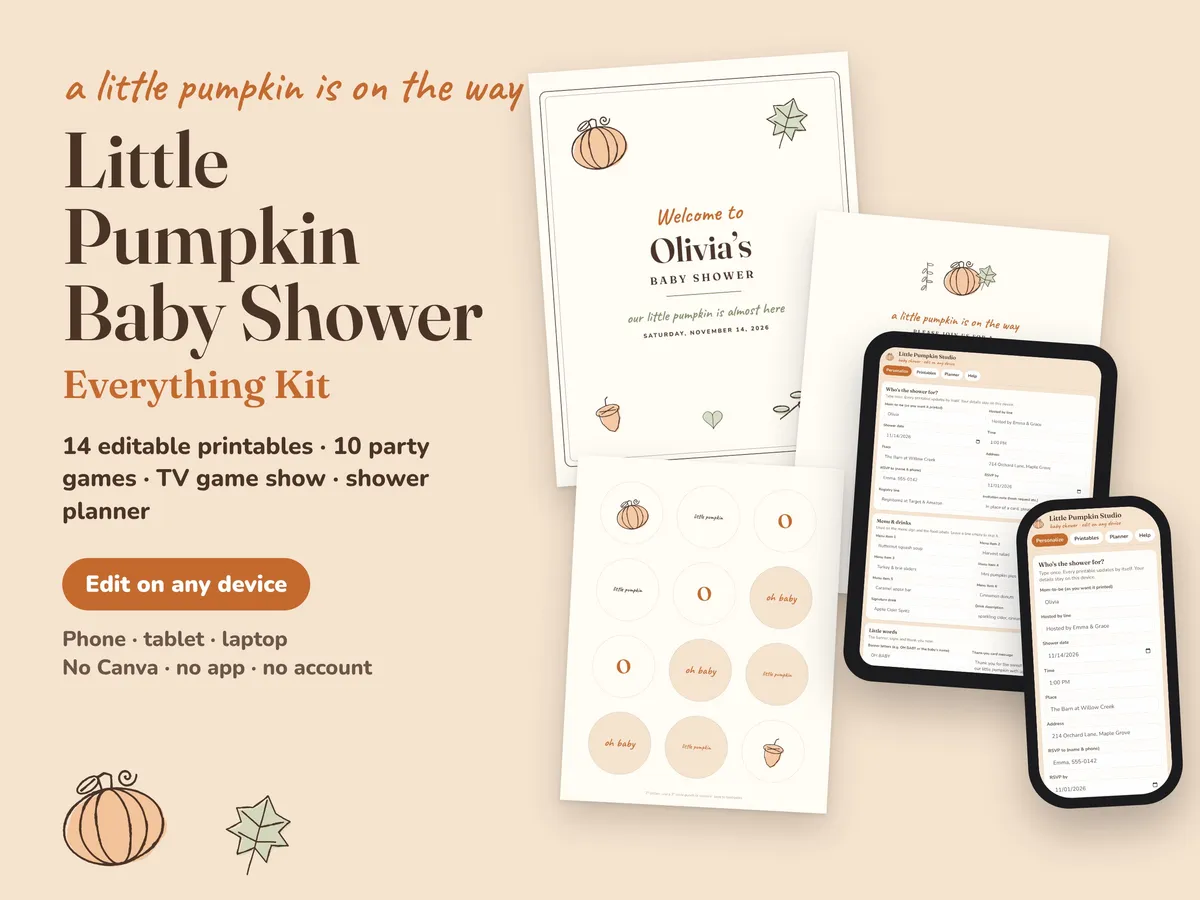
Little Pumpkin
Warm pumpkin orange and sage leaves for a fall shower.
- Printable Suite $14.99 View on Etsy
- Host Kit $22.99 View on Etsy
- Everything Kit $34.99 View on Etsy
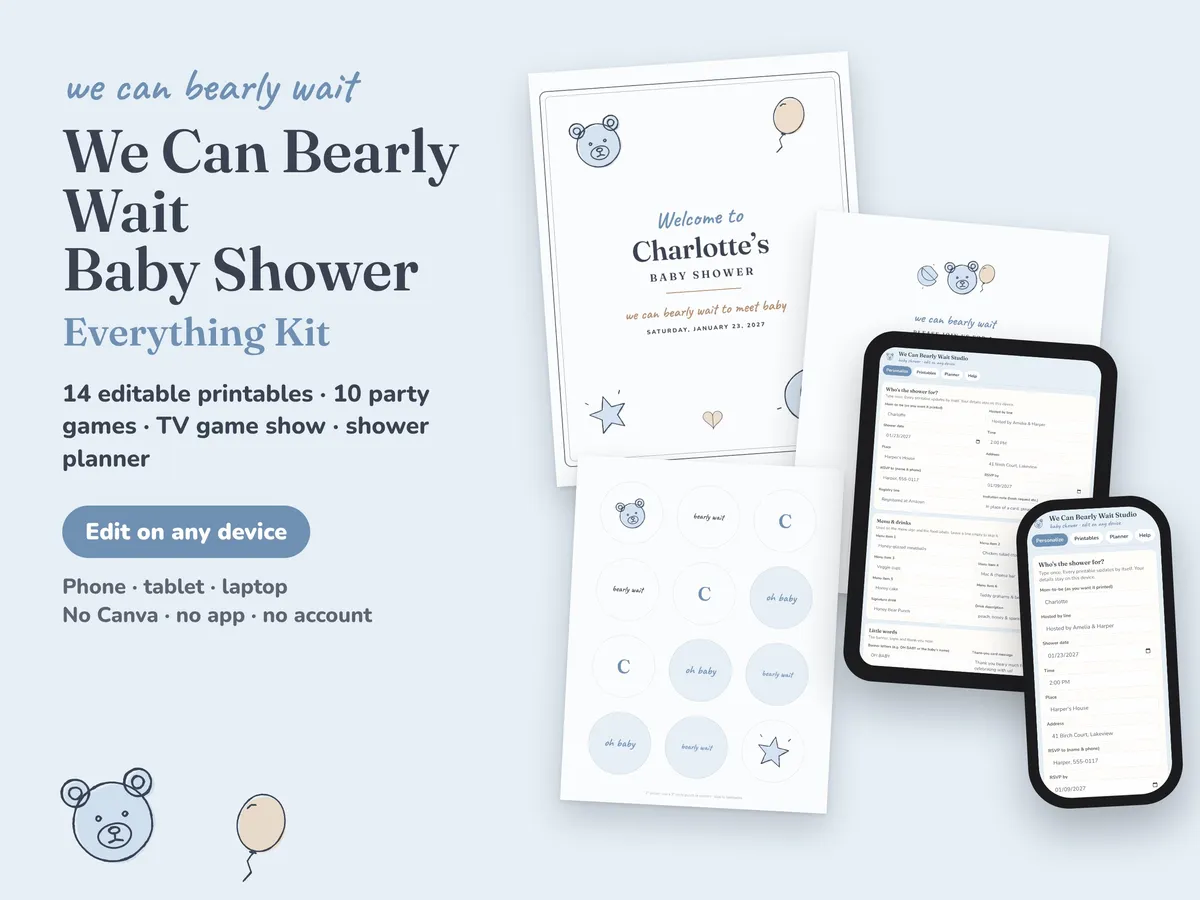
We Can Bearly Wait
Soft blue teddy bears, balloons and stars. Works for any baby.
- Printable Suite $14.99 View on Etsy
- Host Kit $22.99 View on Etsy
- Everything Kit $34.99 View on Etsy
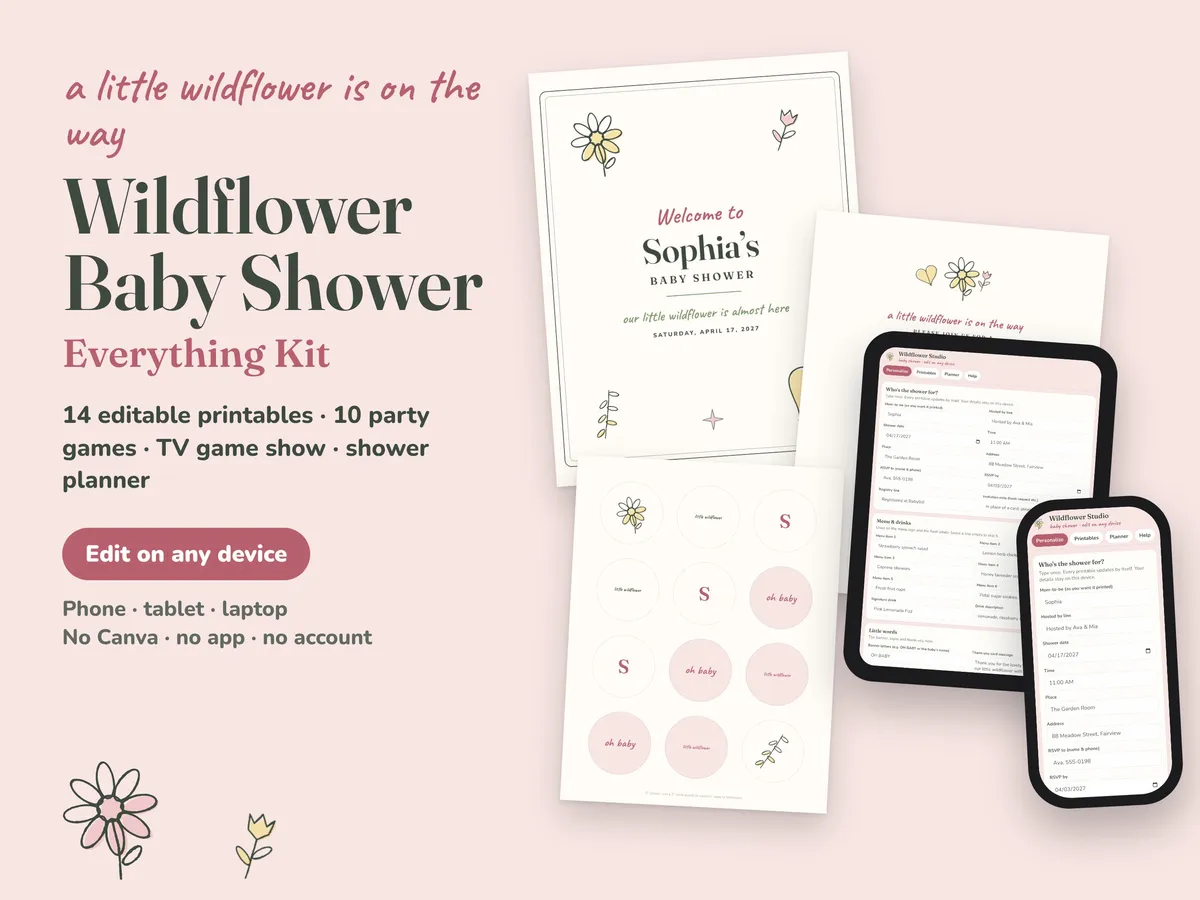
Wildflower
Dusty rose, daisies and green stems for a spring or garden shower.
- Printable Suite $14.99 View on Etsy
- Host Kit $22.99 View on Etsy
- Everything Kit $34.99 View on Etsy
Kit contents, side by side: compare all three kits.
More planning help: the baby shower planning hub has every free calculator and guide in one place.