
How to Compare Moving Company Bids Using the True-Cost Formula
The true-cost formula for comparing moving quotes: how to account for hidden fees, deposits, and distance charges so you can spot the real best-value bid.
Published June 3, 2026
You receive three moving company estimates. One is $2,400. One is $2,950. One is $2,200. The obvious choice seems clear — until you notice that the $2,200 quote is non-binding, doesn’t include stair charges, and has a $300 fuel surcharge buried on page three. The $2,950 quote includes full liability coverage, blanket wrapping for furniture, and a binding not-to-exceed guarantee. The “cheapest” bid could become the most expensive on moving day.
This guide walks through how to build a meaningful comparison across moving quotes, what fees to watch for, and how to use the true-cost formula to identify the actual best-value option.
The Three Types of Moving Quotes (And Why It Matters)
Before comparing numbers, understand what you’re actually being quoted.
Non-binding estimate: The company assesses your move and provides a price range, but the final bill is based on actual weight or time. The estimate is essentially a prediction. Final costs commonly run 10–25% higher on interstate moves.
Binding estimate: The price is fixed. Unless you add significant items or request additional services, you pay exactly what was quoted. Most reputable interstate movers offer binding estimates.
Binding not-to-exceed: If the actual weight or time comes in lower than estimated, you pay the lower amount. If it comes in higher, you pay the estimate. This is the most consumer-protective option.
Always confirm which type you’re receiving and get it in writing before signing anything.
The True-Cost Formula
A simple sticker-price comparison ignores the variables that determine what you actually pay. The true-cost formula:
True Cost = Base Rate + Hidden Fees + Distance/Weight Adjustments + Insurance/Liability Premium
Hidden fees to investigate for each quote:
- Stair carry charges (typically $50–$100 per flight above the first)
- Long carry fee (if the truck can’t park close to your door)
- Fuel surcharge (some companies bury this; others include it in the base rate)
- Packing materials (boxes, tape, and wrapping are often extra)
- Valuation/liability coverage (basic coverage is usually 60 cents per pound — inadequate for electronics or antiques)
- Shuttle fee (if a smaller truck is needed to reach your destination)
- Storage-in-transit (if there’s a gap between your move-out and move-in dates)
- Binding estimate fee (some companies charge $50–$150 for the binding guarantee)
Ask each company specifically: “Are there any charges not included in this estimate?” and document the answer.
Applying the Formula Across Four Quotes
The comparison gets unwieldy fast if you’re doing it in your head or in a general-purpose spreadsheet where formulas drift. The goal is a side-by-side view where each quote is adjusted to the same fee assumptions.
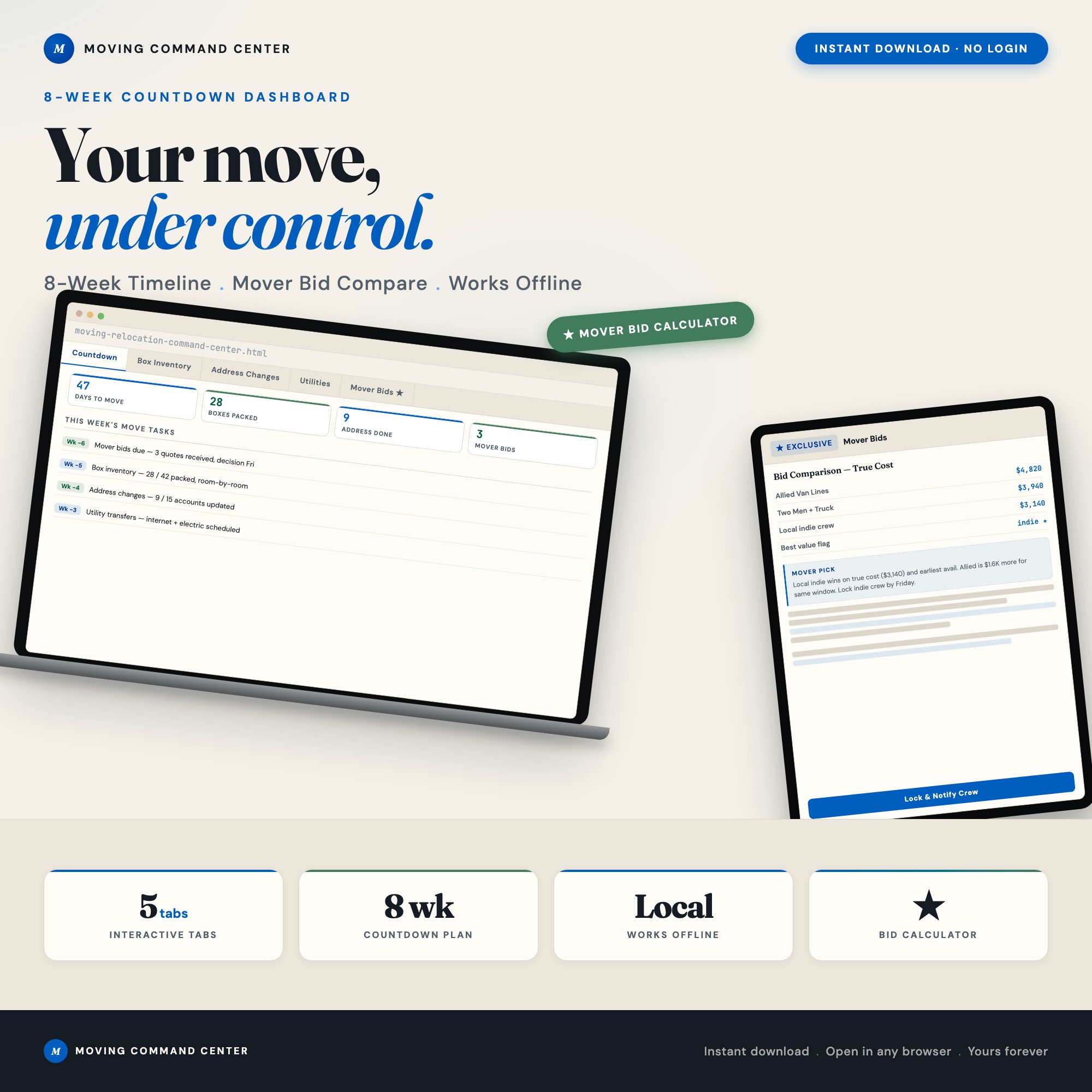
The Moving Relocation Command Center has a dedicated Mover Bids tab that compares up to four quotes side by side with a live true-cost formula. Enter each company’s base rate, then input the fee line items as you confirm them. The calculator applies your inputs and flags the best-value winner automatically — accounting for hidden fees, deposit requirements, and distance charges that distort the headline price.
This is the only interactive moving dashboard on Etsy that runs this calculation. Most alternatives are static PDF checklists or basic spreadsheets that require you to build the formulas yourself.
What Else a Move Needs Tracked
Bid comparison is one piece of an 8-week relocation. The Moving Relocation Command Center covers the rest in four additional tabs:
- Countdown Command — 8-week color-coded timeline with daily task updates
- Box Inventory Hub — room-by-room packing tracker with color labels and contents summaries
- Address Change Central — USPS, banks, IRS, subscriptions, employer, doctor — each with a status checkbox and confirmation field
- Utility Transfer Tracker — gas, electric, water, internet for both old and new addresses, with provider, account number, and transfer confirmation
The combined system means you’re not juggling a separate spreadsheet for each layer of the move. Everything saves to your browser automatically, works offline, and costs $22 one time.
Frequently asked questions
- Do I need special software to use an offline dashboard?
- No. An offline HTML dashboard like the Moving Relocation Command Center is a single file you open in any browser — Chrome, Edge, Safari, or Firefox. Nothing to install, no account to create.
- Is my data private if I use a browser-based dashboard?
- Yes, completely. Data stored in your browser's localStorage never leaves your device. There are no servers, no analytics, and no uploads of any kind.
- Can I back up my data?
- Yes. Every ListingResearchOS dashboard includes an Export Backup button that downloads a JSON file to your computer. Load Backup restores it on any device or browser.
- What makes an interactive HTML dashboard better than a spreadsheet?
- Spreadsheets require manual formula maintenance and lack purpose-built workflows. An interactive HTML dashboard has pre-built logic — like Mover Bid Comparison Calculator with live true-cost formula + best-value winner flag — that a spreadsheet can't replicate without significant engineering work.
- How much does the Moving Relocation Command Center cost?
- It is a one-time purchase of $22 on Etsy. No monthly subscription. Once you buy it, it is yours forever.
Ready-made dashboards
Skip setup — grab an interactive dashboard built for this exact workflow.
ListingResearchOS Shop
All dashboards — one-time purchase, yours forever
Single HTML files. No subscriptions. No login. Works offline in any browser.
Browse all dashboards →