
How to Budget by Paycheck When Your Bills Don't Line Up With Your Pay Dates
Monthly budgets fail people paid weekly or biweekly. Here is the paycheck-period method: assign every bill to the check that covers it.
Published August 1, 2026
A budget can balance perfectly on paper and still overdraft you in real life. The reason is almost never the arithmetic. It is timing: monthly budgets pretend your income arrives as one lump at the start of the month, and for most people paid weekly or biweekly, it doesn’t.
If your rent is due on the 1st and your paycheck lands on the 5th, the month’s totals say you’re fine — and the 1st still finds your account short. The gap between “the month covers it” and “this specific check covers it” is where overdraft fees live.
The fix is to stop budgeting by month entirely and budget by paycheck instead. Here is the full method.
The paycheck-period principle
A paycheck period runs from one pay date until the day before the next one. If you’re paid biweekly on Fridays, each period is 14 days. Everything that happens in that window — the bills that come due, the groceries, the savings you hold back — belongs to that check, not to a calendar month.
This one reframe answers the question monthly budgets can’t: “Can I afford this right now?” A monthly budget can only tell you whether the month works in aggregate. A paycheck budget tells you what is safe to spend from the money you actually have, before the next money arrives.
Step 1: List your real pay dates, several checks ahead
Write down your next six to eight pay dates. Not “twice a month” as an idea — the actual dates. If you’re paid biweekly, they march forward 14 days at a time and drift across the calendar: some months you get two checks, twice a year you get three. That drift is exactly why monthly budgeting fights you, and why you need the real dates in front of you.
Semimonthly (1st and 15th) and monthly earners can do this too — the method still works, the assignment is just simpler.
Step 2: List every bill with its due day
Every recurring bill, its amount, and the day of the month it’s due. Include the quiet ones — the streaming charges, the quarterly water bill, the annual car registration. A bill you didn’t list is a bill that ends up “assigned” to whatever check it ambushes.
Step 3: Assign each bill to the last check before its due date
This is the core move. For each bill, find the last paycheck that lands before the due date. That check owns that bill.
- Rent due the 1st → paid by the final check of the previous month
- Car payment due the 10th → paid by whichever check lands closest before the 10th
- A bill due the 31st in a 30-day month → treat it as due the last day of that month
Once every bill has a home, each check’s math is simple:
check amount − assigned bills − savings = safe to spend
That last number is the one that matters. It is per-check, it is real, and it is what a monthly budget can never give you.
Step 4: Grade every upcoming check before it arrives
With bills assigned, look at each of your next eight checks and mark it:
- OK — bills and savings clear with comfortable room
- TIGHT — it clears, but safe-to-spend is under about 10% of the check
- SHORT — the assigned bills exceed the check
The whole value of the method is seeing a SHORT check weeks before it happens. At that distance it’s a scheduling problem, not a crisis.
Step 5: Fix short checks by moving bills, not by hoping
When a check comes up short, don’t budget harder — move something. Find the smallest bill that clears the gap and pull it one check earlier, to a check with spare room, and pay it early.
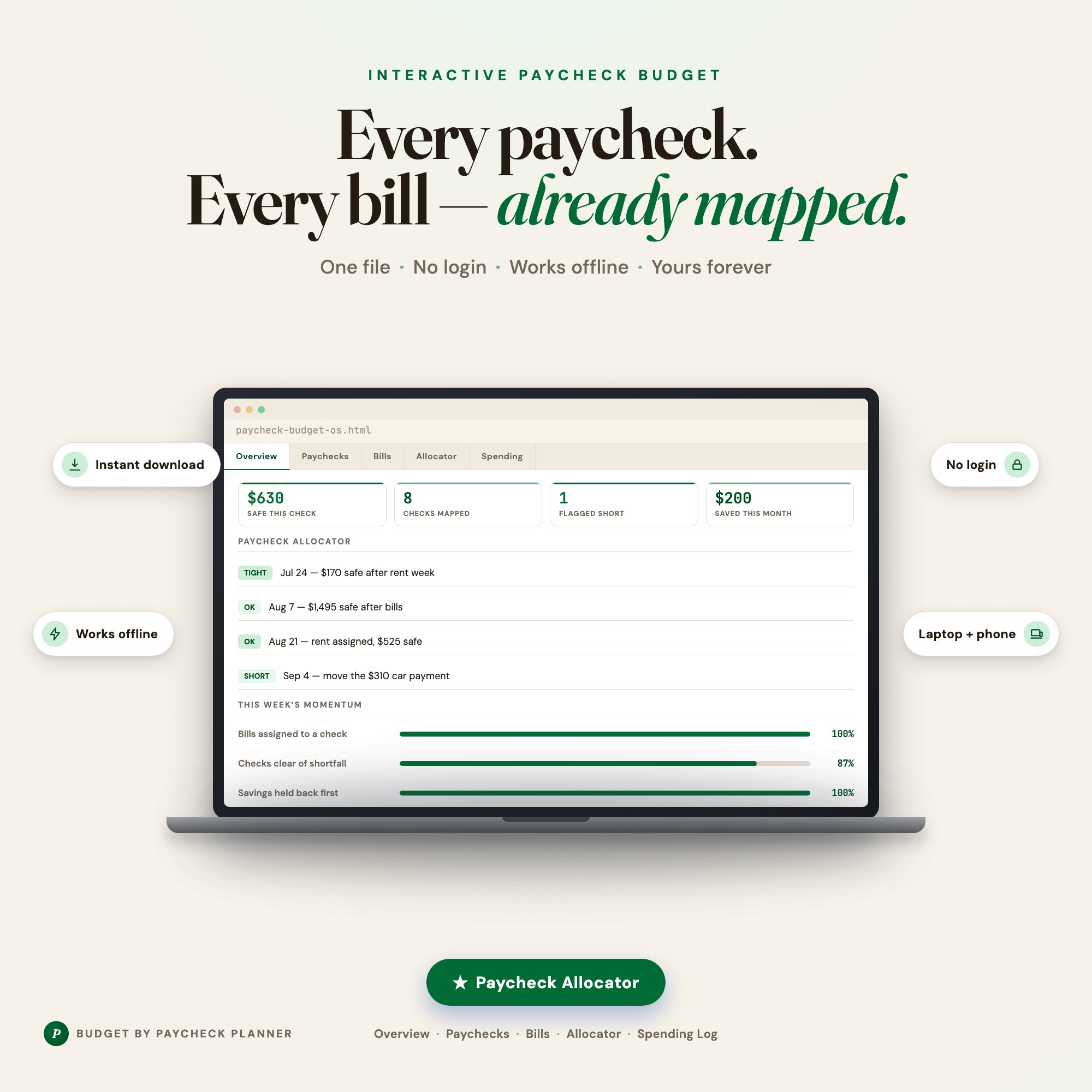
A worked example with biweekly $2,150 checks: the September 4 check is assigned a $310 car payment plus a $1,750 annual insurance bill due September 12 — $2,160 of bills against a $2,150 check, short by $10. The fix is not “spend $10 less.” The fix is: the August 21 check has $525 spare, so the $310 car payment moves there and gets paid early. September 4 now clears with room, and nothing was cut.
For annual bills, the calmer version is to never let them land whole: divide the amount by the number of checks until it’s due and hold back that slice from each check. $1,750 due in ten checks is $175 a check — a line item instead of an ambush.
Step 6: Hold savings back first, per check
Savings assigned “whatever is left at the end of the month” gets nothing, because the end of the month is where leftover money goes to die. Assign savings like a bill — a fixed amount per check, held back before safe-to-spend is calculated. $100 per biweekly check is $2,600 a year without a single act of willpower after setup.
Running it: paper, spreadsheet, or dashboard
The method needs no particular tool. Paper works. A spreadsheet works until the date logic does — biweekly drift, months where a due day doesn’t exist, deciding which check owns a bill due the 1st — and that’s where hand-maintained formulas tend to quietly break.
If you’d rather type your pay schedule and bills once and have the assignment, statuses, and safe-to-spend computed for you, that’s exactly what the Budget By Paycheck Planner does: it generates your next eight real pay dates, assigns every bill to the check that covers it, flags TIGHT and SHORT checks ahead of time, and names the fix when one comes up short. It’s a single offline HTML file — no bank login, no subscription, no formulas to maintain.
Either way, the principle is the thing: every bill gets a check, every check gets a verdict, and payday stops being a math test.
Frequently asked questions
- What does it mean to budget by paycheck instead of by month?
- Instead of totaling income and bills per calendar month, you treat each paycheck as its own mini-budget: the bills due before your next check come out of this check, plus savings, and what remains is your real safe-to-spend. The month is just the sum of its checks.
- Which paycheck should pay a bill?
- The last check that lands before the bill's due date. Rent due the 1st gets paid from the final check of the previous month, not from the check that arrives on the 5th. Assigning every bill this way is the whole method.
- What if one paycheck can't cover all the bills assigned to it?
- Move the smallest bill that clears the gap to an earlier check with spare room, and pay it early. If nothing fits, split the bill across two checks by setting aside half from each. The point is to discover this weeks ahead, not at the register.
- How do annual bills like insurance or registration fit in?
- Two options: assign the full amount to the check before its due date and treat that check as a known heavy one, or divide the annual amount by the number of checks until it is due and hold that slice back from each. Either works; ambushes don't.
- Do I need an app that connects to my bank to do this?
- No. The method needs three lists: your pay dates, your bills with due days, and the assignment between them. You can run it on paper, in a spreadsheet, or in an offline dashboard that does the date math for you — no bank login involved.
Ready-made dashboards
Skip setup — grab an interactive dashboard built for this exact workflow.
ListingResearchOS Shop
All dashboards — one-time purchase, yours forever
Single HTML files. No subscriptions. No login. Works offline in any browser.
Browse all dashboards →