
How Tattoo Artists Track Deposits, Pricing, and Real Take-Home Pay
Stop losing money to no-shows and guessed pricing — how independent tattoo artists track deposits, set rates, and know their true take-home.
Published June 4, 2026
The two things that quietly cost independent tattoo artists the most money are no-shows and guessed pricing. Both are tracking problems before they’re money problems — and both are fixable with a system that takes minutes a week.
No-Shows Are a Deposit Problem
A booked slot that ghosts is pure lost income — that chair time can’t be resold last-minute. The deposit exists to make a no-show cost the client, not you. But a deposit only works if it’s tracked:
- Which client paid a deposit, and how much?
- Was it applied to the final session, or forfeited to a no-show?
- Did the rebook carry the deposit forward, or start fresh?
Artists who keep deposits in their head (or scattered across DMs and a cash app) lose track, apply them inconsistently, and end up eating the cost anyway. A simple ledger — client, amount, status (held / applied / forfeited) — turns the deposit from a vague intention into actual protection.
Pricing You Can Defend
Walk-in math on the spot leads to two failures: quoting too low because you’re put on the spot, or quoting inconsistently so clients compare notes and you look arbitrary. The fix is knowing your numbers before the client is in front of you.
Whether you price hourly or by the flat piece, the real question is the same: after supplies, shop split or booth rent, and taxes, what do you actually keep on that piece? A $600 day sounds great until you subtract $80 in supplies, a 40% shop split, card fees, and a tax set-aside — suddenly the take-home is half the headline.
Once you know your true take-home per hour, you can set a floor rate you never go below, and quote with confidence instead of guilt.
The Five-Minute Weekly System
You don’t need bookkeeping software. You need to capture, consistently:
- Appointments — booked, completed, no-show
- Deposits — amount, client, status
- Pricing — what you quoted and collected per piece
- Supply cost — even a rough per-piece estimate
- Take-home — revenue minus supplies, split/rent, fees, and tax set-aside
The flash and design library is worth tracking too — knowing which designs sell repeatedly tells you what to promote.
One File That Does the Math
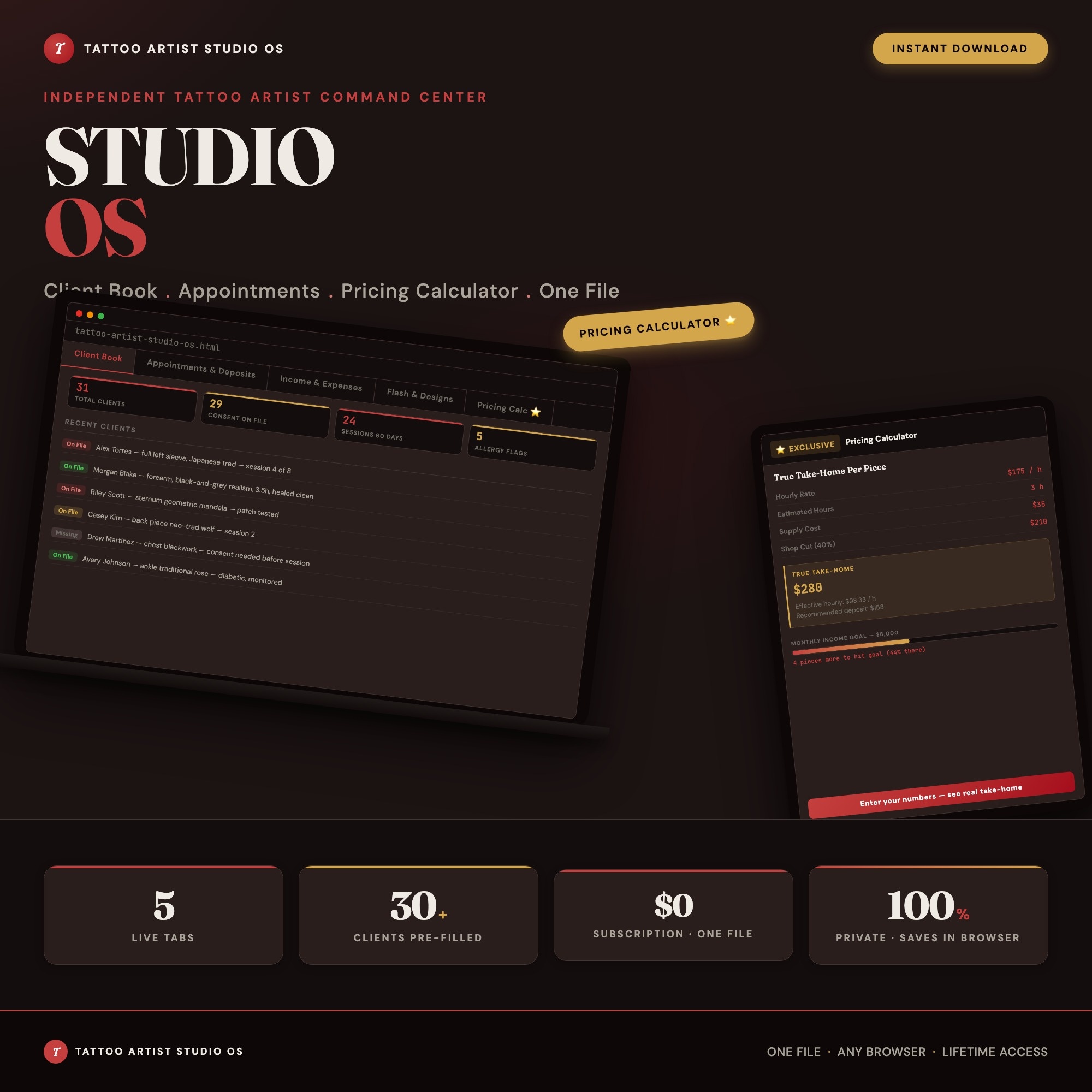
Tattoo Artist Studio OS was built for this exact workflow. It’s an interactive browser dashboard — no login, no subscription — that holds your client book, appointment and deposit tracker, flash design library, and a Pricing & Take-Home Calculator in a single file.
Enter your pricing model (hourly rate or flat piece price), estimated hours, and supply cost, and it returns your real take-home, effective hourly rate, and a recommended tax set-aside. The deposit tracker flags what’s held, applied, or forfeited so a no-show never quietly costs you again. Everything saves locally on your device — your client data never leaves your browser.
For an independent artist or booth renter, it replaces the DM threads, cash-app screenshots, and mental math with one file that tells you what’s booked, what’s owed, and what you actually made.
See Tattoo Artist Studio OS → — one-time $34, works offline, yours for life. Or browse the full shop.
The Takeaway
Track deposits by status, know your true take-home before you quote, and set a floor rate. No-shows stop being free, pricing stops being a guess, and the money you earn is money you actually keep.
Frequently asked questions
- How much deposit should a tattoo artist take?
- Most independent artists take a non-refundable deposit of $50-$150 (or 20-30% of the estimated piece), applied to the final session. The exact number matters less than tracking it: which client paid, how much, and whether it's been applied or forfeited to a no-show.
- Should tattoo artists price by the hour or by the piece?
- Both work. Hourly is simpler for long or unpredictable pieces; flat piece pricing rewards speed and is cleaner for clients. The mistake is not knowing your real take-home under either model after supplies and booth rent — that's what tells you if your rate is actually sustainable.
- What do tattoo artists forget when calculating earnings?
- Supply cost per piece (needles, ink, cartridges, disposables), booth rent or shop split, card fees, and the self-employment tax set-aside. The headline rate always looks bigger than the take-home.
Ready-made dashboards
Skip setup — grab an interactive dashboard built for this exact workflow.
ListingResearchOS Shop
All dashboards — one-time purchase, yours forever
Single HTML files. No subscriptions. No login. Works offline in any browser.
Browse all dashboards →