
Home Inspection Report Turnaround: What a 24-Hour Promise Costs
A 24-hour report promise is a deadline you set yourself and then never measure. Here is how to track it, and what the median actually tells you.
Published September 11, 2026
Somewhere in your inspection agreement is a sentence you wrote once and have not looked at since. It says the report will be delivered within twenty-four hours. Or forty-eight. Or “the next business day.”
That sentence is the only performance standard your business has. It is also, for most solo inspectors, completely unmeasured. You know you are usually fast. You know there was that one week in August. You could not tell an agent what percentage of your reports land inside your own promise, because nobody is counting.
This is a strange situation to be in. You set the number yourself, you are judged on it by every agent who refers you, and you have no idea what it is.
The promise is a contract term, not a marketing claim
Start with what the number actually is. A turnaround commitment in a signed inspection agreement is a term of that agreement. It is not a slogan on your website, and it is not aspirational. If your agreement says twenty-four hours, twenty-four hours is the standard you are held to — by your client, and by the agent whose transaction timeline is built around it.
This matters because of how the number tends to get chosen. Most inspectors pick it by looking at what the competition advertises, then shaving a few hours off to sound better. That is a marketing decision being written into a contract, which is exactly backwards. The right way round is to measure what you can actually deliver and then promise slightly less than that, so the promise has slack in it.
You cannot do that without data, which brings us to the measurement problem.
Hours or days — say which one you have
There are two ways to record a job, and they answer different questions.
If you log only dates — inspected the 4th, delivered the 5th — you can say the report took “one day.” But a job inspected at 8am and delivered at 7pm the same evening also took “one day,” and so did a job inspected at 4pm on the 4th and delivered at 11pm on the 5th. Those are an eleven-hour turnaround and a thirty-one-hour turnaround, and against a twenty-four-hour promise one of them is a pass and one is a fail.
If you log clock times as well, you get hours, and hours is what your promise is denominated in.
The honest move is to record times when you have them and be explicit when you do not. A system that quietly converts “one day” into “24 hours” is inventing precision you never captured, and it will tell you that you are meeting a promise you are actually missing. If some of your jobs only have dates, measure those in days and say so, rather than blending both into one number that means neither.
This is the single most common way turnaround tracking goes wrong, and it goes wrong in the flattering direction, which is why nobody catches it.
Median, not mean
Once you have a set of measured jobs, resist the urge to average them.
Here is why. Suppose a normal week of yours looks like this — six reports, turned around in 14, 18, 20, 22, 26 and 54 hours. The mean is about 25.7 hours, which against a twenty-four-hour promise reads as a failing business. The median is 21 hours, which reads as a business that is comfortably inside its promise with one bad job in it.
The median is the truer description. Five of those six reports were fine. One was a disaster — and the disaster is worth looking at on its own, as a separate number, rather than being allowed to smear itself across the other five.
So track three things, not one:
- Median turnaround — what a typical job actually takes
- On-time rate — what share of delivered reports landed inside the promise
- Slowest job — the worst case, kept visible instead of averaged away
The three together tell a story that no single number can. A median well inside the promise with an on-time rate of 60% means you are fast most of the time and catastrophically slow occasionally, which is a scheduling problem. A median just under the promise with a high on-time rate means you have no slack, and the first sick day will put you underwater — which is a promise problem, and the fix is to change the agreement, not to work faster.
The on-time rate is the number agents feel
Your median is the number you experience. The on-time rate is the number your referral sources experience, and they are not the same thing at all.
An agent is not tracking your average. An agent remembers the specific transaction where the report did not arrive when you said it would, because their client’s inspection objection deadline did not move to accommodate you. One missed report inside a tight contingency window can cost the relationship that sends you a dozen jobs a year, and it will cost it silently — nobody calls to tell you they have stopped referring.
This is also why the slowest job deserves its own line. A 54-hour report against a 24-hour promise is not a rounding error. Somebody’s week was affected by it, and if you do not know which job it was and which agent sent it, you cannot make the call that keeps the relationship.
Measure delivered reports, not booked jobs
One methodological trap, because it quietly ruins the number.
Your on-time rate should be calculated over reports you have actually delivered. A job you inspected this morning has not been delivered yet, and it is not late yet either — it is still inside the window. Counting it as a miss makes your rate drop every time you do an inspection, which is absurd. Counting it as a hit makes your rate rise for work you have not done.
It belongs in a third category: outstanding, with a clock running. That is a different display from your historical performance, and conflating them produces a metric that swings wildly for reasons that have nothing to do with how you are performing.
The same applies to jobs with no delivery date recorded at all. If you cannot measure it, it should not silently count as a pass.
What to do with the number once you have it
Three decisions come out of this data, and none of them are available to you without it.
Repricing the promise. If your on-time rate against twenty-four hours is poor but your median is well under forty-eight, your business is not slow — your agreement is wrong. Widening the promise to forty-eight hours costs you nothing in practice and converts a standing failure into a standing success. Agents would rather have a forty-eight-hour promise you keep than a twenty-four-hour promise you miss a third of the time.
Finding the job type that breaks you. If you log what kind of inspection each job was, you can look at turnaround by type. Most inspectors find one category that consistently blows the window — often the large or complex properties where the report itself is three times the length. That is a pricing conversation, not a speed conversation: if a job takes twice as long to write up, it should not cost the same as one that does not.
Knowing which relationship is at risk. Late reports are not distributed evenly across your referral sources. If you record which agent sent each job, you can see whether your misses are concentrated with one agent — which is the relationship to call before it quietly ends.
The tracking has to be one step, or it will not happen
The reason none of this gets measured is not that inspectors do not care. It is that measuring it usually means a spreadsheet with a column for inspection date, a column for inspection time, a column for delivery date, a column for delivery time, a formula that handles overnight gaps correctly, and the discipline to fill in all four on a day when you have three inspections and a report to write.
That does not survive contact with a busy week. The only version that works is one where logging the job is the measurement — you enter the inspection once, you mark it delivered when you send it, and the median, the on-time rate and the outstanding clock all fall out of that automatically without a second act of data entry.
Whatever tool you use, that is the test to apply to it: does keeping the number cost you anything beyond the work you were already doing? If it does, you will stop, and you will be back to not knowing.
The number you promised is the number you are judged on. It is worth knowing whether you are keeping it.
Frequently asked questions
- What is a normal home inspection report turnaround time?
- There is no universal number, and any figure quoted as an industry standard is worth checking against its source before you repeat it in your own agreement. What governs you is whatever your inspection agreement says, which is a number you chose. The useful question is not what other inspectors promise but what percentage of the time you hit the promise you already made.
- How do I measure my own report turnaround?
- Record the inspection date and time and the delivery date and time for every job, then measure the gap against the promise in your agreement. If you capture clock times you get an answer in hours; if you only capture dates you get an answer in days, and you should label it that way rather than implying precision you did not record.
- Should I use the mean or the median turnaround?
- Median. One catastrophic week — a sick child, a failed hard drive, a 6,000 square foot house with a finished basement — drags a mean far enough to make a healthy practice look broken, and it also hides a slow drift when everything else is fine. Look at the median for the typical job and the slowest job separately.
- Does a faster report turnaround actually win more referrals?
- An agent working a contingency window cares about the date the report lands, because their client's inspection objection deadline does not move. Whether speed wins you a specific agent is something only your own referral data can show — which is why it is worth recording which agent sent each job alongside how fast you turned it around.
- What should I do when I am going to miss a report deadline?
- Tell the client and the agent before the deadline passes, not after. The failure mode that costs referrals is not the late report, it is the silent late report, because the agent finds out from their client instead of from you.
Ready-made dashboards
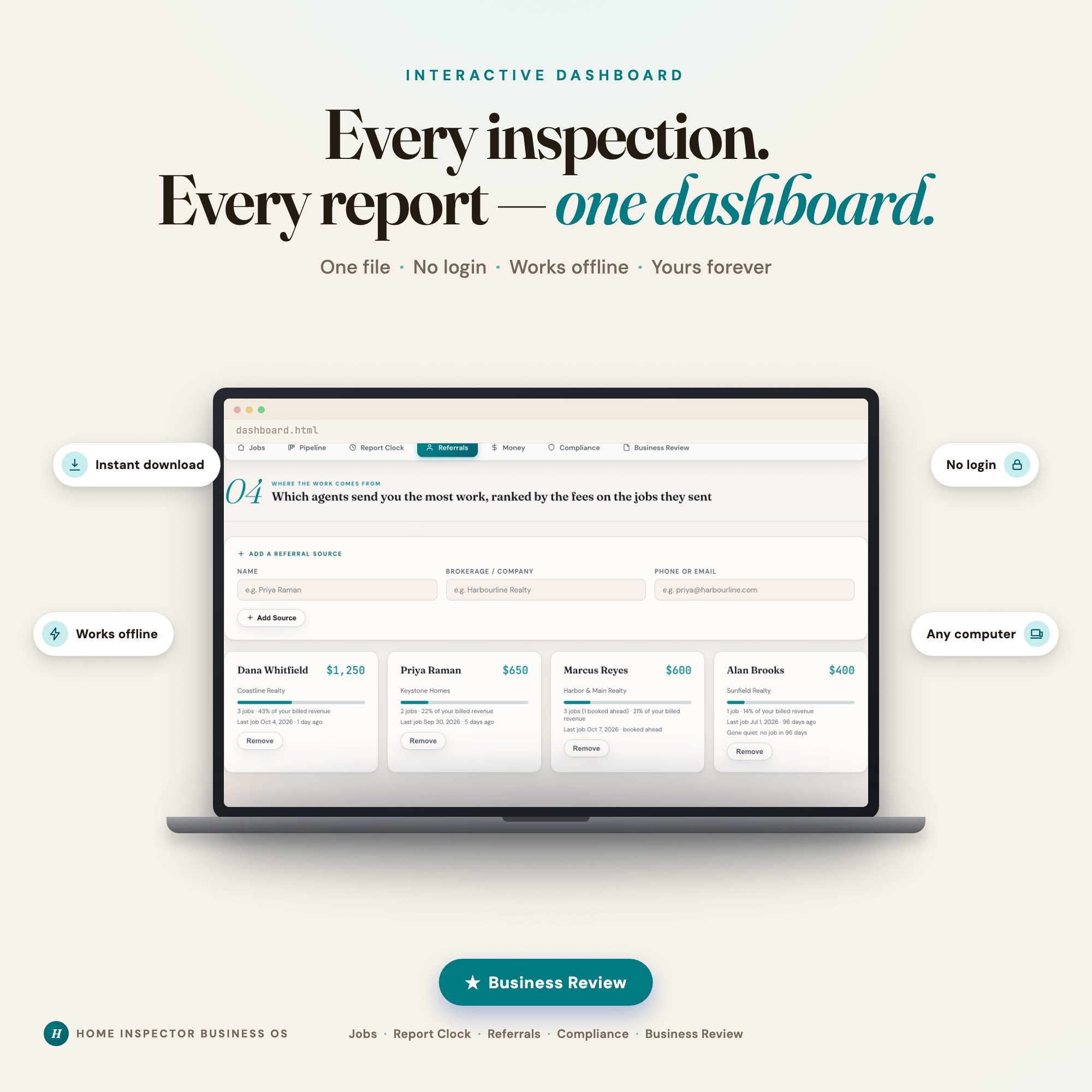
Skip setup — grab an interactive dashboard built for this exact workflow.
ListingResearchOS Shop
All dashboards — one-time purchase, yours forever
Single HTML files. No subscriptions. No login. Works offline in any browser.
Browse all dashboards →