
Home Bakery Expense Tracker: Why Your Cake Price Is Losing You Money
Ingredient cost is the small part. Here is how to price a custom cake with labor, overhead and a real margin — and what your effective hourly rate says.
Published August 2, 2026
You quoted $85 for the cake. Ingredients came to about $22. That’s $63 of profit, which sounds fine.
Except it took you six hours across two days — shopping, baking, cooling, crumb-coating, chilling, decorating, boxing, and the fifteen-minute handover conversation. Plus the board, the box, the ribbon, the dowels, and enough oven gas to notice.
$63 minus roughly $8 of packaging and overhead is $55, over six hours. About $9 an hour, for skilled custom work, before tax.
That’s the arithmetic almost no home bakery does, and it’s why the most talented bakers in a local market are frequently the ones making the least per hour.
Four inputs, and most pricing uses one
Ingredient cost, per recipe at that size. Not a guess and not a monthly grocery total — that specific recipe, costed per batch and per serving, so you know what one eight-inch two-layer actually consumes.
Labor: your hours × a rate you’d accept. This is the input that gets skipped, and skipping it is not a discount to the customer. It’s a discount to yourself, and it permanently caps what the business can pay you.
Overhead, as a percentage. Boxes, boards, ribbon, dowels, parchment, piping bags, oven gas, equipment wear, mileage, licensing, insurance. Each one trivial. Together, a real slice of every order.
Target margin, on top of all three. Profit isn’t what’s left over by accident. It’s a number you decide and then price toward.
Most home bakery pricing uses input one, adds a feeling, and calls it a price.
Decorating time is the invisible cost
Here’s the trap specific to custom work.
Two cakes, same size, same recipe, nearly identical ingredient cost. One is a smooth buttercream finish with a drip. The other is hand-piped florals with a sculpted topper.
Four hours apart in labor.
If price is anchored to size and ingredients — which is how most quotes get built — the intricate cake and the simple cake are priced within twenty dollars of each other. Which means the simple orders subsidise the complex ones, and your most impressive work is your least profitable work.
That’s backwards, and it’s self-reinforcing: the elaborate cakes are what get posted, what get shared, and what bring in more requests for elaborate cakes.
The number worth watching
Not profit per order. Effective hourly rate per order.
Profit per order rewards big cakes. Effective hourly rate tells you which work is actually worth taking, and it’s the number that reveals that a $60 dozen of simple cookies can out-earn a $200 tiered cake.
Track it for ten orders and you’ll have something most home bakeries never develop: a clear view of which part of your menu deserves to be promoted, and which orders you should be pricing considerably higher or politely declining.
What to track
Four connected things:
- An order pipeline — customer, item, due date, details, quoted price, deposit, and status from inquiry through booked, baking, ready, delivered
- Recipe costing — each recipe broken to ingredient cost per batch and per serving, with yield, so cost per cake is known rather than estimated
- Pricing and profit per item — ingredients plus labor plus overhead against your price, showing margin and profit per order
- Customers and income — repeat-order history and monthly revenue
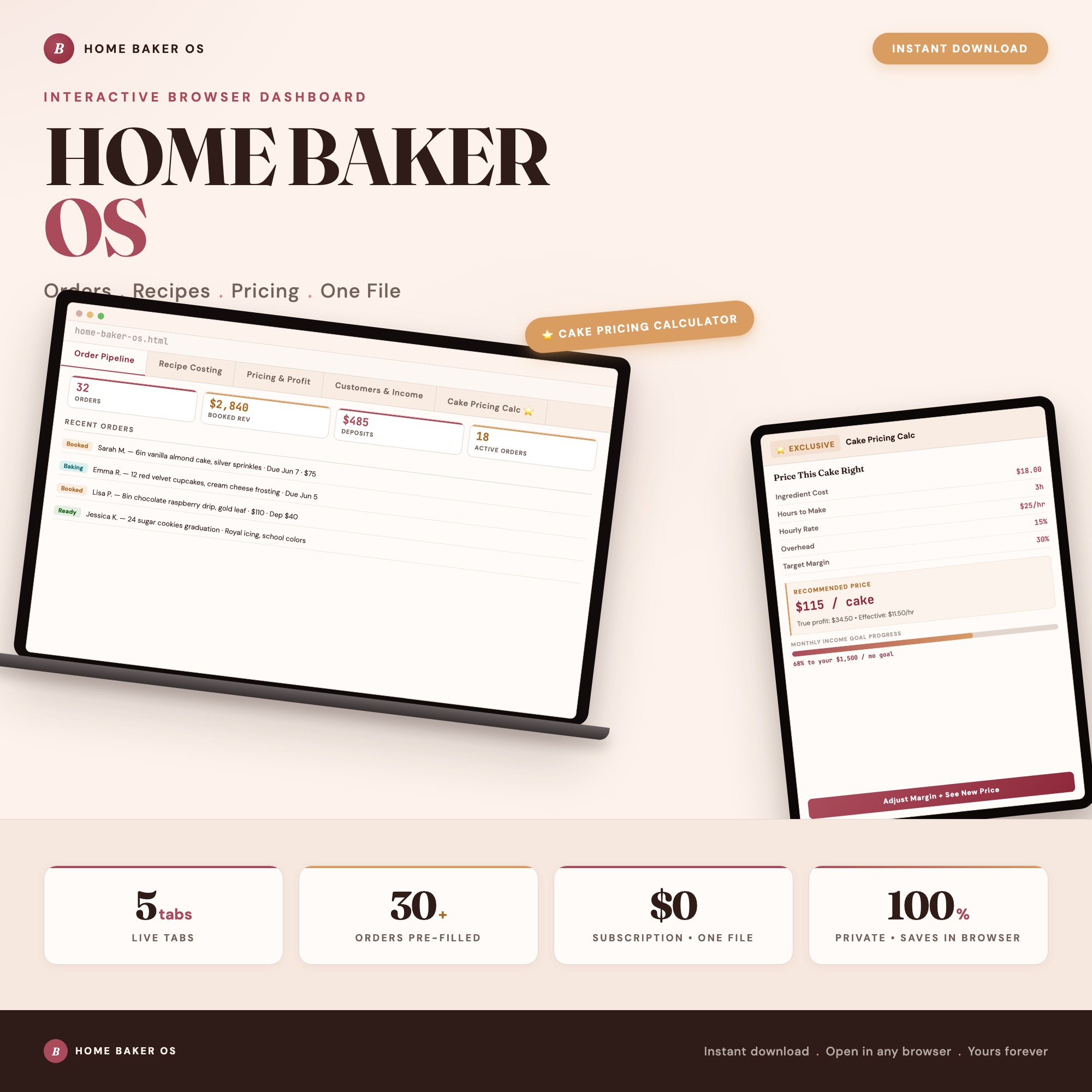
That’s what the Home Baker OS is built around. Its pricing calculator takes ingredient cost, your hours × hourly rate, overhead percentage, and a target margin, and returns a recommended price, true profit per order, and your effective hourly rate against a live monthly income-goal bar. One browser file, no login, no subscription, and customer details stay on your device.
Do this once
Take your last three orders. Write down honest total hours for each — including shopping, cleanup, and messaging. Divide profit by hours.
If any of them is under what you’d earn in an ordinary job, that item is underpriced, and it’s underpriced by a specific, calculable amount.
Frequently asked questions
- How do I price a custom cake?
- Four inputs, in order: ingredient cost for that specific recipe and size, your decorating and baking hours multiplied by an hourly rate you would actually accept, an overhead percentage covering the costs that are not ingredients, and a target profit margin on top. Skipping any of the four is how bakers end up working for free.
- What counts as overhead for a home bakery?
- Everything consumed that is not in the recipe: boxes, boards, ribbon, dowels, parchment, piping bags, gas and electricity for the oven, equipment replacement, packaging, delivery mileage, and your cottage-food licensing or insurance. Individually trivial, collectively a real percentage of every order.
- What hourly rate should I use?
- One you would genuinely accept from an employer for skilled work, not minimum wage. Pricing your own labor low is not a discount you are giving the customer — it is a discount you are giving yourself, and it sets the ceiling on what the business can ever pay you.
- Why do custom cake orders lose money when the price looks fine?
- Because decorating time is the cost that scales invisibly. Two cakes with nearly identical ingredient costs can differ by four hours of hand-piped work. If the price is anchored to ingredients and size, the intricate one is subsidised by the simple one, and complex orders quietly become the least profitable work you do.
- Should I charge for consultations and revisions?
- They are real hours and they belong in the labor input, whether you bill them as a separate line or fold them into the price. The mistake is leaving them out entirely, which is common for orders that involve several rounds of design conversation before anything gets baked.
Ready-made dashboards
Skip setup — grab an interactive dashboard built for this exact workflow.
ListingResearchOS Shop
All dashboards — one-time purchase, yours forever
Single HTML files. No subscriptions. No login. Works offline in any browser.
Browse all dashboards →