
HOA Treasurer Report Template: What to Include in a Board Report
What belongs in an HOA treasurer report: budget variance, dues aging, reserve funding status, and the format that actually helps your board vote.
Published September 30, 2026
Most new volunteer treasurers inherit a spreadsheet, a reserve study nobody has reopened, and a vague sense that they’re supposed to “give a report” at the next meeting. Here’s what an HOA treasurer report needs to actually contain, and why each section matters to the board that’s reading it — check your governing documents for any additional reporting requirements specific to your association.
1. Budget vs. Actual: Every Line, Not Just the Total
A report that shows only “we spent $X this month” tells the board nothing about whether that’s on track. Break out every budget line — landscaping, insurance, utilities, management fees, reserve contribution — against what was actually spent, and flag any line that’s already past its annual budgeted amount. Carry the reserve contribution as its own line item, separate from operating expenses, so a transfer into reserves never quietly makes the operating result look worse than it is.
2. Dues Collections and Delinquency Aging
Show what was assessed, what’s been collected, and what’s outstanding — aged into buckets (30/60/90 days is common, though your collection policy may use different windows). This matters for two reasons: it tells the board how much cash is actually coming in versus billed, and it identifies which units need a collection action under your association’s policy. Don’t let a prepaid owner’s balance net out against a delinquent one elsewhere — every unit should show its own status.
3. Reserve Funding Health
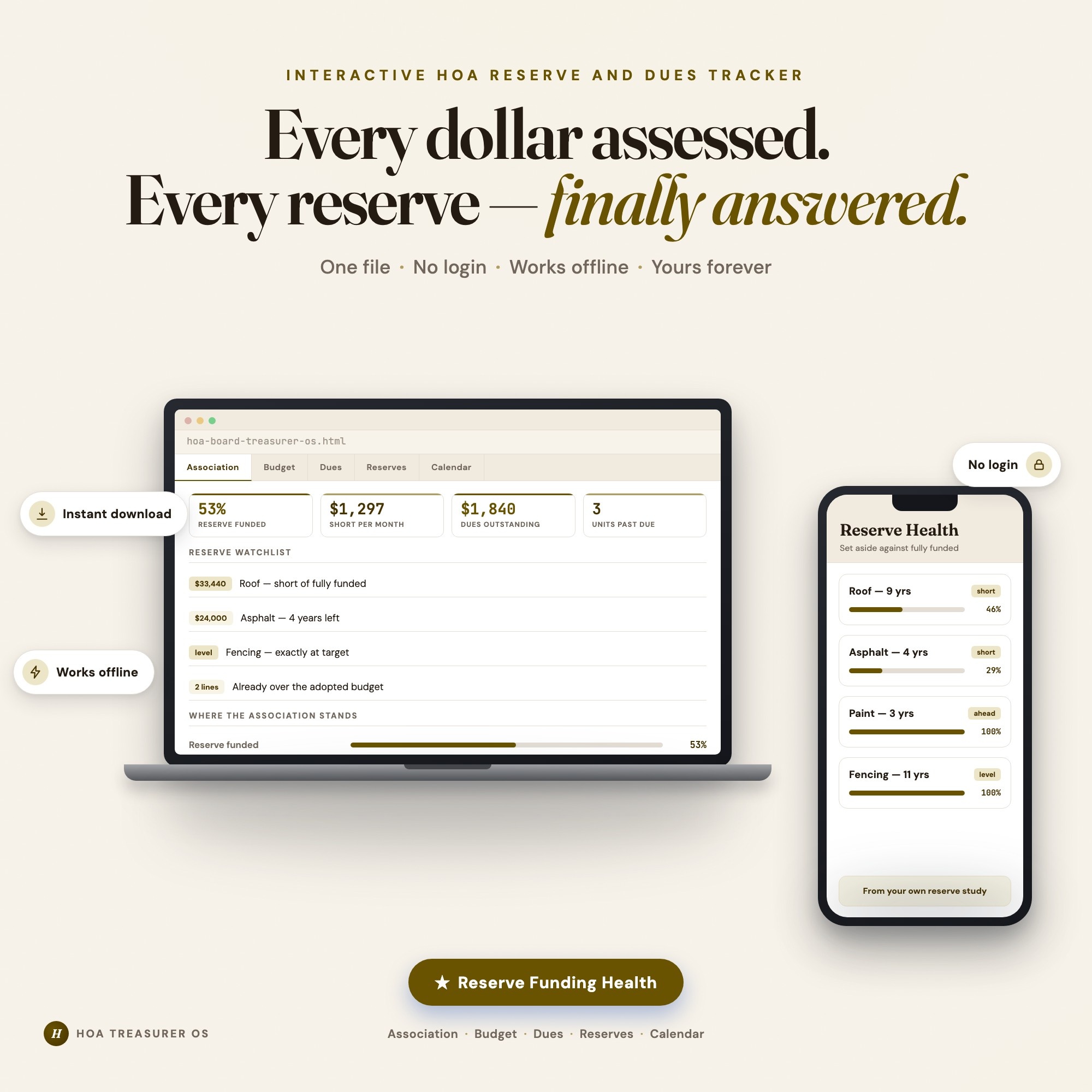
This is the section most treasurer reports skip entirely, and it’s the one boards most need. For each major component in your reserve study — roof, paving, siding, whatever your association tracks — you need the replacement cost, the remaining useful life, and what the component’s “fully funded” balance should be at this point. Band that against your board’s adopted funding target, and the report can state a single number: what the association is actually contributing each month, what it needs to be contributing, and the shortfall per unit if there is one. A board voting on next year’s budget without this number is guessing.
4. Compliance Calendar
List upcoming dates that fall to the treasurer or affect the finances: budget adoption deadline, reserve study update, annual meeting, audit or financial review, state association filing, insurance renewal. These dates come from your governing documents and your state — the report should track them, not invent them.
5. The Report Itself: Format for a Meeting, Not a Spreadsheet Dump
The board reading your report is not going to interpret a raw spreadsheet in a meeting. A usable treasurer’s report reads like a short narrative: collections and aging, budget variance highlights, reserve funding status and monthly shortfall, and any dates coming up. That’s the version that goes into the packet and the minutes.
How the Dashboard Builds This Report For You
Pulling budget lines, a dues roster, and a reserve study out of three separate spreadsheets every month is where most volunteer treasurers lose their evenings. The HOA Board Treasurer OS tracks all of it in one offline dashboard — association and board info, budget vs. actual with over-budget lines flagged automatically, dues and delinquency aging, and a Reserve Funding Health tab that turns your reserve study into a single fully-funded percentage and a monthly shortfall figure. One click on the Monthly Board Report tab assembles a plain-text report in the shape your board actually reads, ready to paste into the packet or an email.
It is a working tracker, not a substitute for your association’s CPA or attorney — every dollar figure, useful life, and funding target is one you enter from your own records, and anything going to the members should still be reviewed by your professional advisors first.
Frequently asked questions
- What should be included in an HOA treasurer report?
- A complete treasurer's report covers four areas: budget vs. actual for the period, dues collections and aging delinquencies, reserve fund status against your funding target, and any upcoming compliance dates (audit, filing, insurance renewal). Boards that only see a bank balance can't evaluate whether the association is actually on track.
- How often should an HOA treasurer report to the board?
- Monthly is standard for most self-managed associations, even if the full board meeting is quarterly. A monthly report keeps small variances visible before they compound, and gives you a paper trail if a decision is questioned later.
- What is reserve funding percent and why does my board ask about it?
- It's the ratio of what your reserve fund currently holds to what it should hold given the replacement cost and remaining useful life of every major component — roof, paving, siding, and so on. A board that doesn't know this number can't set dues correctly or budget a special assessment before it's forced on them.
- Do I need accounting software to produce a treasurer's report?
- No. Most small self-managed associations don't need full accounting software — they need a way to track budget lines, dues per unit, and reserve components against a target, then turn that into a report. A dashboard built for exactly this can replace three separate spreadsheets without the overhead of a general ledger system.
- How much does the HOA Board Treasurer OS cost?
- One-time purchase of $28 on Etsy. No subscription, no login required.
Ready-made dashboards
Skip setup — grab an interactive dashboard built for this exact workflow.
ListingResearchOS Shop
All dashboards — one-time purchase, yours forever
Single HTML files. No subscriptions. No login. Works offline in any browser.
Browse all dashboards →