
8-Week Moving Checklist: How to Organize a Cross-Country Move
A week-by-week cross-country move checklist covering mover bids, address changes, box inventory, and utility transfers — with what to do and when.
Published June 3, 2026
Cross-country moves have a way of going wrong in very specific, preventable ways: the mover quote that didn’t include fuel surcharges, the address change that didn’t reach the IRS until six months after the move, the utility that wasn’t scheduled at the new place before move-in day.
This checklist covers what to do in each of the eight weeks before your move, organized by the problems that actually derail families.
Week 8 Before Move: Lock In Your Mover
Getting three binding quotes from licensed interstate movers is the first concrete task. “Binding” means the price won’t change unless you add services or items. Non-binding estimates can increase by 10% or more on delivery day.
What to compare across quotes:
- Base rate (per weight or per cubic foot)
- Fuel surcharge (varies by distance and current rates)
- Packing fees if you want them to pack fragile items
- Long-carry fees if your home has stairs or the truck can’t park close
- Valuation coverage (standard at $0.60/lb is essentially nothing — full-value protection is worth the extra cost for a long-distance move)
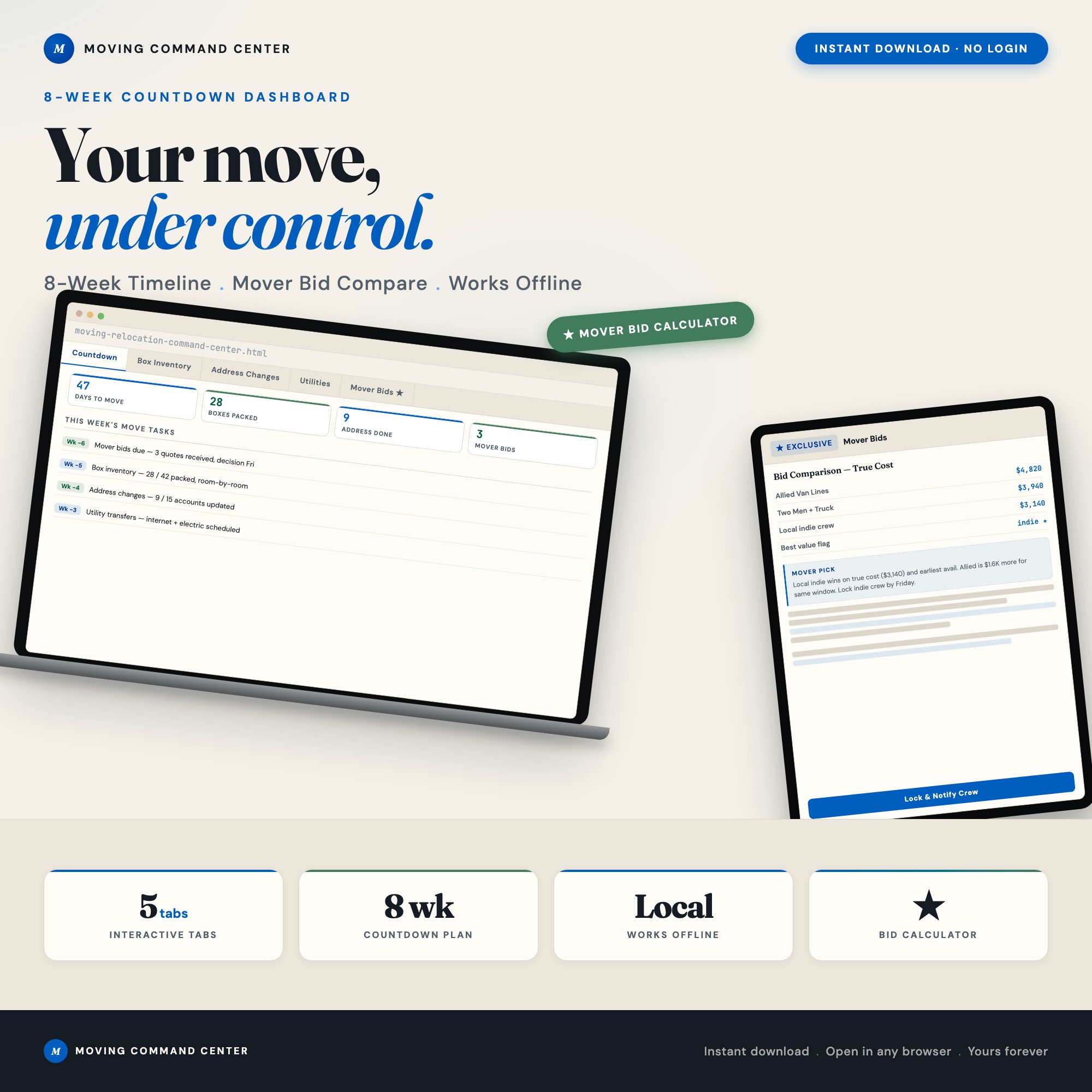
The Mover Bids tab in the Moving Relocation Command Center takes up to four quotes side by side and calculates the real total cost per company including add-on fees, showing you the actual best-value winner — not just the headline rate.
Also this week: decide what you’re donating or selling before packing. Every item you don’t ship saves money.
Week 7: Gather Supplies and Begin Packing Non-Essentials
Order boxes, packing paper, and tape now. Underestimate how many you need and you’ll be scrambling at week 2.
Start with items you won’t need for two months: out-of-season clothes, books, decorative items, garage items. Label every box on three sides with room and a brief contents note. The Box Inventory tab lets you assign color codes per room and log box contents so you can find anything in the new house without opening every box.
Weeks 6–5: Start the Address Change Campaign
Address changes take longer than most families expect because the list is longer than they realize. A complete list includes:
- USPS mail forwarding (forward both your name and any variation you receive mail under)
- All financial accounts: banks, credit cards, investment accounts
- Employer HR (payroll, benefits, W-2 delivery)
- IRS (Form 8822 online or by mail)
- Voter registration in new state
- Vehicle registration and driver’s license (30 days after move in most states)
- All insurance: health, auto, homeowners/renters
- All doctors, dentists, specialists
- Recurring subscriptions and delivery services
The Address Change Central tab covers all these with a status field (not started / submitted / confirmed) so you can see what’s still outstanding. Starting at week 5 gives you a manageable pace of 5–8 accounts per week.
Week 5: Utility Setup at the New Address
Most people cancel utilities at the old address. They forget to set up utilities at the new one until the week of the move — and then discover the internet won’t be installed for 10 days.
Schedule setup at the new address now: electric, gas, water, internet, and any home security or automation systems. Call or schedule online and get confirmation numbers for everything. The Utility Transfer Tracker covers both addresses simultaneously: old address cancellation dates and new address start dates in one view.
Weeks 4–3: Pack Remaining Rooms
Pack room by room. Finish one room completely before starting another — partial packing in every room makes move day harder. Label boxes by destination room in the new house (where you want it to land), not just what’s inside it.
This is also the window to confirm your mover, get a written confirmation of pickup date and delivery window, and verify your full-value protection is in place.
Week 2: Final Administration
- Confirm school enrollment and record transfers if moving with school-age children
- Transfer prescription medications: ask your pharmacy to transfer to a location near the new address
- Return any library books, rental equipment, or borrowed items
- Change your payment methods on any recurring services (autopay accounts need updated before you close the old bank accounts)
Week 1: Essentials Box and Move-Day Prep
Pack a dedicated essentials box or bag that travels with you in the car: medications, phone chargers, a change of clothes for each person, important documents (passports, birth certificates, insurance cards), toilet paper for day one, and a basic toolkit. This box does not go on the truck.
Confirm arrival window with your mover and verify their contact number. Do a final walkthrough of every room and closet on move-out day.
After Move: First 30 Days
Confirm your forwarding is receiving mail. Complete remaining address changes (utilities you missed, magazine subscriptions you forgot). Register to vote in the new state if you haven’t. Transfer vehicle registration and get a new driver’s license within 30 days.
The Moving Relocation Command Center tracks all of this in one offline file. Five tabs — Countdown Command, Box Inventory, Address Changes, Utilities, and Mover Bids — cover everything in this checklist without a subscription or a cloud account. One-time purchase of $22.
Frequently asked questions
- When should I book a moving company for a cross-country move?
- Book 6–8 weeks out, especially if you're moving in summer (May–August) when movers are fully booked. Get at least three quotes and compare the full cost including fuel surcharges, packing fees, and stair charges — not just the base rate.
- What is the most common thing families forget during a cross-country move?
- Utility transfers for the new address. Most people remember to cancel utilities at the old place, but forget to schedule setup at the new one — and arrive to no electricity or internet. The utility tracker should cover both addresses simultaneously.
- How long does it take to complete all address changes?
- Most families need to update 30–50 accounts: USPS, banks, voter registration, employer, IRS, insurance, doctors, subscriptions, and more. Starting at week 5 gives you enough time without it becoming overwhelming.
- How do I compare moving company quotes accurately?
- Get quotes in writing that include binding or not-to-exceed estimates. Hidden costs to watch for: fuel surcharges, long-carry fees (if the truck can't park close to your door), stair fees, elevator fees, and crating fees for large items. The Mover Bid Comparison tab in the Moving Relocation Command Center calculates the true cost including these charges side by side.
- What is the Moving Relocation Command Center?
- It's an offline HTML dashboard with five tabs for managing a cross-country move: Countdown Command (8-week task timeline), Box Inventory (room-by-room with color labels), Address Change Central (50+ accounts with status tracking), Utility Transfer Tracker (both old and new addresses), and Mover Bids (side-by-side quote comparison with true-cost calculator). One-time purchase of $22.
Ready-made dashboards
Skip setup — grab an interactive dashboard built for this exact workflow.
ListingResearchOS Shop
All dashboards — one-time purchase, yours forever
Single HTML files. No subscriptions. No login. Works offline in any browser.
Browse all dashboards →