
What No-Shows Actually Cost a Private Practice
Counting no-shows tells you nothing. Converting them to dollars per month — and ranking which clients drive them — changes what you do next.
Published July 27, 2026
Most solo clinicians have a rough sense that no-shows are a problem. Very few can say what the number is.
That gap matters more than it sounds, because a count and a cost lead to completely different decisions. “I had six no-shows last month” produces a shrug. “No-shows cost me $900 last month, and $10,800 annualised” produces a policy change.
A Count Is Not a Signal
Every scheduling spreadsheet tallies no-shows as a raw number. That framing hides everything useful.
Six missed sessions is not one fact — it is several. Were they spread across six clients or concentrated in two? Were they same-day cancellations you could not refill, or cancelled with enough notice that the slot went to someone on the waitlist? Did any of them get charged under your late-cancel policy?
A count flattens all of that into a single meaningless integer. A cost forces the distinctions, because you cannot compute the dollars without knowing which slots were actually lost.
The Three Leaks Are Different Problems
Lumping every scheduling gap together is why practices struggle to fix them. There are three, and each has a different remedy:
Cancellations with notice. Not necessarily lost income — if the notice was enough to refill the slot, cost is zero. If you have no waitlist, it is a full loss. The fix is structural: a waitlist and a refill process.
Late-cancels and no-shows. Almost always unrecoverable. The slot is gone and no one else can take it at two hours’ notice. The fix is policy — a written window, and actually enforcing the fee.
Unbilled completed sessions. The work was done. The client attended. The claim or invoice never went out, usually because a progress note stalled and the billing was gated behind it. This is not lost time, it is unclaimed revenue — fully recoverable, and the most quietly expensive of the three because nothing about your calendar shows it.
Track them as one blob and you cannot tell which lever to pull. Track them apart and the answer is usually obvious within a month.
Concentration Matters More Than Volume
A practice with twelve no-shows spread evenly across thirty clients has a systems problem — reminders, scheduling friction, maybe an intake mismatch.
A practice with twelve no-shows where seven come from two clients has a clinical and contractual problem with two specific people. That is a conversation about attendance as part of the treatment frame, or a decision about whether that arrangement is workable.
Same headline number, entirely different response. You only see the difference if attendance is tracked per client and ranked, rather than summed.
Notes and Billing Are the Same Deadline
For solo practitioners, the progress note is frequently the bottleneck that creates the third leak.
The session happens. The note is deferred. The claim waits on the note. Two weeks later the note is written, and by then some payer timely-filing windows are uncomfortably close — and occasionally missed entirely.
Treating note completion as a clinical obligation with a soft deadline, rather than the first step of getting paid, is what turns a documentation backlog into a revenue backlog. They are the same deadline wearing different clothes.
The Compliance Calendar Nobody Diarises
Alongside caseload and billing sits a set of dates that are invisible until they are urgent: license renewal, CEU hours accrued against the requirement, malpractice insurance renewal, and supervision hours if you are pre-licensure.
None of these are frequent enough to stay in working memory, and all carry real consequences for missing them. They belong in the same system as everything else, precisely because they surface so rarely.
One File That Computes the Leak
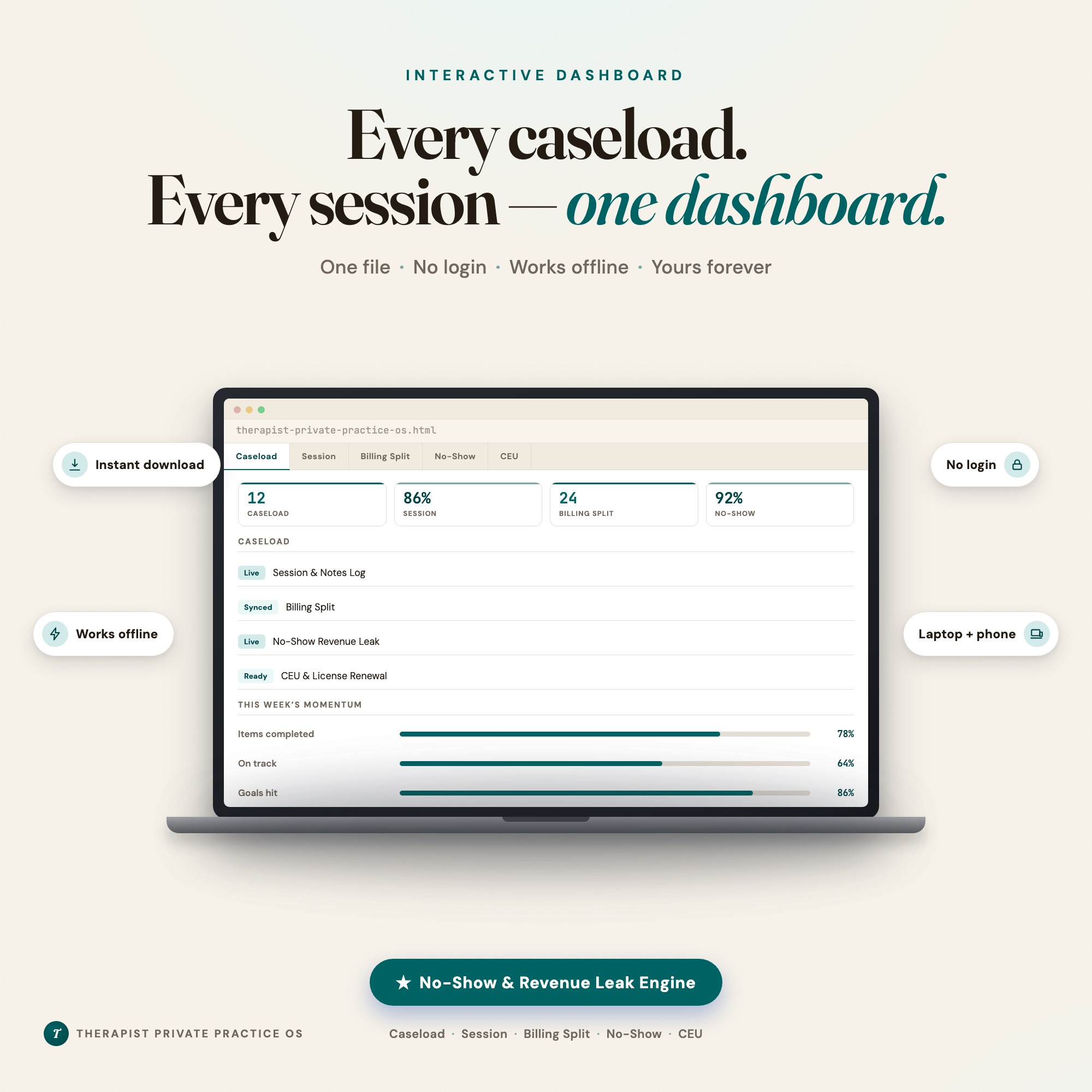
Therapist Private Practice OS was built for solo clinicians carrying all of this alone. It is an interactive browser dashboard — no login, no subscription, no cloud — holding caseload, session log, billing, and CEU and license tracking in a single file.
Its No-Show & Revenue Leak Engine computes the real dollar cost of cancellations, late-cancels, and unbilled sessions per month, and ranks exactly which clients are draining the schedule. Every competing spreadsheet in this space tallies no-shows as a raw count; this one converts them into a figure you can act on and attributes them.
Everything saves locally in your browser and never leaves your device.
A note on what this is: a practice-organisation tool, not an EHR and not a clinical record system. It does not submit claims, is not a substitute for HIPAA-compliant record keeping where that applies, and every figure is calculated from what you enter. Keep protected health information in whatever compliant system your practice already uses.
See Therapist Private Practice OS → — one-time $28, works offline, yours for life. Or browse the full shop.
The Takeaway
Counting no-shows changes nothing. Convert them to dollars per month, separate the three leaks — refillable cancellations, unrecoverable late-cancels, and unbilled completed work — and rank them by client. The moment the number has a currency symbol in front of it, the policy decision you have been postponing usually makes itself.
Frequently asked questions
- How much do no-shows cost a private practice?
- Multiply your session rate by the number of unfilled cancellations, late-cancels, and no-shows in a month. At a $150 rate, four lost slots a month is $600 — roughly $7,200 a year. The figure is usually far larger than clinicians expect, because nobody totals it.
- What is a reasonable no-show rate for a therapy practice?
- Reported rates in outpatient mental health vary widely, commonly cited in the 10-20% range depending on population, setting, and reminder systems. Your own baseline matters more than any benchmark — track your rate for a few months, then judge whether policy changes actually move it.
- Should I charge a late-cancellation fee?
- A written policy with a defined window, usually 24 or 48 hours, is standard. Enforcement is what makes it work, and enforcement is much easier when you can see exactly what unenforced cancellations have cost. Check your payer contracts, since some restrict charging fees for insurance clients.
- Why track unbilled sessions separately from no-shows?
- They are different leaks with different fixes. A no-show is lost time; an unbilled session is completed work that never got claimed — usually because a progress note or claim was never submitted. The second is fully recoverable revenue, and it is invisible unless tracked deliberately.
Ready-made dashboards
Skip setup — grab an interactive dashboard built for this exact workflow.
ListingResearchOS Shop
All dashboards — one-time purchase, yours forever
Single HTML files. No subscriptions. No login. Works offline in any browser.
Browse all dashboards →