
Wedding Planner Pricing: How to Know If an Event Actually Paid You
Package price is not profit. Here is how to calculate net profit, margin, and effective hourly rate per wedding — and why planners chronically undercharge.
Published August 2, 2026
Ask a wedding planner what a wedding is worth and you’ll get the package price. Ask what they kept and the answer gets vague.
That gap is where the undercharging lives. It isn’t a confidence problem or a negotiation problem. It’s a measurement problem — the package price is visible at the moment you quote, and every cost and hour that eats it arrives over the following eight months, separately, never assembled into a single figure.
By the time the wedding is done, nobody goes back and does the arithmetic. So the next couple gets quoted off the same package price, and the cycle repeats.
Three numbers per event
Net profit. Package price minus everything you personally covered. Not the vendors the couple paid direct — the costs you absorbed. Printing and signage. Mileage and parking across venue visits. Your assistant’s day-of rate. Any vendor cost bundled inside your package instead of billed through. Emergency-kit restocks. The rush fee you ate to keep a timeline intact.
Profit margin. Net profit as a percentage of package price. This is what makes events comparable across price points, and it’s how you discover that your $8,000 full-service package and your $3,500 partial-planning package are not nearly as far apart as they look.
Effective hourly rate. Net profit divided by every hour the event consumed. This is the number that changes behavior, and it’s the one most planners have never calculated, because they count the wedding day and forget the eight months in front of it.
Count honestly: discovery call, proposal writing, contract, venue walkthrough, every vendor email thread, timeline drafts and revisions, the final headcount scramble, rehearsal, wedding day, post-event wrap and vendor payments. A full-service wedding easily runs past a hundred hours. A planner who divides by twelve is telling themselves a number that’s off by roughly eight times.
What the numbers usually reveal
Once you have profit, margin, and hourly rate on every event from the last year side by side, the pattern is almost always the same:
- The biggest package isn’t the best event. High price, but the scope expanded, the client needed more hand-holding, and the hourly rate landed below a smaller, tighter package.
- Tightly-scoped partial planning outperforms. Fewer hours, fewer absorbed costs, and a margin that survives contact with reality.
- One event lost money. Not obviously — it just had a long tail of small absorbed costs and an unbounded revision cycle. It only looks like a loss when everything is totaled in one place.
None of that is visible from a list of package prices. It requires costs and hours attached to each event individually.
The other number: what you’re owed
Wedding work is paid in installments across months. Per couple, a payment schedule feels manageable. Across a full booked season, the total contracted but not yet collected is often the largest single figure in the business — and almost nobody has it in one place.
It matters because it tells you what kind of problem a slow month is. Booked revenue that hasn’t landed is a collections issue, and you fix it with a reminder and a due date. An empty pipeline is a marketing issue, and you fix it somewhere else entirely. Without a running AR total, those two look identical from inside a slow month.
What to run the business on
This is what the Wedding Planner Business OS is built for, and worth naming what it is not: it’s not a 300-page planning binder for the couple. Every top search result for wedding planning is a consumer product. This is the business side.
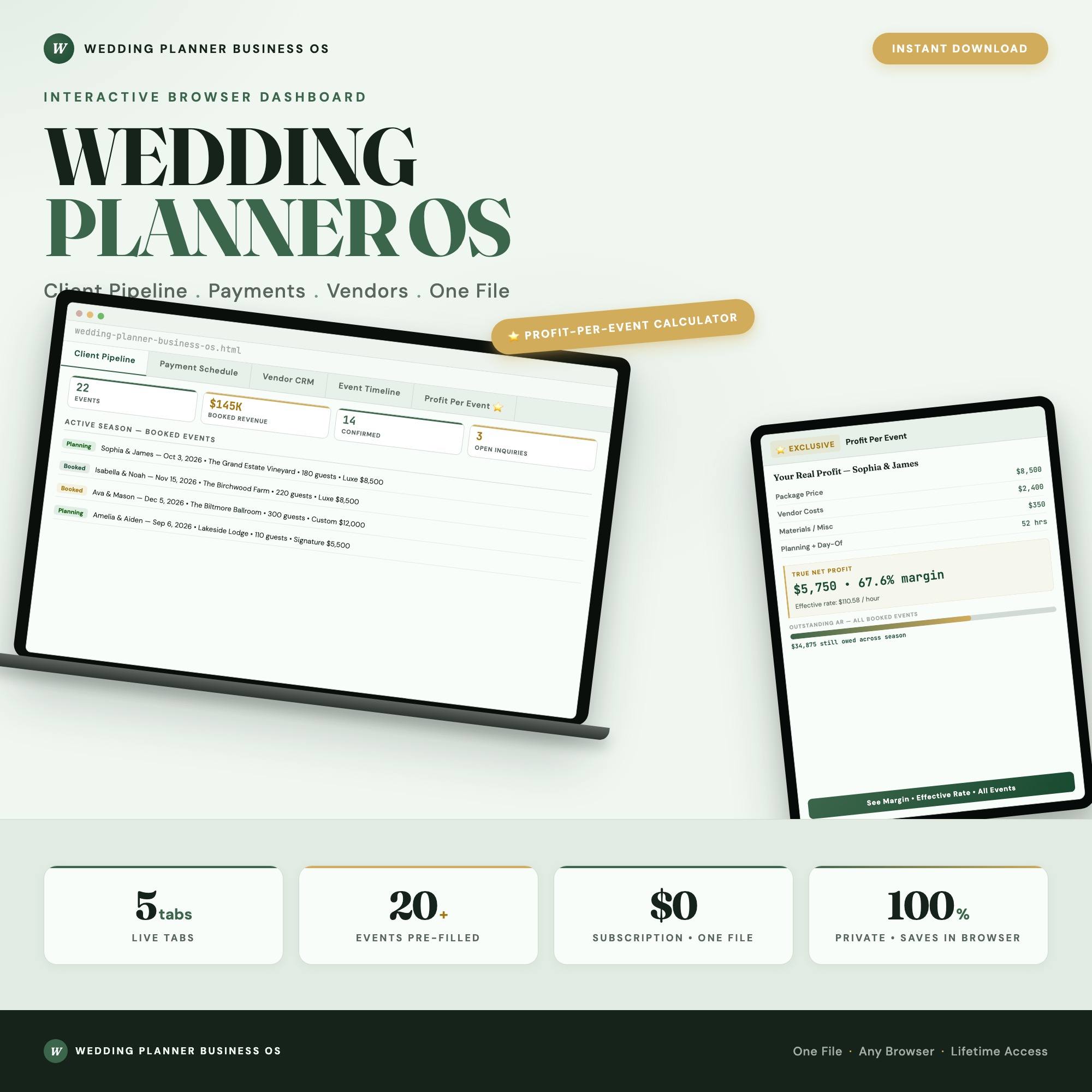
Five tabs. Client Pipeline — every couple with wedding date, package, venue, headcount, and status from inquiry through proposal, booked, planning, done. Payment Schedule — deposits and installments per client with due dates, paid versus balance, and an auto-totaled outstanding AR across every booked event. Vendor CRM — photographers, florists, caterers, venues, DJs with preferred status and referral notes. Event Timeline — day-of builder plus planning-milestone checklist with days-to-event flags. Profit Per Event — package price, vendor and material costs, and your planning hours in; true net profit, margin percentage, and effective hourly rate out.
One HTML file, any browser, no login, no subscription. Client and financial records stay on your own device.
The one habit worth building
After every wedding, before you archive the folder, total the costs you absorbed and the hours you actually spent. Ten minutes.
Do it for four events and you will price differently — not because someone told you to raise your rates, but because you’ll finally be able to see which of your packages was worth doing.
Frequently asked questions
- How do I calculate profit per wedding?
- Package price, minus every cost you personally cover (materials, signage, printing, travel, assistant pay, any vendor cost inside your package rather than billed direct), gives net profit. Divide that by every hour you spent on the event — including inquiry calls, venue walks, and vendor chasing — for your effective hourly rate. That last number is usually the shock.
- Which hours count toward an event?
- All of them. The discovery call, the proposal you wrote that took two hours, the venue walkthrough, every vendor email thread, the timeline revisions, the rehearsal, the wedding day itself, and the post-event wrap. Planners routinely count only the wedding day, which can overstate their hourly rate by several times.
- Why do wedding planners undercharge?
- Because the only number visible at quoting time is the package price, and it looks large. Costs arrive later and hours accumulate invisibly across months, so the gap between the price and what you kept is never assembled into one figure. Nothing corrects a price you never measured.
- What is outstanding AR and why track it across events?
- Accounts receivable is money contracted but not yet collected — the installments still owed across every booked couple. Tracked per client it looks manageable; totaled across a season it is often the largest number in the business, and it tells you whether a slow month is a booking problem or a collection problem.
- Should I raise prices or take fewer events?
- Calculate effective hourly rate per event first. If your best-paying event by hourly rate is also your least stressful, the answer is usually fewer events at a higher price. If a low-priced package has a strong hourly rate because it is tightly scoped, the answer may be more of those. You cannot tell without the per-event number.
Ready-made dashboards
Skip setup — grab an interactive dashboard built for this exact workflow.
ListingResearchOS Shop
All dashboards — one-time purchase, yours forever
Single HTML files. No subscriptions. No login. Works offline in any browser.
Browse all dashboards →