
Self Care Planner Templates: Why You Abandon Them by Week Three
Blank self-care templates ask for input and return nothing. Here is what a tracker has to give back, and the six areas worth balancing.
Published August 2, 2026
You’ve done this before. New notebook or new template, genuine intention, a good first week. Ten days of consistent logging. Then a gap, then a longer gap, then the tab stays closed.
It’s tempting to read that as a discipline failure. It’s more useful to read it as a design failure, because the pattern is too consistent across too many people to be about individual willpower.
Blank templates take and never give
Open a typical self-care planner template. Mood field. Sleep hours. Water. Habit checkboxes. Gratitude lines.
Fill it in. What comes back?
A page that looks like yesterday’s page. The template has accepted your input and returned nothing you didn’t already know — you were there for your day, you’re aware of how it went.
So the daily cost is real and immediate, and the payoff is deferred and abstract (“this will be useful eventually”). That’s an unfavourable trade, and habits built on unfavourable trades don’t survive a busy week. Not because you lack discipline, but because nothing is reinforcing the behaviour.
The cruel part of the timing: the useful patterns need roughly two to three weeks of data to surface. Most people quit at two to three weeks. The reward sits just past the point where the habit reliably dies.
What has to come back
The tracker has to show you something you could not have seen unaided:
- Your energy drops on the same weekday, every week
- Sleep is materially better on days you did one specific thing
- You have not logged anything in the “connection” column in eleven days
That third one is the category that matters most and gets tracked least.
Six areas, because one axis lies
Most self-care tracking collapses to sleep and exercise. Both measurable, both easy to log, both genuinely important — and together they produce a badly incomplete picture.
Six areas hold up better: rest, movement, connection, creativity, nourishment, boundaries.
The specific list is less important than having more than one or two axes, because the common failure mode is being fine on the measured dimensions and quietly depleted on the unmeasured ones. Someone sleeping eight hours and training four times a week can be badly depleted in connection and creativity, and a two-axis tracker will show green while that’s happening.
Balance across areas is a different question from performance within one, and it needs an instrument that can see more than one thing.
Printable, app, or neither
Printables can’t compute. They will never show you a pattern, because computing one is your job and you’re not going to do it by hand.
Apps compute, but the price is an account, usually a subscription, and your mood data — which is about as personal as data gets — living on someone else’s server.
The third option is something that calculates but stays local: a file that runs in your browser, does the math, and keeps the record on your own device.
What that looks like in practice
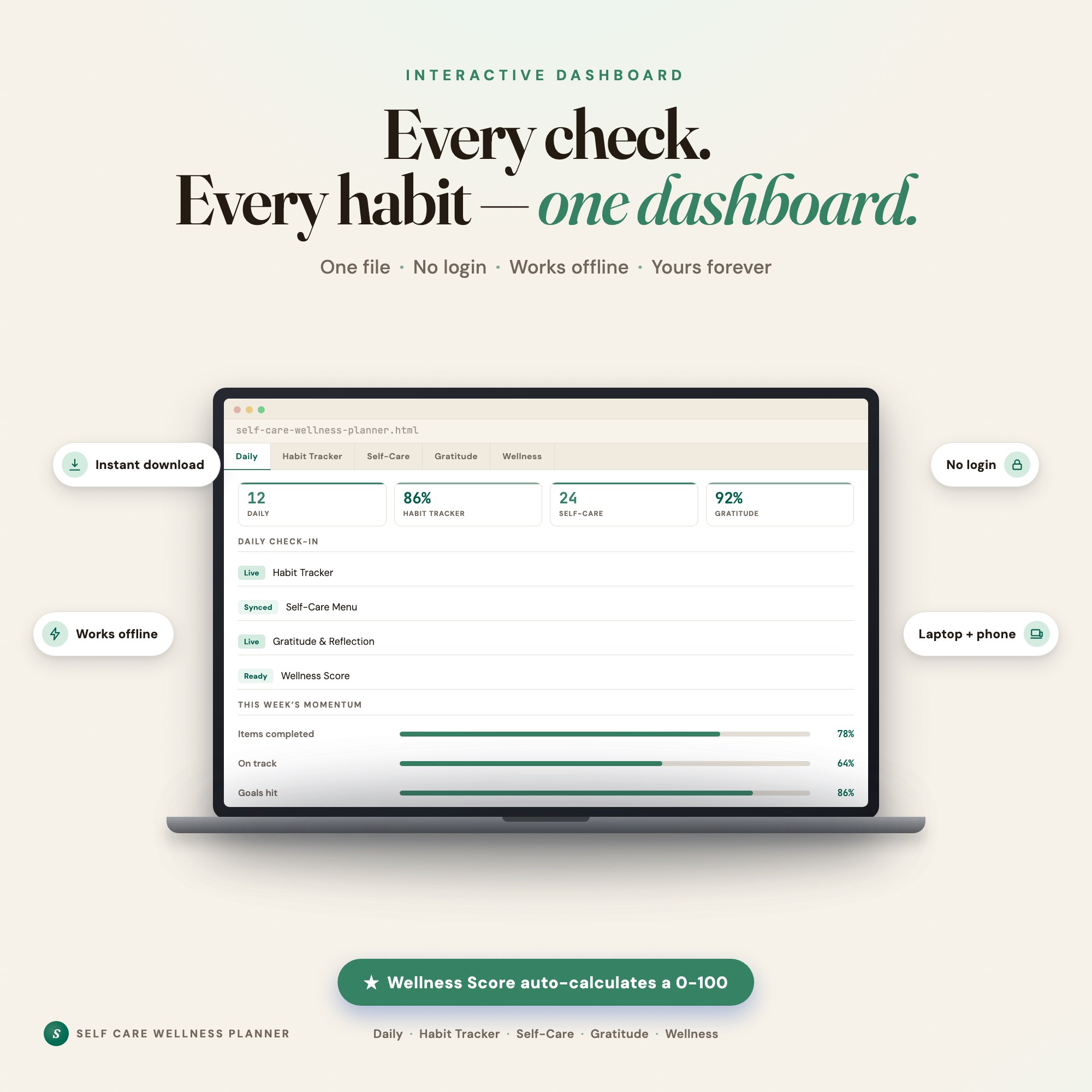
Five views, where the last one is the reason the other four get maintained:
- A daily check-in for mood, energy, and sleep in a couple of taps, with the week charting itself so patterns are visible without any effort from you
- A habit tracker with auto-counting streaks
- A self-care menu across the six areas, where ticking an action logs the date
- Gratitude and reflection, building a searchable running log
- A wellness score that computes a balance figure across all six areas from the week’s data — and names the single area you’ve neglected most, with one action to take
That last view is what the Self Care Wellness Planner is built around: a 0–100 balance score across rest, movement, connection, creativity, nourishment and boundaries, calculated from what you actually logged, that points at the neglected area rather than leaving you to spot it. It’s one browser file, no app and no subscription, and since the record is your mood and sleep history, it stays on your own device.
If you try again
Make the first two weeks as cheap as possible. Log less than you think you should — mood and energy alone is enough to produce a pattern.
The goal for the first fortnight isn’t a complete record. It’s surviving to the point where the data starts telling you something, because that’s where the habit stops requiring willpower and starts paying for itself.
Frequently asked questions
- Why do self-care planners stop getting used?
- Because logging costs effort every day and returns nothing on any single day. A blank template accepts your mood and your habits and hands back a page that looks exactly like yesterday's. Without visible feedback the habit has no reinforcement, so it decays quietly rather than being consciously quit.
- What should a self-care tracker actually show me?
- A pattern I could not see without it. Which day of the week my energy reliably drops, which habit correlates with better sleep, which area of my life I have quietly stopped attending to. Recording is the cost; the pattern is the payment.
- What are the six areas of self care worth tracking?
- Rest, movement, connection, creativity, nourishment, and boundaries. The specific list matters less than having more than one axis — people who track only exercise and sleep tend to be quietly starved in connection or creativity and have no instrument that would show it.
- Is a printable or an app better for self care tracking?
- Printables cannot compute, so they never show you a pattern. Apps compute but ask for an account, a subscription, and your mood data on someone else's server. The middle option is something that calculates locally and keeps the record on your own device.
- How long before patterns become visible?
- Usually two to three weeks of mostly-consistent logging — which is, unhelpfully, right around when most people quit. That timing is why the first fortnight has to be made as low-effort as possible; the reward is just past the point where the habit typically dies.
Ready-made dashboards
Skip setup — grab an interactive dashboard built for this exact workflow.
ListingResearchOS Shop
All dashboards — one-time purchase, yours forever
Single HTML files. No subscriptions. No login. Works offline in any browser.
Browse all dashboards →