
How Hairstylists Track Real Take-Home Pay: Booth Rent vs. Commission
Work out your true take-home as a booth renter or commission stylist — the costs that quietly eat your pay, and a faster way to track it.
Published June 4, 2026
Most stylists know their service prices by heart and have no idea what they actually keep. That gap is where the stress lives — you can be fully booked and still feel broke, because the number that matters is take-home, not revenue.
This walks through how to find your real number whether you rent a booth or work on commission, and which costs quietly drain it.
Revenue Is Not Income
A $120 color service is not $120 in your pocket. Before anything reaches you, it passes through:
- Product cost — the color, developer, toner, and backbar used on that client
- Card processing — roughly 2.6-3% if the client paid by card
- Your split or rent — either a commission percentage off the top, or a slice of your fixed monthly booth rent
- Taxes — nobody withholds them for you when you’re self-employed
By the time you account for those, that $120 service might net you $55-75. Multiply the leak across a full week and the difference between “busy” and “profitable” becomes obvious.
The Booth Rent Math
Booth rent is a fixed cost — say $900/month. It doesn’t care whether you did 20 clients or 80. That’s the trap and the opportunity:
- A slow month spreads $900 across few services, so your effective cost per client is brutal.
- A strong month spreads the same $900 across many services, and your take-home percentage climbs fast.
The number to watch is your monthly break-even: total fixed costs divided by your average net-per-service. Below it you’re paying to work; above it, every service is mostly yours. Booth renters who track this stop panicking in slow weeks and start booking with intention.
The Commission Math
Commission flips the structure. There’s no fixed rent, but the salon takes a percentage of everything — often 40-60%. The math is simpler per service but punishes growth: the more you produce, the more dollars leave in the split. A stylist clearing $8,000/month on a 50% split is handing over $4,000 — far more than a booth rent would have cost at that volume.
That’s why so many stylists eventually switch to booth rent: there’s a revenue level where fixed rent beats a percentage. Knowing your crossover point is the difference between guessing and deciding.
What to Track Every Week
You don’t need an accounting degree. You need five things captured consistently:
- Services and prices — what you did and charged
- Product cost per service — even a rough per-client estimate
- Retail sales — often your highest-margin income, and the most under-tracked
- Rent or split — your structure, applied automatically
- Tax set-aside — a percentage skimmed off net, every week, into a separate account
The habit beats the tool. But the right tool makes the habit effortless.
A Faster Way to See Your Number
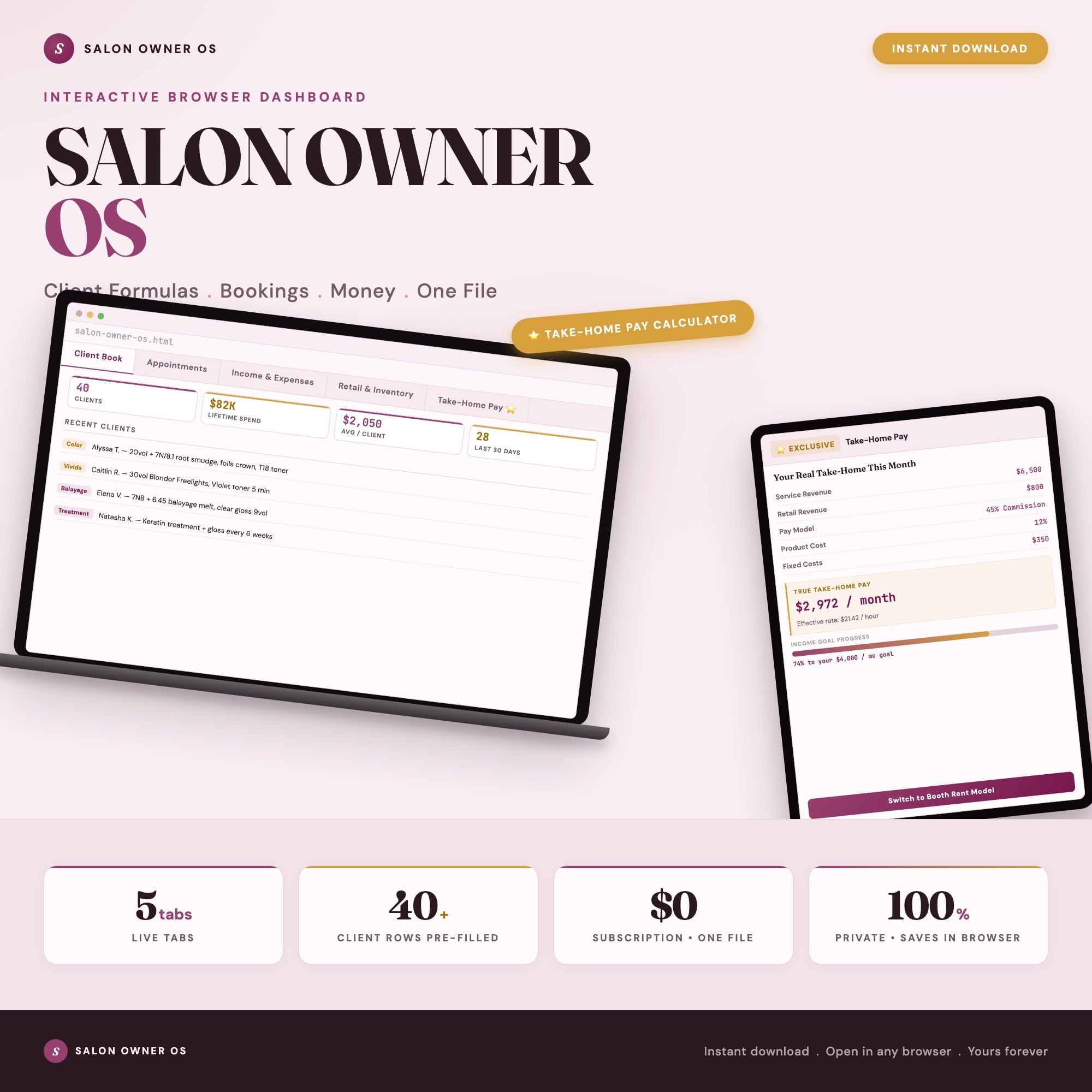
Salon Owner OS was built for exactly this. It’s an interactive dashboard that runs in your browser — no login, no subscription, no spreadsheet formulas to maintain. You enter your pay model (commission split % or flat booth rent), your monthly service and retail revenue, and your costs, and the Take-Home Pay Calculator returns what you actually keep, your effective hourly rate, and a recommended tax set-aside.
It also holds your client formula book and income log in the same file, so the record that drives the math lives next to the math. Your data stays on your device — nothing uploads anywhere.
For an independent stylist, booth renter, or solo nail and lash owner, it replaces the pile of notes-app formulas and half-finished spreadsheets with one file that just answers the question: what did I actually make?
See Salon Owner OS → — one-time $32, works offline, yours for life. Or browse the full shop.
The Takeaway
Track five things weekly, know your booth-vs-commission crossover, and set aside taxes before you spend. The stylists who keep the most aren’t always the busiest — they’re the ones who know their number.
Frequently asked questions
- Is booth rent or commission better for take-home pay?
- It depends on your monthly revenue. Booth rent is a fixed cost, so the more you earn the better it gets — high earners usually keep more on booth rent. Commission takes a percentage, so it scales with you and hurts more as you grow. The break-even point is the number you need to know, and it moves with your product and supply costs.
- What expenses do stylists forget when calculating take-home?
- Color and product cost per service, backbar supplies, card processing fees, booth rent or commission split, education, and the self-employment tax set-aside. Booth renters especially forget that nobody is withholding taxes for them.
- How much should a self-employed stylist set aside for taxes?
- A common starting point is 25-30% of net profit, but it depends on your bracket and state. The point is to set it aside per paycheck, not discover it in April.
Ready-made dashboards
Skip setup — grab an interactive dashboard built for this exact workflow.
ListingResearchOS Shop
All dashboards — one-time purchase, yours forever
Single HTML files. No subscriptions. No login. Works offline in any browser.
Browse all dashboards →