
Coaching Client Software: The Number That Predicts Renewal
Sessions delivered says nothing about whether a client will renew. Goal completion does — and most coaches have never measured it.
Published August 2, 2026
Ask a coach how a client is doing and you’ll usually hear something about sessions — how many they’ve had, how the last one went, whether they showed up.
Ask whether that client will renew, and the answer gets much less confident.
Those two questions have different answers because they’re measured by different things, and most coaching practices only track one of them.
Sessions delivered measures you, not them
Session count is an activity metric. It tells you what you did.
It’s easy to track, it’s what you invoice against, and it feels like progress because it accumulates. But a client can attend every session, on time, engaged, and be no closer to the thing they hired you for.
Goal completion is the outcome metric. It measures whether the coaching is producing the change the client is paying for. And it’s the one that predicts renewal, because renewal is a judgment the client makes about results, not about attendance.
What that gap looks like in practice
A client is eight sessions into a ten-session package. Attendance perfect, sessions feel good, rapport is strong.
Their goal milestones have barely moved.
That client is very unlikely to renew, and the renewal conversation is two sessions away. If you’re tracking goal progress, you saw this weeks ago and had time to change the approach, name it directly, or reset the goal to something achievable.
If you’re tracking sessions, everything looked fine right up until the client said they’d like to take a break, and it arrived as a surprise.
The information existed. Nothing was recording it.
Why the tools fragment
Almost every 1:1 coaching practice ends up with three systems:
- Session notes in a document or notes app, one per client, chronological
- Goals in whatever was used during onboarding — a worksheet, a doc, a worksheet in the client’s possession
- Packages and payment in an invoicing tool, tracking money and nothing else
Each is fine. The problem is that they don’t reference each other, so the question “has this client made progress since session three” requires opening two of them and holding the answer in your head.
Nobody does that routinely for every client. So it gets done for the client you’re worried about, which is to say after the concern rather than before it.
Track the client’s milestones, not your metrics
One caution about measurement in coaching: it goes wrong when the coach imposes metrics the client didn’t choose.
Progress tracked against milestones the client defined does something different. Reflected back in a session, it reads as encouragement — here’s what you’ve moved since we started. It also gives a session structure when the client arrives without an agenda, which is otherwise where an hour can quietly circle.
The awkwardness people associate with tracking usually comes from measuring the wrong things, not from measuring.
What connected looks like
Five views where the last one only works because the first four connect:
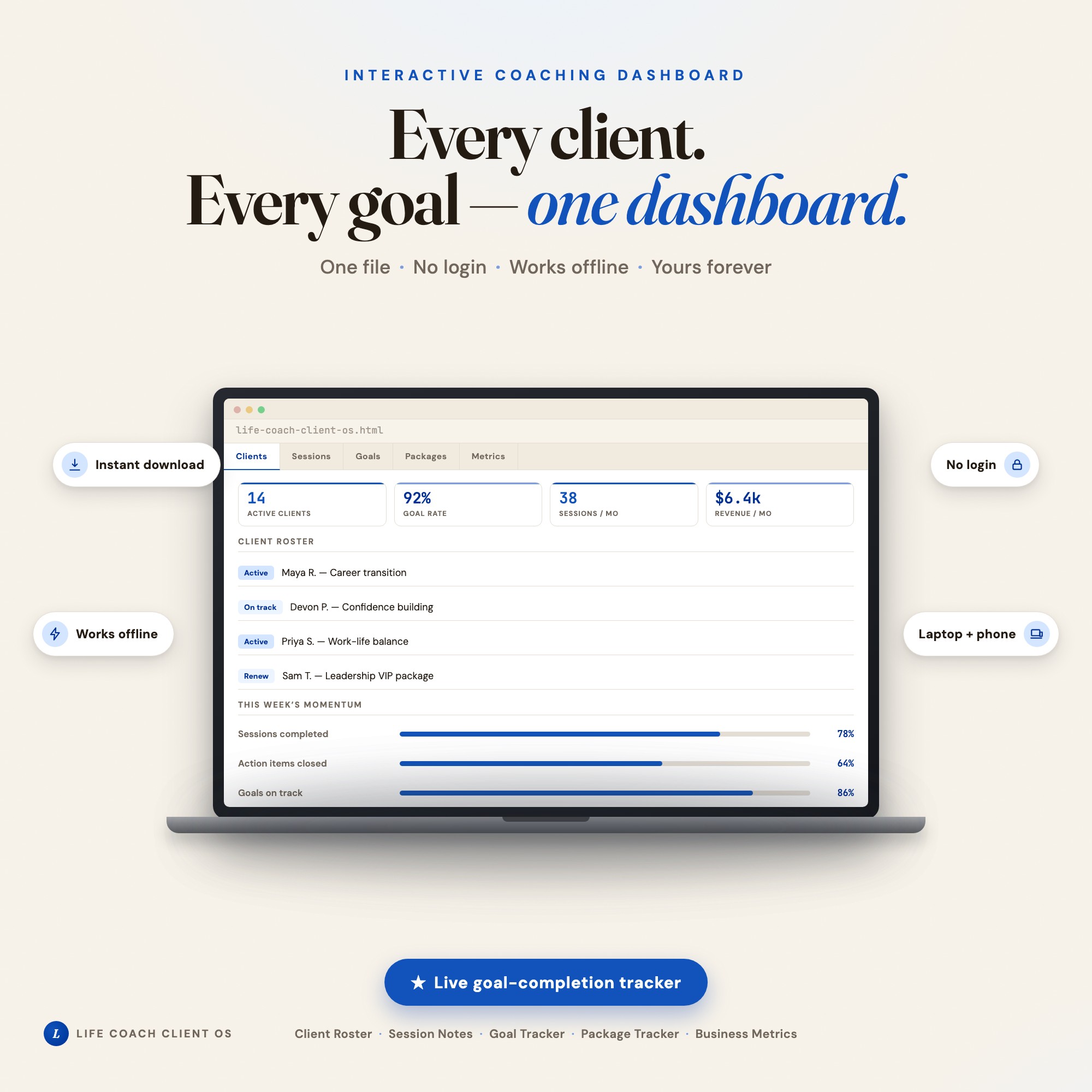
- A client roster with status, session count and notes
- Session notes, date-stamped per client, with next-step checklists so commitments carry between sessions
- A goal tracker with per-client goal cards, milestone checkboxes and live progress bars
- A package tracker — 1:1, group, VIP — with payment status and sessions remaining
- Business metrics: revenue, goal completion rate across the practice, sessions per client
That per-client live goal-completion tracking is what the Life Coach Client Management Dashboard is built around — progress percentages that update as milestones get checked, sitting alongside the session notes and package tracking rather than in a separate file. One browser file, no login, no subscription, and since it holds session notes about people’s personal lives, the record stays on your own device.
The review worth doing
Once a month, look at goal completion across your whole roster, not client by client.
The clients near the bottom are your renewal risk, and it’s usually not the ones you’d guess — a warm, enjoyable coaching relationship can sit at the bottom of that list, which is exactly why the number is worth having rather than trusting your read of the room.
Frequently asked questions
- What should coaching client software actually track?
- Four connected things: the client roster with status, date-stamped session notes with next steps, per-client goal progress, and package payment with sessions remaining. The connection is the point — session notes that do not link to goal progress cannot tell you whether the coaching is working.
- Why is goal completion a better metric than sessions delivered?
- Because sessions delivered measures your activity and goal completion measures the client's outcome. A client eight sessions into a ten-session package with almost no goal movement is unlikely to renew, and that is visible weeks before the renewal conversation if you are tracking it.
- How do I track client progress without it feeling clinical?
- Track milestones the client defined, not metrics you imposed. Progress against their own stated goal reads as encouragement when you reflect it back, and it gives structure to a session that might otherwise circle. The awkwardness comes from measuring the wrong things.
- Do I need dedicated coaching software or will notes and a spreadsheet do?
- It depends on caseload and whether the pieces connect. Dedicated platforms are excellent and priced for practices with steady client volume. For a small 1:1 practice the requirement is that goals, sessions and packages live in one place — the format matters less than whether you will keep it current.
- How many sessions before I know coaching is working?
- Rather than guessing at a session count, watch whether milestone completion is moving at all by roughly the midpoint of a package. Movement that has stalled by then is a signal to change the approach while there is still package left to change it in.
Ready-made dashboards
Skip setup — grab an interactive dashboard built for this exact workflow.
ListingResearchOS Shop
All dashboards — one-time purchase, yours forever
Single HTML files. No subscriptions. No login. Works offline in any browser.
Browse all dashboards →