
Christmas Gift Budget Template: Why the Per-Person Math Always Breaks
Every gift budget template holds until you overspend on one person. Here is how to rebalance the rest, and the two deadlines that decide December.
Published August 2, 2026
Almost every Christmas gift budget follows the same arc.
October: you pick a total. It feels responsible. You divide it roughly across the people on your list, maybe in a spreadsheet, maybe in a notes app.
Late November: you find something genuinely perfect for one person. It’s over their share. You buy it anyway — correctly, it’s a good gift — and you tell yourself you’ll make it up somewhere.
January: the credit card statement tells you where you made it up. Nowhere.
The failure is arithmetic, not discipline
That overspend was not the mistake. The mistake is what didn’t happen after it.
When one person goes over, staying inside the total requires every other person’s remaining allowance to shrink. That’s not optional — it’s what “total budget” means. But performing it means recalculating a dozen numbers, so in practice it gets replaced by a vague intention to be careful.
And a vague intention doesn’t tell you the thing you actually need to know: which specific person now has to be cut, and by how much.
This is the structural weakness in every gift budget template. Google Sheets, Excel, printable — they all record what you spent and show a remaining total. The per-person remainder after a rebalance is a number the template makes you compute by hand, every single time, which means after the second or third overspend nobody does.
Tiers, not per-person numbers
The fix starts before the shopping.
Assigning each of eighteen people their own budget figure is a task that looks organised and collapses immediately, because it’s eighteen decisions made with no information and no ability to absorb a change.
Tiers work better. Two or three groups — immediate family, then extended family and close friends, then teachers, coworkers, neighbours. Each tier carries a weight. The total divides across them. Individuals who genuinely need a ceiling get a hard cap.
Now an overspend has somewhere to propagate to. Instead of eighteen separate budgets breaking independently, you have a structure that can redistribute — and the question “who has to be cut” has an answer instead of a shrug.
The two deadlines nobody budgets for
Spend pace against days remaining. Not just “how much is left” but whether you’re spending fast enough to finish and slow enough to fit. Finishing your list on the 22nd is not a success if the last four gifts cost double because you were out of time.
Last safe shipping date, per recipient. This one is genuinely per-person, because destinations differ. Cross-country parcels, international, and local pickup have completely different cutoffs. The costly version of this mistake is discovering the cutoff a day after it passed and paying for expedited shipping — a cost that appears in no gift budget anywhere.
And the small stuff: wrapping, cards, postage. Reliably underestimated, and they scale with headcount, so the households with the longest lists get hit hardest.
What a working version does
Five things, connected:
- A total budget, with committed, still unspent, people with nothing bought yet, and days remaining live on one screen
- Recipients grouped by relationship and priority tier, with optional hard caps
- A gift ledger with estimated versus actual cost and status — idea, bought, wrapped, shipped, delivered
- Automatic rebalancing: log an overspend and every other person’s remaining allowance recomputes, naming who gets cut and by how much
- Spend pace and per-recipient last safe shipping date
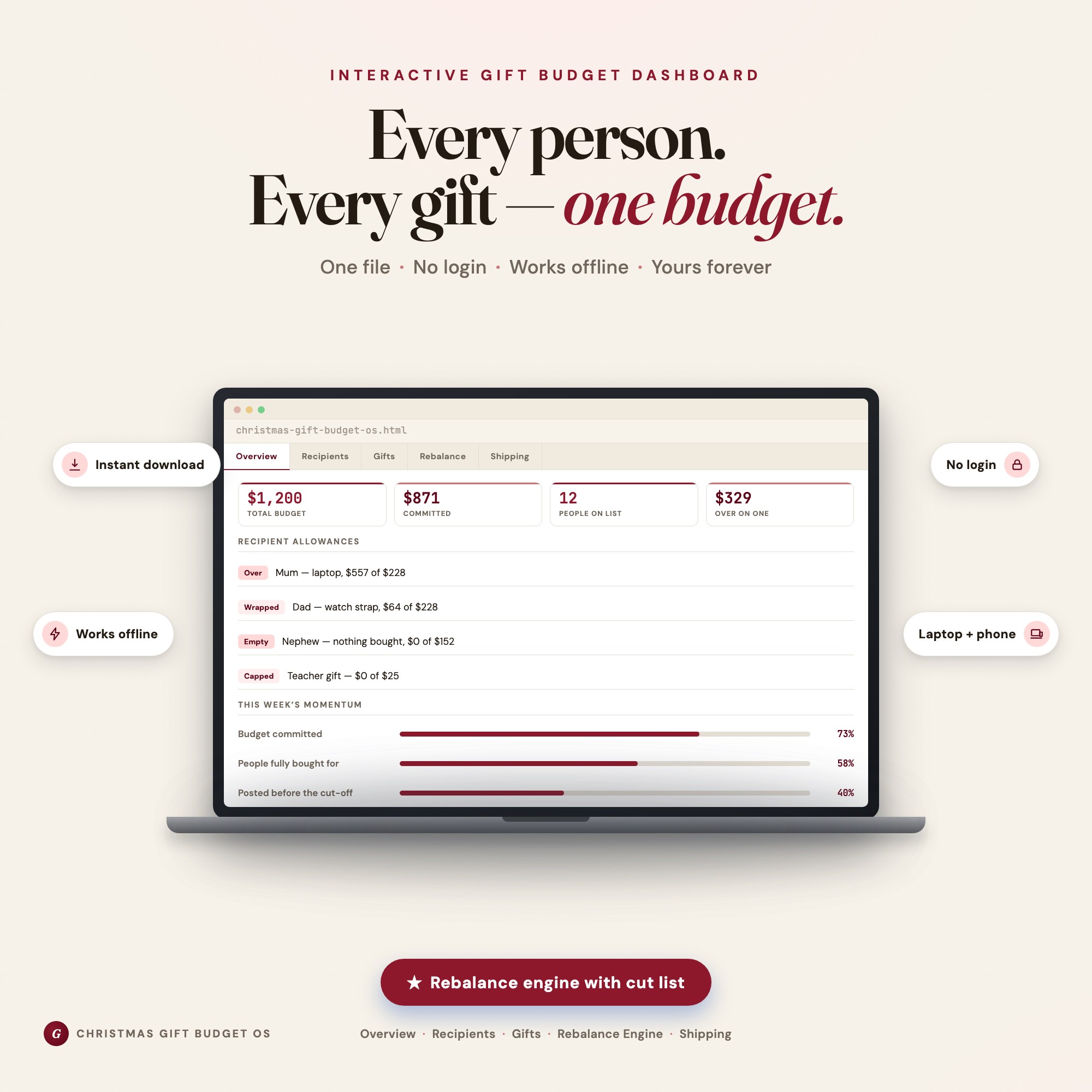
That rebalancing engine is the whole point of the Christmas Gift Budget Dashboard — it allocates the total across recipients by tier weight, and the moment a gift goes over someone’s allowance it recomputes everyone else’s and tells you exactly who has to absorb it. It also tracks spend pace against days remaining and each recipient’s shipping cutoff. One browser file, no login, no subscription.
Do this in August, not November
The reason to set this up now is that the budget failure is almost always a timing failure wearing a spending costume.
Gifts bought early are cheaper, because you bought them because they were right rather than because time ran out. Shipping bought early is cheaper. And a list built in August has four months of absorbing changes before it has to survive December.
Frequently asked questions
- How do I split a Christmas budget across people?
- Group recipients into two or three priority tiers rather than assigning each person a number by hand. Give each tier a weight, let the total divide across them, then adjust individuals who need a hard cap. Tiers survive contact with reality; a hand-built per-person list does not.
- What happens when I overspend on one person?
- Every other person's remaining allowance has to shrink, or the total breaks. That is the recalculation nobody does, because in a spreadsheet it means editing a dozen cells. Skipping it is precisely how a budget that looked fine in November becomes a January credit card surprise.
- When should I start Christmas shopping to stay on budget?
- Earlier than feels necessary, because the budget failure is usually a timing failure. Gifts bought under deadline pressure cost more, and shipping upgrades bought in the last week can add a meaningful amount that no gift budget accounts for.
- What is a last safe shipping date and why track it per person?
- It is the latest day you can order something and still have it arrive in time for that recipient. It differs per person because destinations and carriers differ — a cross-country parcel and a local pickup have very different cutoffs, and the expensive mistake is discovering that on the wrong side of it.
- Should I include wrapping, cards, and postage in the gift budget?
- Yes. They are reliably underestimated and they scale with the number of recipients, which means they hit hardest in exactly the households running the biggest lists. Left out, they arrive as an overspend nobody budgeted for.
Ready-made dashboards
Skip setup — grab an interactive dashboard built for this exact workflow.
ListingResearchOS Shop
All dashboards — one-time purchase, yours forever
Single HTML files. No subscriptions. No login. Works offline in any browser.
Browse all dashboards →