
Book Launch Checklist: The ARC Number That Decides Launch Day
Most launch checklists count tasks. The metric that moves launch day is how many ARC readers who committed actually posted a review.
Published August 2, 2026
Open any book launch checklist and you’ll find thirty tasks. Cover reveal. Newsletter swaps. Preorder link. Goodreads listing. Launch-day post. Street team.
Work the list honestly and you can complete every item and still have a launch that goes nowhere. Because a checklist measures whether you did things, and launch day is decided by a number that appears on no checklist.
The number: committed-to-posted conversion
You recruit fifty advance readers. Forty-two say yes and receive the file.
On launch day, how many reviews are actually live?
That number — posted divided by committed — is the one that matters, and it’s almost always dramatically lower than authors expect. Fifty ARC readers at 20% conversion is ten reviews, not fifty. And ten reviews and fifty reviews are completely different launches, because a browsing reader deciding whether to buy an unknown author’s book is looking at exactly that.
Reviews aren’t really a ranking input. They’re a conversion input. They change the share of people who click through and then purchase, and that’s what produces sales velocity in the concentrated window that does drive rank.
So conversion is the metric. Not ARC readers recruited, which is the vanity version of it.
Work backward, don’t pick round numbers
“I’ll get 50 ARC readers” is a goal chosen because it’s round.
The useful version starts at the other end. How many reviews do you want live on launch day? What share of your committed readers realistically post? Divide.
Thirty reviews at 50% conversion means sixty committed readers — and getting sixty commitments means approaching substantially more than sixty people, because not everyone you ask says yes.
That arithmetic changes your recruiting timeline before you’ve sent a single file, which is exactly when you want to know it.
The nudge recovers more than you’d think
Most ARC readers who don’t post aren’t refusing. They read the book, meant to review it, and the intention decayed the way intentions do.
One polite, specific reminder — with a direct link to where the review goes, not a general “reviews help authors!” — recovers a meaningful share of them.
Which means your ARC tracking needs a nudged state, separate from committed and posted. Without it you can’t tell the difference between a reader who was asked once and forgot, and one who was asked twice and declined. Those need different treatment, and lumping them together means you either over-chase people who’ve opted out or never follow up with the ones who’d say yes.
Eight weeks, because of other people
The reason launch planning starts around eight weeks out isn’t that thirty tasks take eight weeks. Most of them take an afternoon.
It’s that the long-lead items depend on other people’s schedules:
- ARC readers need weeks to actually read a book. You can’t compress this.
- Promo sites book out in advance, sometimes well in advance for good slots.
- Newsletter swaps need coordination with authors who have their own calendars.
Everything you control can be done late. Everything that depends on someone else cannot, and those are the items that decide whether launch week has anything happening in it.
What to actually run a launch on
- A countdown timeline with tasks placed on real dates from T-8 weeks through post-launch, each with status and channel
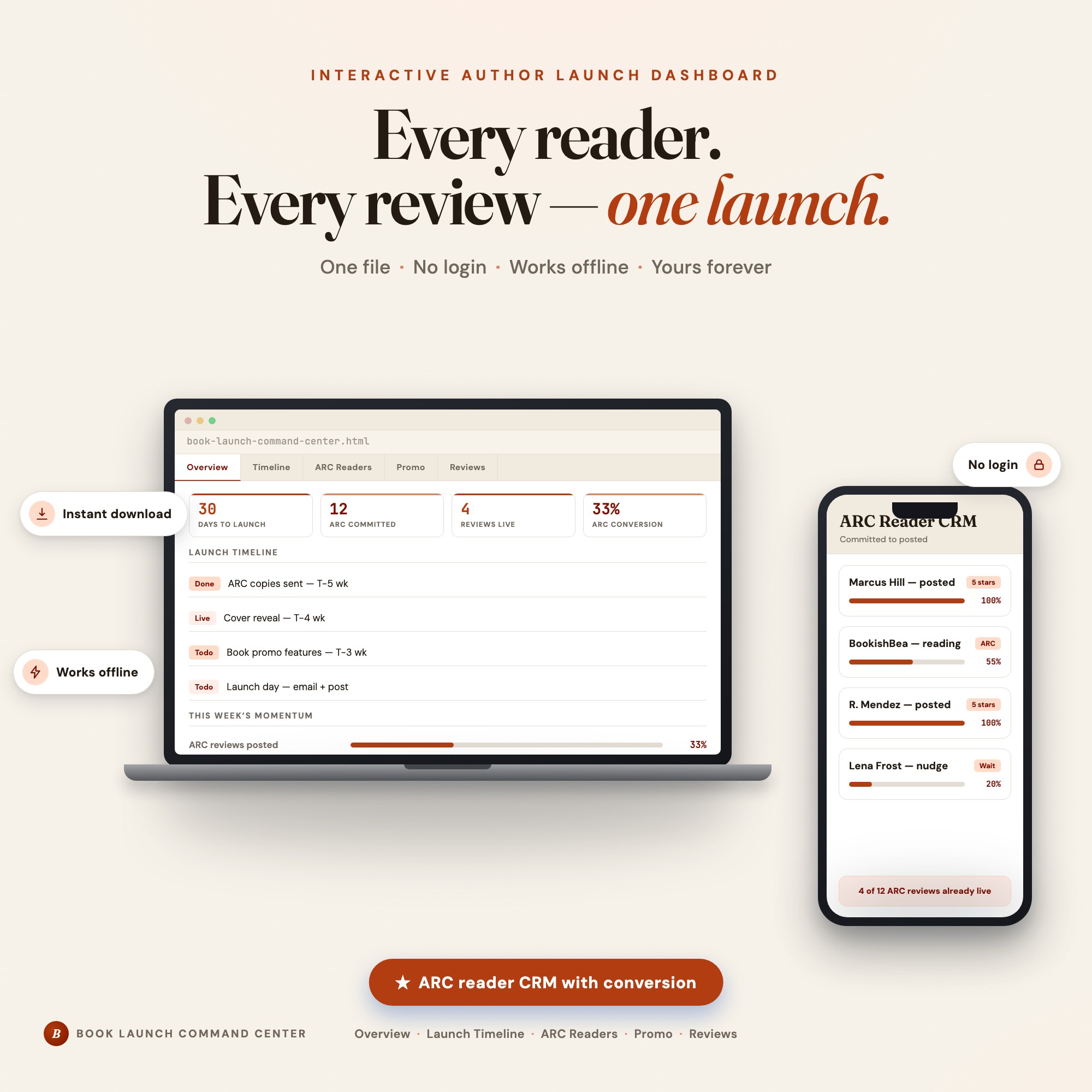
- An ARC reader CRM — per reader: source, format sent, sent date, committed, nudged, review status, stars
- A live committed-to-posted conversion rollup
- Promo bookings in one table with dates and cost
- A readiness view that tells you where you stand rather than requiring you to infer it
That ARC CRM with a conversion rollup is what the Book Launch Command Center is built around — per-reader pipeline through source, format, committed, nudged and posted, with the conversion percentage calculated live so the number that decides launch day is visible while you can still act on it. The timeline tab is a T-minus war room pre-seeded with tasks from eight weeks out. One browser file, no login, no subscription.
If you do one thing eight weeks out
Write down the number of reviews you want live on launch day. Then work backward through your conversion rate to how many readers you need to approach.
That single calculation is the difference between recruiting a number that felt right and recruiting a number that produces the launch you’re planning for.
Frequently asked questions
- What is ARC conversion and why does it matter?
- It is the share of advance readers who committed to reviewing and actually posted one. It matters because reviews present on launch day are what a browsing reader sees, and a list of fifty ARC readers converting at twenty percent produces ten reviews, not fifty. The gap between those numbers is where most launches quietly fail.
- How many ARC readers should I recruit?
- Work backward from the reviews you want on launch day and your realistic conversion rate rather than picking a round number. If you want thirty reviews and half your committed readers post, you need sixty committed — and you will need to approach considerably more than sixty to get sixty commitments.
- When should a book launch checklist start?
- Roughly eight weeks out, because the long-lead items are the ones that cannot be compressed. ARC readers need weeks to actually read the book, and promo sites are frequently booked out well in advance. Tasks you can do in a day can wait; tasks that depend on other people cannot.
- Should I nudge ARC readers who have not posted?
- Yes, once, politely, with a direct link to where the review goes. Most non-posting readers are not refusing — they finished the book, meant to review it, and lost the thread. A single specific reminder recovers a meaningful share, which is why tracking who has been nudged matters as much as tracking who committed.
- What actually moves launch-day rank?
- Sales velocity in a concentrated window, supported by reviews that make a browsing reader willing to buy. Reviews are not a direct ranking input so much as a conversion input — they change the percentage of people who click and then purchase, which is what produces the velocity.
Ready-made dashboards
Skip setup — grab an interactive dashboard built for this exact workflow.
ListingResearchOS Shop
All dashboards — one-time purchase, yours forever
Single HTML files. No subscriptions. No login. Works offline in any browser.
Browse all dashboards →