
Promotion Tracker: Notion vs. Spreadsheet vs. Dedicated Dashboard
Honest comparison of Notion, Google Sheets, Lattice, and an offline Career Growth Dashboard for tracking your path to promotion — cost, privacy, and fit.
Published June 3, 2026
Our verdict
For professionals targeting a promotion in the next 6-12 months, the Career Growth Dashboard wins on total cost and workflow fit. Notion works if you need team collaboration. Google Sheets is fine for lightweight tracking but breaks down when you need a promotion narrative. Lattice and 15Five are employer-side tools — not for individual use.
The promotion tracker you pick shapes how review season goes for you this year. The wrong tool means your wins are scattered, your narrative is improvised, and your manager has to advocate for you without the evidence to do it. Here is an honest breakdown of every real option.
The Core Comparison
| Notion | Google Sheets | Lattice / 15Five | Career Growth Dashboard | |
|---|---|---|---|---|
| Cost | $10–20/mo | Free (Google account) | Employer-paid | $25 one-time |
| Offline | Partial | No | No | Fully offline |
| Data privacy | Cloud | Cloud | Employer-visible | Browser only |
| Built for promotion | No | No | Partial | Yes |
| Setup time | Hours | 30–60 min | N/A | Under 5 min |
| Promotion narrative output | Manual | Manual | None | Auto-generated |
Notion: Flexible but Labor-Intensive
Notion is genuinely powerful. If you want to build a custom career tracker from scratch, you can do it there. The problem is that “from scratch” is the key phrase. You’ll spend a weekend designing the schema, then another hour every month maintaining it. Most professionals who start a Notion career tracker abandon it before review season because the maintenance overhead outweighs the benefit.
Notion also costs $10–$20/month depending on your plan, stores everything on Notion’s servers, and requires an internet connection to work. For sensitive career data — including manager feedback, salary targets, and performance concerns — some professionals are uncomfortable with that arrangement.
Choose Notion if: You already have a paid Notion workspace, you enjoy building systems, and you have time to maintain custom databases.
Google Sheets: Lightweight, But No Output Layer
Google Sheets is the default choice because it’s free and familiar. You can build a wins log, a skills tracker, and a 1:1 notes column without paying a dollar. For the first few months of tracking, it works.
Where it falls apart is review season. Google Sheets can hold your data but can’t turn it into anything. Writing your self-review still requires you to read every row, draft a narrative from scratch, and hope you didn’t forget a key win. That’s the gap most professionals don’t notice until they’re sitting down to write their review at 11pm the night before it’s due.
Choose Google Sheets if: You only have a few things to track, you’re not targeting a promotion in the near term, and you’re comfortable doing the narrative work manually.
Lattice and 15Five: Not For You, For Your Employer
Lattice and 15Five are performance management platforms sold to companies, not individuals. Your employer pays for them and controls what they measure. When you leave the company, your data stays with them. These tools are designed to help managers and HR track performance across teams — not to help you build a personal promotion case.
If your company uses one of these platforms, use it for the structured reviews it requires. But don’t rely on it as your personal promotion tracker. It measures what the company cares about, not what you need to prove to advance.
Career Growth Dashboard: Built for This Specific Problem
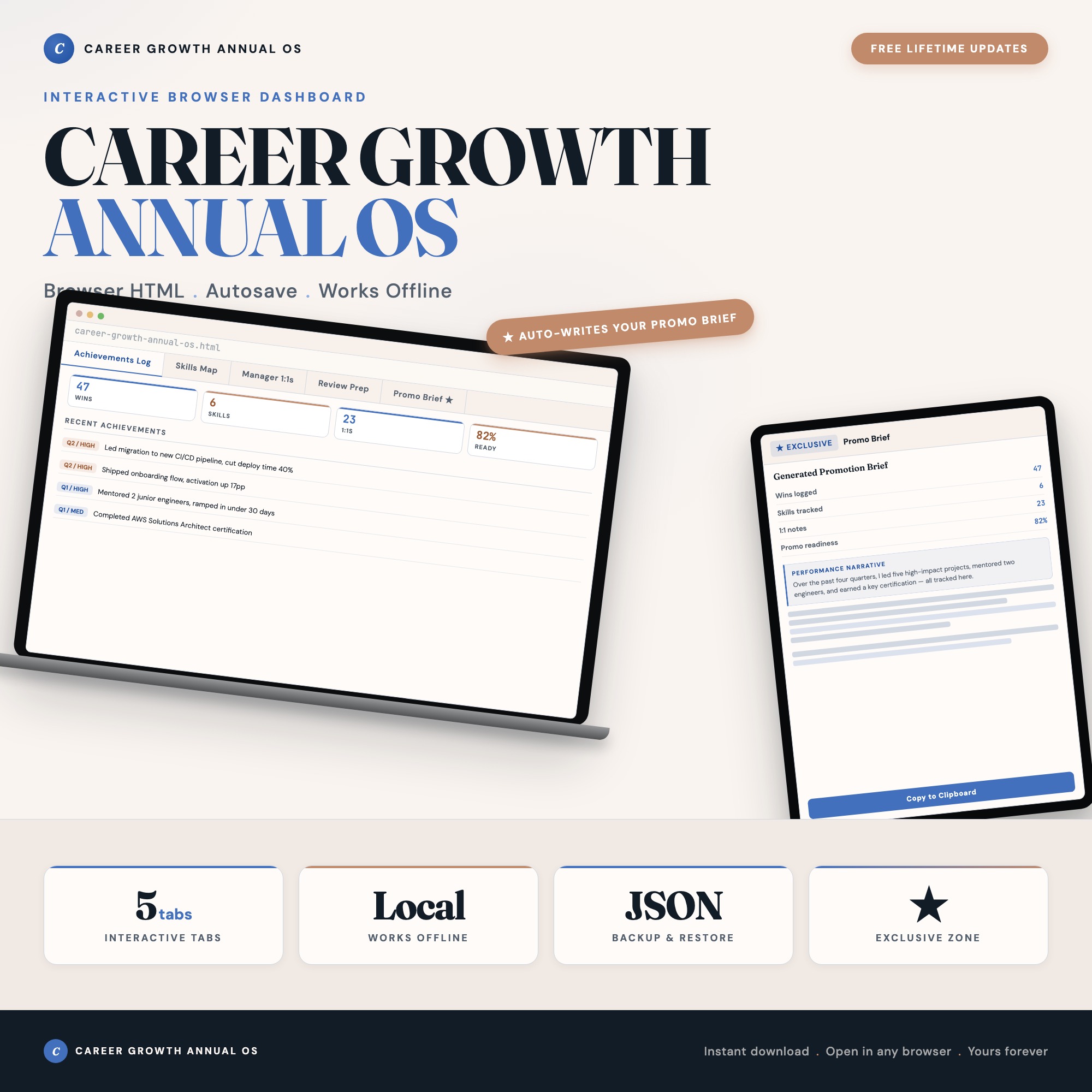
The Career Growth Dashboard is a single HTML file built for the promotion-targeting workflow. It has five tabs that work together: an Achievements Log where you record wins as they happen, a Skills Map that tracks your current vs. target skill level per quarter, a Manager 1:1s log that captures feedback and open action items, a Review Prep board that aggregates your strongest quarters, and the Promotion Brief tab.
The Promotion Brief tab is the feature no other option ships. It reads your wins, skills data, and manager feedback from the other four tabs and assembles a formatted 1-page performance narrative on demand. That’s the output that actually matters in review season: a structured case for your promotion, built from your own data, not something you have to draft from scratch the night before.
At $25 one-time, it costs less than two months of Notion. Everything stays in your browser — no cloud account, no IT approval needed to use it on your work laptop.
Choose the Career Growth Dashboard if: You’re targeting a promotion in the next 6–12 months and you want a system that produces a promotion narrative, not just a place to store notes.
The Honest Verdict
If you need team visibility or cloud sync, Notion is the only real option. For individual promotion tracking with a real output layer, the Career Growth Dashboard is the purpose-built choice. Google Sheets is fine for lightweight logging. Lattice and 15Five are employer tools, not personal ones.
The question is whether you want to store data or whether you want a promotion case. Those are different things, and most tools only do the first.
Frequently asked questions
- What makes a promotion tracker different from a regular goal tracker?
- A promotion tracker needs to capture wins, skills gaps, manager feedback, and produce a performance narrative for review season. Generic goal trackers don't have that output layer. The Career Growth Dashboard's Promotion Brief tab turns your logged data into a formatted 1-page narrative automatically.
- Is Notion good for tracking career growth?
- Notion can work, but you'll spend significant time building the structure before doing any actual tracking. It's a blank canvas, not a purpose-built promotion system. Most professionals abandon their Notion career tracker after a few weeks because maintenance outweighs the benefit.
- Can I use the Career Growth Dashboard without internet?
- Yes — it runs entirely in your browser using localStorage. After the initial download, no internet connection is required. It works on your work laptop without any IT approval or cloud sync.
- How does Lattice or 15Five compare to an individual promotion tracker?
- Lattice and 15Five are employer-administered performance platforms — your manager and HR control them, and your access ends when you leave the company. They track what your company wants to measure. The Career Growth Dashboard tracks what you need for your promotion case.
- How much does the Career Growth Dashboard cost?
- One-time purchase of $25 on Etsy. No monthly fee, no renewal. You own the file permanently.
The winner: interactive dashboards
No spreadsheet. No subscription. One HTML file that runs offline in your browser.
ListingResearchOS Shop
Stop comparing — start using
Interactive dashboards. One-time purchase. No subscriptions. Works offline.
Browse all dashboards →