
Estate Executor Checklist: Spreadsheet vs. Software vs. Offline Dashboard
Comparing estate executor tools: free spreadsheet checklists, EstateExec software, and an offline dashboard that calculates state probate deadlines.
Published June 3, 2026
Our verdict
For adults recently named executor of a parent's or spouse's estate, the Estate Executor OS at $29 one-time provides asset inventory, account closure tracking, family update logs, distributions ledger, and the only interactive Probate Deadline Auto-Calculator on the market — statutory deadlines computed from date of death and state, not guessed.
Being named executor is rarely something people plan for. You are often grieving at the same time you are trying to understand what the role legally requires. Here is an honest breakdown of the tools available and what actually matters during the first six months of estate administration.
The Spreadsheet Reality
Most new executors start with a Google Sheet or Excel template downloaded from a law firm’s website. These are better than nothing: they provide a structure for listing assets, noting account closure status, and checking off tasks.
What free spreadsheets cannot do: calculate the statutory deadlines that vary by state and date of death, track which beneficiaries have been updated and when, log signed distributions with receipt capture, or flag the creditor claim window before it closes. Those deadlines differ by state and by which date they run from — the inventory alone is due 90 days after qualifying in Texas, 60 days after letters in Florida and four months after letters in California — and executors usually learn that only after one has passed.
EstateExec: The Most Complete Software Option
EstateExec is purpose-built for executors. It guides you through the asset inventory process, tracks account closure tasks, calculates estate value for tax purposes, and generates reports for beneficiaries and the probate court. For complex, high-value estates — particularly those over $1M or with business interests — the guidance is genuinely useful.
The cost structure: free for estates under $1M, then a fee (typically $200-$600) based on estate size. That sliding fee makes sense for large estates but feels disproportionate for a $400K estate where you primarily need deadline tracking and document organization.
EstateExec stores your data on their servers. For the most sensitive financial and legal data you will ever handle, that is worth considering.
Trust and Will: Focused on Planning, Not Administration
Trust and Will is primarily an estate planning platform — creating wills, trusts, and advance directives. It has some executor support resources, but it is not built for the operational work of estate administration. The planning and administration phases are different jobs requiring different tools.
The Offline Option: Estate Executor OS
The Estate Executor OS is a browser-native dashboard built for the first 6-12 months of estate administration. Five tabs, $29 one-time, everything stored on your device.
Asset Inventory: Log every account, property, vehicle, insurance policy, and digital asset in one place. Up to 60 rows with full notes.
Account Closure: A pipeline for tracking cancel, transfer, and closed status across every bank, credit card, utility, and subscription. The tab that prevents accounts from falling through the cracks for months.
Family Updates: Log what you told which beneficiary and when. No more sibling phone calls asking why they were not informed. A timestamped record of every family communication.
Distributions Ledger: Calculate each beneficiary’s share, log payment date, and capture signed receipt confirmation. A clean paper trail for the final accounting.
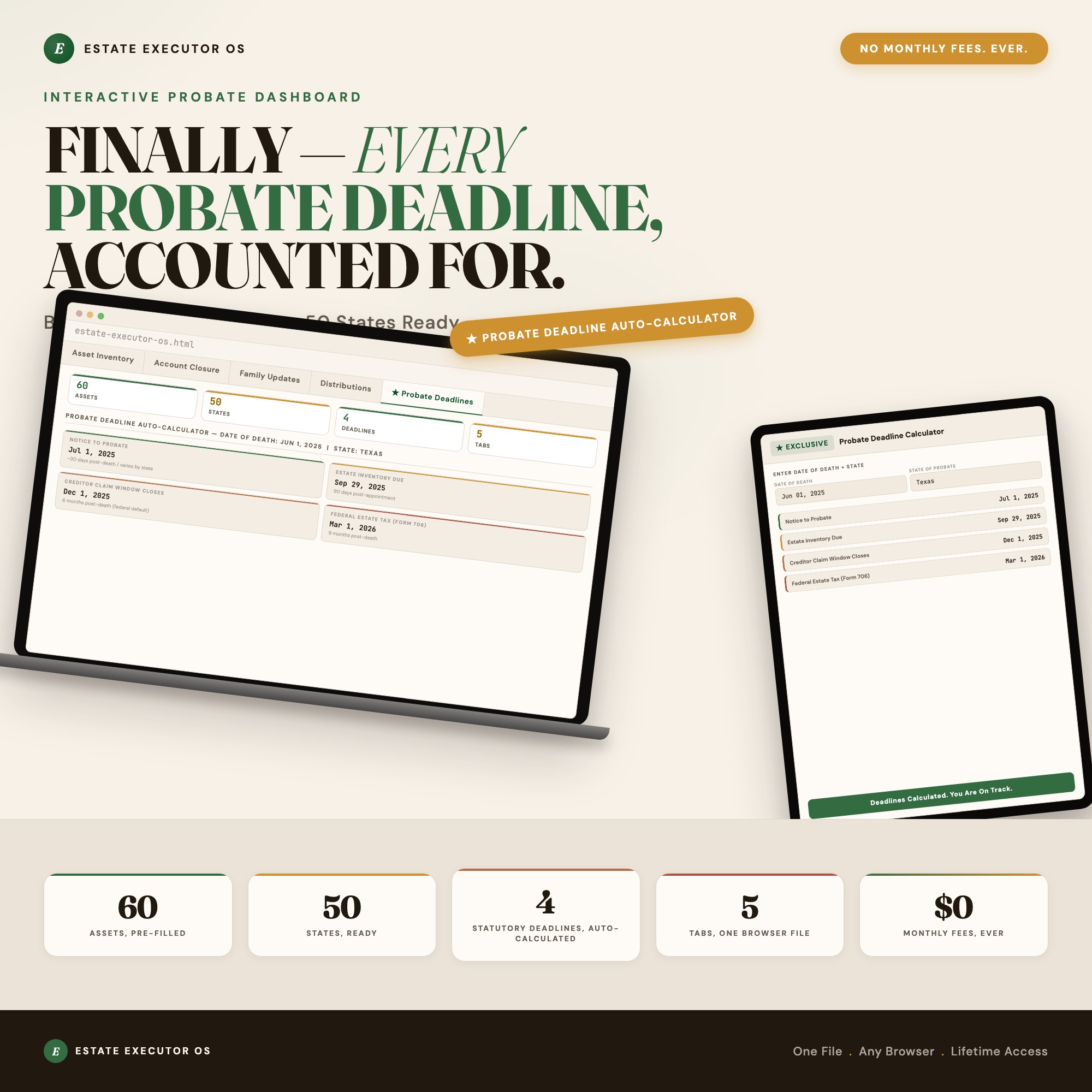
Probate Deadline Calculator: Enter the date of death, the date letters issued and your state. For Texas, Florida and California the dashboard returns every statutory deadline we have read from the statute, dated and cited; for other states it lists what to ask the court clerk. Every alternative we found is a static checklist. This tab exists because missing a probate deadline is the executor mistake with the most serious consequences.
The Beneficiary Communication Problem
One aspect of estate administration that no tool handles well is the communication record with beneficiaries. Most executors manage this through email and text messages — fragmented, unsearchable, and unavailable when a beneficiary calls claiming they were never notified of a decision.
The Family Updates tab in the Estate Executor OS logs every communication: which beneficiary was contacted, what was communicated, and when. If a beneficiary later disputes that they were informed about the asset distribution timeline, you have a timestamped record of every touchpoint. For executors managing complex family dynamics — multiple beneficiaries, second marriages, estranged relatives — this documentation layer is the difference between a clean close and a dispute.
Tool Comparison
| Free Spreadsheet | EstateExec | Trust and Will | Estate Executor OS | |
|---|---|---|---|---|
| Asset inventory | Manual | Yes | No | Yes (60-row structured) |
| Probate deadline calculator | No | Partial | No | Yes (state + date-of-death) |
| Account closure pipeline | No | Yes | No | Yes |
| Family update log | No | Limited | No | Yes (timestamped) |
| Distributions ledger | Manual | Yes | No | Yes (with receipt capture) |
| Cost | Free | Free-$600 | $159-$249/yr | $29 one-time |
| Data on your device | Partial (Google) | No | No | Yes (localStorage) |
For executors who need deadline clarity more than anything else, the Estate Executor OS gives you the statutory timeline automatically from the two numbers you already know: date of death and state of probate. Available at ListingResearchOS on Etsy.
Frequently asked questions
- What does EstateExec cost?
- EstateExec charges based on the estate size: free for estates under $1M, then a percentage fee for larger estates (typically $200-$600 for a mid-size estate). It also has a $59.99/year professional subscription for estate attorneys.
- What are the critical probate deadlines most executors miss?
- The inventory and the creditor notices come first, and both vary by state. The inventory is due 90 days after the executor qualifies in Texas (Estates Code §309.051), 60 days after letters in Florida (Fla. Prob. R. 5.340) and four months after letters in California (Prob. Code §8800(b)). Texas also requires newspaper notice to creditors within one month after letters (Estates Code §308.051). The full list for each state is on the probate timeline pages.
- Do I need probate software or can I use a spreadsheet?
- A spreadsheet works for asset inventory and basic tracking. It cannot auto-calculate state-specific probate deadlines, does not prompt the creditor claim window close, and has no structured account closure pipeline. Executors who miss deadlines usually had no automated reminder system.
- What does the Probate Deadline Auto-Calculator do?
- Enter the date of death, the date letters issued and your state. For Texas, Florida and California, the Estate Executor OS lists every statutory deadline we have read from the statute, dated and cited. For other states it lists exactly what to ask the court clerk, instead of guessing.
- Is estate executor data sensitive to store in the cloud?
- Estate data is among the most sensitive financial and personal information you will ever handle: account numbers, beneficiary details, legal documents, asset values. The Estate Executor OS stores everything in your browser's localStorage. Nothing reaches any external server.
The winner: interactive dashboards
No spreadsheet. No subscription. One HTML file that runs offline in your browser.
ListingResearchOS Shop
Stop comparing — start using
Interactive dashboards. One-time purchase. No subscriptions. Works offline.
Browse all dashboards →