
9 Things to Do in Your First Week at a New Job (That Most People Skip)
9 high-leverage actions for your first week at a new job, including a stakeholder map, quick-wins identification, and an early start on your 30/60/90 plan.
Published June 3, 2026
Most people’s plan for starting a new job is to show up, be helpful, and figure it out. That works fine if your goal is to survive the first quarter. If your goal is to build a reputation that sticks — the kind that makes your manager think of you for the interesting project at month four — the first week requires more deliberate action.
Here are the nine things that actually matter, and that most new hires skip entirely.
Build your stakeholder map on day one
Not day 30. Day one. Write down every person whose opinion of you will affect your next 90 days: your direct manager, their manager, your cross-functional partners, anyone who controls resources or decisions you will need. For each person, note their role, their priorities, and what you know about how they measure success.
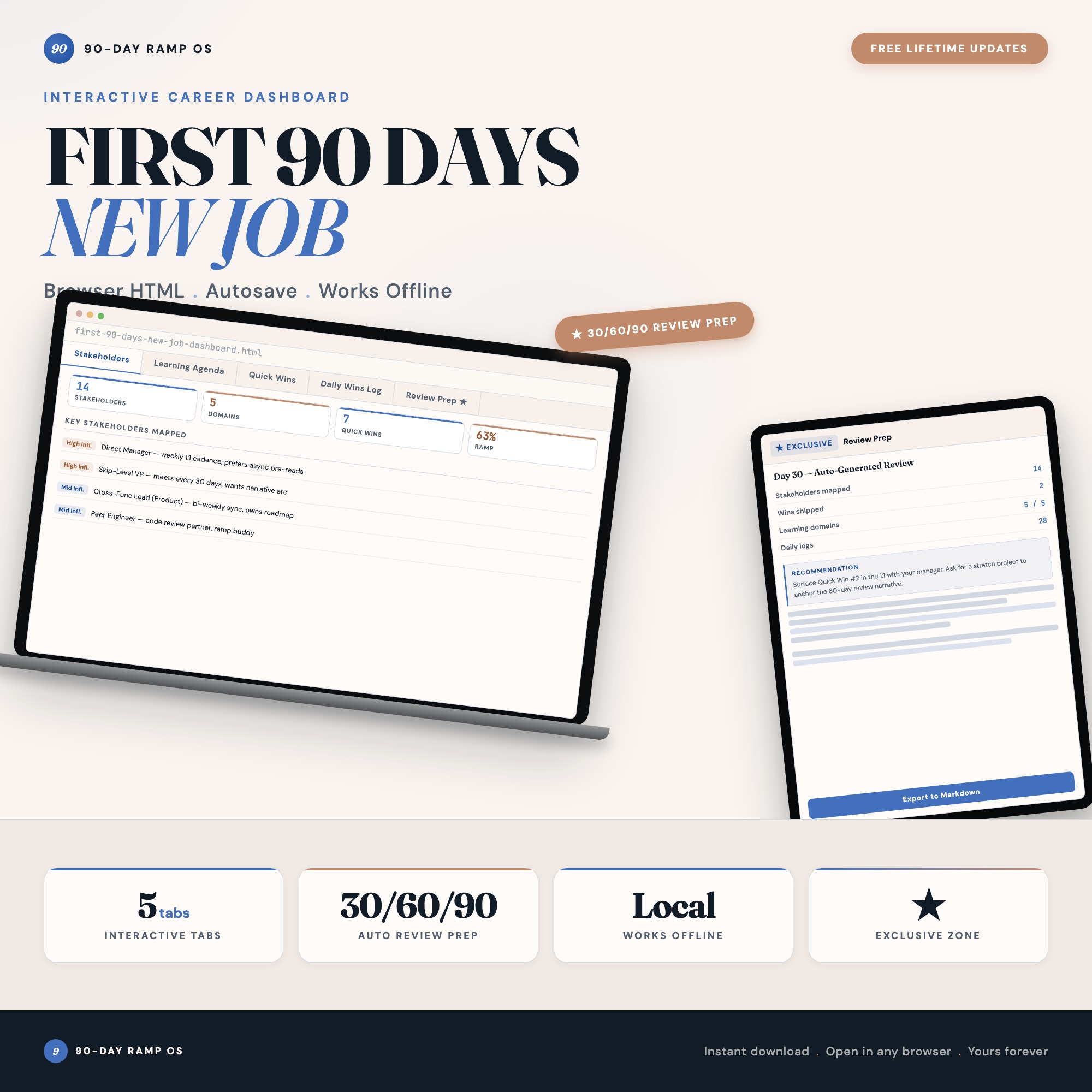
The First 90 Days New Job Dashboard Stakeholders tab captures name, role, influence level, touchpoints, and relationship health for your full network. You will update it constantly in the first four weeks.
Identify the three people you most need to earn trust from
Stakeholder mapping is broad. This narrows it. Who are the three people — not necessarily your direct manager — whose support will determine how quickly you can operate with autonomy? They might be the senior engineer on your team, the product manager you will work closest with, or the executive assistant who controls your manager’s calendar. Know who they are before you need them.
Schedule listening sessions in week one
The fastest way to build credibility in a new role is to ask good questions, not give answers. Request 30-minute conversations with 5 to 8 people in your first week — peers, cross-functional partners, a direct report if applicable. Your goal is not to impress them. It is to understand what they think the team’s biggest problems are and what success looks like to them. You will learn more in three hours of listening sessions than in four weeks of observing.
Map the political landscape before you take a position
Every team has dynamics: who has influence beyond their title, whose opinions carry weight in meetings, where the historical tension points are. Walking into your first team meeting without this map means you may unknowingly stake a position that aligns you with the wrong faction on your second day. Ask questions before you assert opinions.
Define your quick wins explicitly in week one
Quick wins are small, visible, positive-impact actions you can complete in the first 60 days to build credibility before your first formal review. They should be things your manager cares about, things you can actually ship, and things that are visible to at least two other people. Write them down. The First 90 Days New Job Dashboard Quick Wins tab is a kanban board with columns for Idea, In Progress, and Shipped — specifically for this purpose.
Start a daily wins log on day one
What did you ship today? Who did you meet? What did you learn? Three questions, answered in under five minutes each evening. By day 30, you have a complete record of your first month. By day 90, that log becomes the evidence base for your performance narrative — not a vague impression of “things went well,” but specific actions, specific relationships, specific outcomes.
Organize your learning agenda by domain
Every new role has five learning domains: product, process, people, politics, and culture. “Getting up to speed” is vague. “Understanding how the product roadmap is prioritized and who drives that process” is a specific learning goal. A structured learning agenda organized by domain with progress tracking lets you see your knowledge gaps systematically and prioritize the most business-critical domains first.
Prepare your 30-day review talking points before day 30
Most new hires walk into their first 30-day check-in and answer their manager’s questions reactively. The best ones walk in with a written narrative: here is what I shipped, here is what I learned, here is where I need support, here is my focus for days 31 to 60. Preparing this requires that you have been logging your progress daily — which is why starting on day one matters.
The exclusive feature in the First 90 Days New Job Dashboard is the 30/60/90 Review Prep tab: click Generate Review at the 30-day mark and it reads your stakeholder notes, quick wins log, learning agenda progress, and daily journal — then assembles a structured performance narrative formatted for a 1:1 with your manager. Export as markdown, paste into your notes app, and walk into the meeting with receipts.
Set up your personal system before the first meeting
A new job is a context switch that generates information faster than most people can process it: new people, new processes, new tools, new political dynamics. If your tracking system is not in place before week one, you will spend week two trying to reconstruct what happened in week one. Open the dashboard before day one, enter your start date, your role, and your manager’s name. Everything else builds from that anchor.
The Infrastructure Behind a Strong First 90 Days
The First 90 Days New Job Dashboard covers Stakeholders, Learning Agenda, Quick Wins, Daily Wins Log, and 30/60/90 Review Prep in one HTML file for $25. Works offline, no subscription, your data stays on your device.
Frequently asked questions
- What is the most important thing to accomplish in the first 30 days at a new job?
- Build a stakeholder map and ship at least one visible quick win. The stakeholder map tells you who has influence over your success. The quick win earns you credibility before your first formal review.
- What should I track daily in my first 90 days?
- What you shipped, who you met, and what you learned. Three fields, logged once per day, creates the evidence base that makes your 30/60/90 review conversation something you control rather than survive.
- Do I need to spend a lot of money on tools?
- No. The First 90 Days New Job Dashboard costs $25 as a one-time purchase — built for knowledge workers who want to outperform expectations in their first quarter, not just get through onboarding.
- How quickly can I get started with the First 90 Days New Job Dashboard?
- Under 5 minutes. Download the file, open it in any browser, and start using it immediately. Everything autosaves automatically.
Featured dashboards from this list
Interactive HTML dashboards — one-time purchase, works offline, no subscription.
ListingResearchOS Shop
All dashboards — single file, yours forever
Interactive HTML. No subscription. Works offline in any browser.
Browse all dashboards →