
7 Things Every First-Time Marathoner Should Track During Training
7 data points first-time marathoners should log across 16 weeks — from weekly mileage and shoe rotation to race pace projection and taper-week prep.
Published June 3, 2026
The training log is where most first-time marathoners make their worst decisions — either by not keeping one and flying blind, or by logging everything in a fitness app that never connects the data points that matter. Sixteen weeks of training generates a lot of numbers. The ones below are the ones that will actually determine your race day outcome.
Weekly mileage with per-week totals
Total weekly mileage is the primary training load metric for marathon prep. You need to see it week over week — not just today’s run, but the rolling pattern. Most overuse injuries in marathon training are invisible until week 10 or 11 because the runner never noticed the sharp mileage climb in weeks 6 through 8.
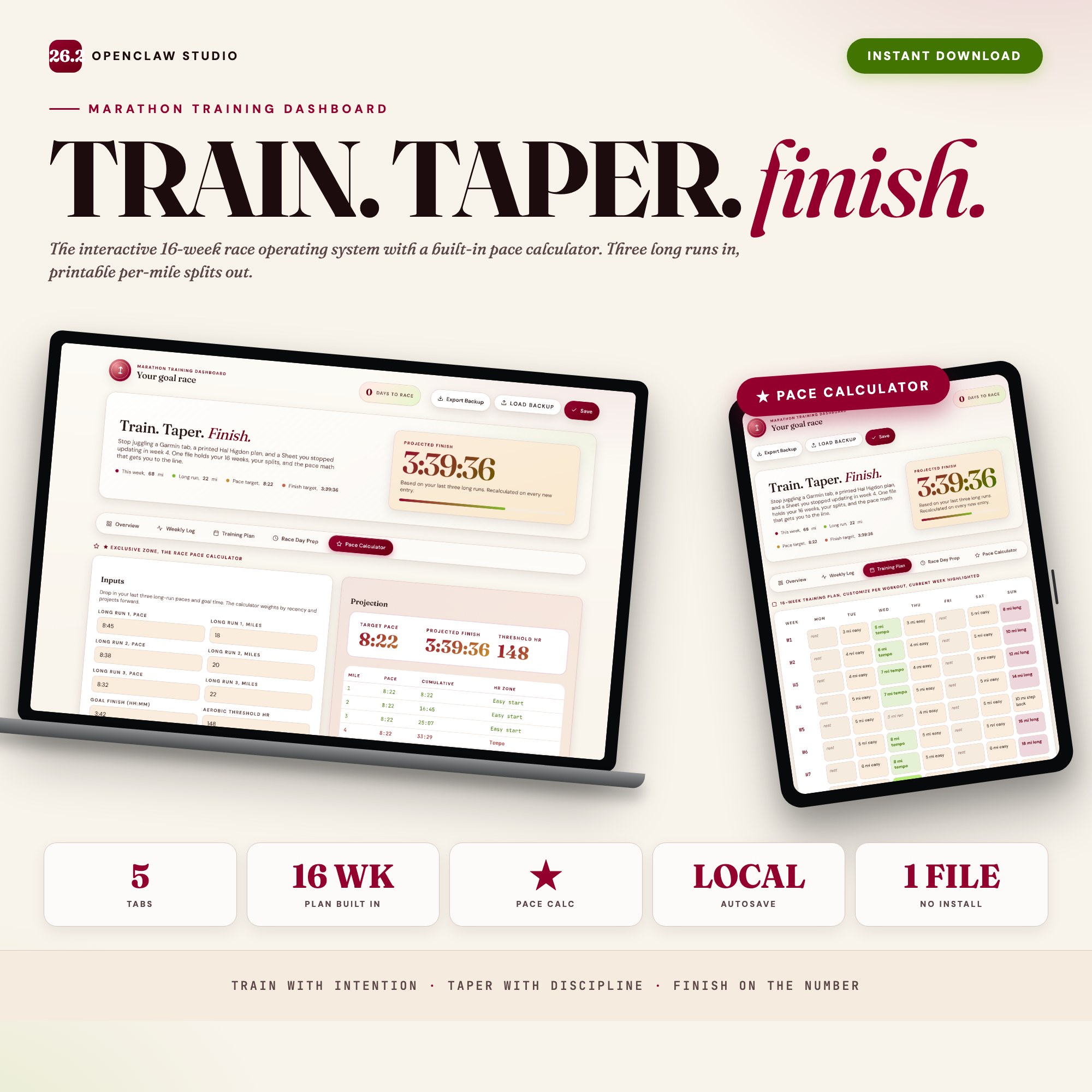
The Marathon Training Dashboard includes a weekly log with per-week mileage rollup built in, alongside a 16-week training plan pre-loaded with easy, tempo, long, recovery, and rest days.
Pace and heart rate per run
Pace tells you what you ran. Heart rate tells you what it cost your body. Together, they reveal something neither shows alone: aerobic efficiency. If your 9:00/mile pace is costing you 165 bpm in week 3 and 152 bpm in week 12 at the same effort, your aerobic base is building correctly. If the HR stays flat, something is wrong.
Log both on every run. The pattern matters more than any single data point.
Long run progression
Your long run is the backbone of marathon training. Logging each long run with the date, miles, pace, and how you felt at miles 16, 18, and 20 gives you the evidence base you need to set a realistic race pace goal. Most first-timers set their goal time based on ambition. The data from your long runs will either validate or correct that number before it’s too late.
Shoe and surface rotation
Running injuries are often traced back to a single shoe-surface combination that accumulated too much impact over too many miles. Log which shoe you wore and what surface you ran on for each session. When your knee starts talking to you in week 11, you will be able to look back and see exactly when it started correlating with the new shoe model.
Race pace projection from recent training data
This is the calculation that most first-time marathoners either skip or do badly. Running your marathon at the wrong pace is the single biggest controllable variable on race day. A pace calculator that takes your recent training run paces and heart rate data and outputs a projected finish time — broken into per-mile splits by HR zone — is different from a generic finish time predictor.
The exclusive feature in the Marathon Training Dashboard is the Race Pace Calculator in Tab 5: drop in your last three long-run paces and your aerobic threshold HR, and it computes your target marathon pace, projected finish time, and a printable pace band split by HR zone. You walk to the start line knowing the number with training data behind it.
Taper week protocol
The two to three weeks before race day are where most runners sabotage themselves — either by panicking and running too much, or by becoming completely sedentary and losing sharpness. A taper-week protocol that tells you exactly what to run each day, what to eat, and what to check off your gear list removes a significant amount of anxiety from the final stretch.
Race day gear and logistics checklist
Arriving at the start line with everything you need sounds simple. In practice, at 5:30 AM with nervous energy running high, it is not. A gear checklist — shoes, race kit, belt, gels, anti-chafe, drop bag contents — combined with an alarm time, pre-race breakfast plan, and course notes eliminates the preventable mistakes.
Tracking All Seven in One Place
The Marathon Training Dashboard is a single HTML file covering all five phases of race prep: Overview, Weekly Log, Training Plan, Race Day Prep, and Pace Calculator. $24 one-time, works offline in any browser.
Frequently asked questions
- What is the most important thing to track in the first four weeks of marathon training?
- Weekly mileage and RPE (rate of perceived exertion). These two together tell you if you are building too fast. The standard rule is never increase weekly volume by more than 10% in a single week.
- Do I need a GPS watch to track marathon training effectively?
- No. A GPS watch is useful but not required. What you actually need is a log where you record your pace, distance, HR, and RPE after each run. That data compound over 16 weeks into the prediction that matters most: your finish time.
- What makes an offline HTML dashboard better than a subscription app?
- Cost and reliability. Strava and TrainingPeaks cost $10-$20/month. The Marathon Training Dashboard is $24 one-time and works on any device without internet — including during taper week when the last thing you need is a login problem.
- How quickly can I get started with the Marathon Training Dashboard?
- Under 5 minutes. Download the file, open it in any browser, and start using it immediately. Everything autosaves automatically.
Featured dashboards from this list
Interactive HTML dashboards — one-time purchase, works offline, no subscription.
ListingResearchOS Shop
All dashboards — single file, yours forever
Interactive HTML. No subscription. Works offline in any browser.
Browse all dashboards →