
6 Things You Must Track During FODMAP Reintroduction
The 6 variables to log during FODMAP reintroduction to pin down your real triggers, and why incomplete tracking leaves results too vague to act on.
Published June 3, 2026
The FODMAP reintroduction phase is where the diagnostic work actually happens. The elimination phase establishes a clean baseline by removing all high-FODMAP foods. Reintroduction is the 6-week structured process of systematically reintroducing individual FODMAP groups one at a time to identify which ones trigger your symptoms.
The accuracy of your trigger identification depends entirely on the quality of your tracking. Incomplete or inconsistent logging produces ambiguous results that are difficult for your GI doctor or dietitian to interpret. Here are the six variables that need to be logged throughout reintroduction.
1. The Specific Food and Portion Size Tested
Each reintroduction challenge involves eating a test portion of a specific food containing a single FODMAP group. The exact food matters — canned chickpeas and dried lentils are both high in galacto-oligosaccharides (GOS), but portion size and preparation affect FODMAP load differently.
Log the food by name, the portion size in grams or common measures, and the time consumed. Vague entries like “had some wheat bread” cannot be analyzed for FODMAP group correlation.
2. Symptom Onset and Severity
Gut symptoms from FODMAP challenges do not always appear immediately. Some responses are delayed by 12-48 hours, which is why each FODMAP group requires 3 days of testing followed by 2-3 washout days before the next challenge.
Log symptom onset time and rate each symptom (bloating, pain, urgency, nausea, fatigue) on a consistent 1-5 scale at multiple points: 1 hour, 4 hours, and 24 hours after the challenge. Without timing data, you may misattribute symptoms from one challenge to the next food tested.
3. Bowel Pattern and Bristol Stool Scale
Bristol Stool Scale entries are essential clinical data for your GI doctor. Log stool type (1-7 on the Bristol scale), frequency, and any urgency or pain during the reintroduction period.
This data point is often the clearest signal when a FODMAP group is causing a response, and it is the one most patients are reluctant to track. Your GI doctor needs it.
4. FODMAP Group Being Tested
The 5 main FODMAP groups are fructose (excess), lactose, polyols (sorbitol and mannitol), fructans, and GOS. Each challenge tests one group at a time. Log which group is being tested on each day so you can analyze results by group, not just by individual food.
Some patients react to multiple groups. The correlation only becomes visible when you have clean group-level data.
5. Stress Level and Sleep Quality
Gut symptoms can be amplified or caused by stress and poor sleep independently of FODMAP intake. This is a confounding variable that makes reintroduction results unreliable if you do not track it.
Log your stress level (1-5) and sleep quality (1-5 or hours slept) each day. If you have a high-stress day during a challenge, note it — the symptom response on that day should be interpreted cautiously as a potential confound.
6. Other Foods Consumed That Day (FODMAP Stacking)
One of the most common reasons FODMAP reintroduction produces confusing results is “FODMAP stacking” — consuming moderate-FODMAP foods throughout the day in addition to the challenge food, which pushes total FODMAP load over your personal threshold.
Log everything you ate that day, specifically looking for other moderate-FODMAP ingredients. Your dietitian will review this when interpreting ambiguous results.
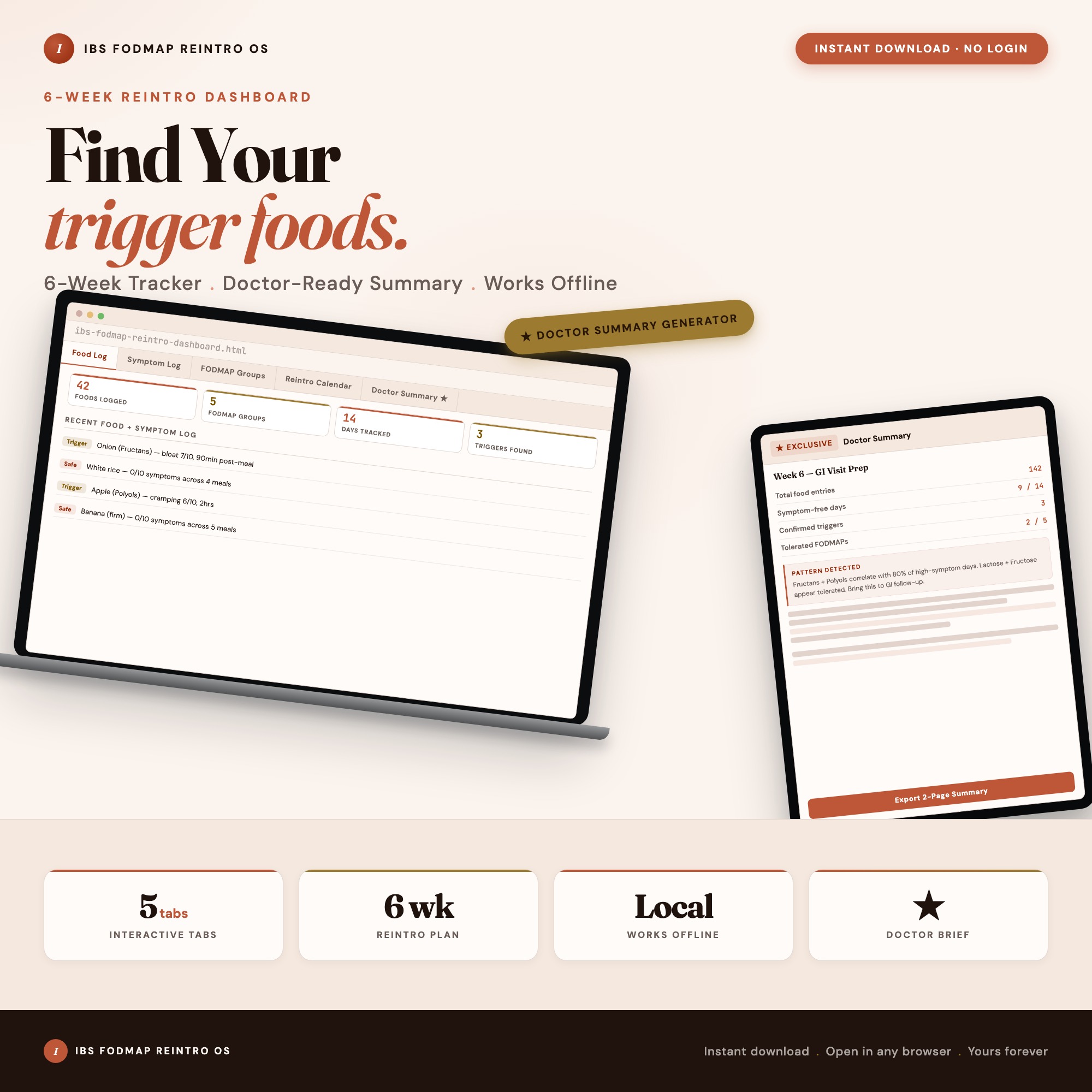
Maintaining six data points per day across a 6-week protocol in a standard food journal is feasible but produces records that are hard to analyze at the end. The IBS FODMAP Reintroduction Dashboard is an interactive browser dashboard built specifically for this phase: a Food Log, a Symptom and Bowel Log, a FODMAP Groups tracker, a 42-day calendar view, and a Doctor Prep Summary Generator that reads all logged data and produces a 2-page doctor-ready trigger correlation summary you can hand to your GI doctor at your follow-up appointment.
At $22 one-time, no subscription, your gut health data stays on your device. Available on Etsy.
Frequently asked questions
- Why does the FODMAP reintroduction phase require tracking rather than just eating intuitively?
- Gut symptoms are often delayed by 12-48 hours and can be caused by multiple compounding factors — stress, portion size, FODMAP stacking, or a specific FODMAP group. Without structured logging, it is nearly impossible to isolate which food caused which symptom.
- Do I need to spend a lot of money on tools?
- No. The IBS FODMAP Reintroduction Dashboard costs $22 as a one-time purchase — less than two months of most subscription tools. And it is purpose-built for your workflow.
- What makes an offline HTML dashboard better than a subscription app?
- Privacy (your gut health data stays on your device), specificity (it is built for FODMAP reintroduction, not generic food journaling), and the Doctor Prep Summary Generator that creates a 2-page trigger report from your 6 weeks of logged data.
- How quickly can I get started with the IBS FODMAP Reintroduction Dashboard?
- Under 5 minutes. Download the file, open it in any browser, and start using it immediately. Everything autosaves automatically.
Featured dashboards from this list
Interactive HTML dashboards — one-time purchase, works offline, no subscription.
ListingResearchOS Shop
All dashboards — single file, yours forever
Interactive HTML. No subscription. Works offline in any browser.
Browse all dashboards →