
10 Moving Mistakes Families Make (And How an Organized System Prevents Them)
The 10 most costly moving mistakes families make — from skipping mover comparisons to missing utility transfers — and concrete steps to avoid each one.
Published June 3, 2026
Family moves look manageable until week six, when everything compresses at once. School enrollment, utility transfers, mover coordination, address changes, and the boxes that still need packing all converge in a two-week sprint that should have been spread across eight. Most of the chaos is preventable — if you catch these ten mistakes before they happen.
1. Getting Only One Mover Quote
Moving company pricing varies by 30-50% for the same job. Families who call one company and book it leave real money on the table. Get at least three written quotes, compare total cost (not just the base rate — hourly fees, fuel surcharges, stair fees, and deposit terms all affect the real number), and identify the true value winner.
2. Waiting Too Long to Start Address Changes
The USPS mail forward takes 7-10 business days to activate. Banks require mailing address changes through secure channels with identity verification. Voter registration often has a deadline relative to the next election. If you start address changes the week of the move, you will spend months dealing with mail going to the wrong place.
Start the address change process 3-4 weeks before move day. The list is longer than people expect: bank accounts, credit cards, IRS, voter registration, insurance, employer HR, pediatrician, dentist, pharmacy, and every subscription you pay monthly.
3. Skipping Utility Transfer Coordination
Families who do not coordinate utility transfers in advance face one of two problems: service gaps at the new home or double-billing at the old one. Internet alone requires a 2-week lead time for installation scheduling in most markets.
Create a utility transfer checklist with both the old address and new address columns. Gas, electric, water, internet, cable, trash collection, and any home security services need account numbers, cancellation dates, and installation confirmation at the new address.
4. Packing Without a Box Inventory System
Boxes without a systematic labeling scheme turn the first week in your new home into an excavation. “Kids stuff” on 14 boxes is not a system.
Label every box with room destination, general contents, and a priority code (Open first / Regular / Storage). A box inventory log that tracks box number against contents lets you find the coffee maker at 7am on Day 1 without opening 12 boxes.
5. Underestimating How Long It Takes to Pack a Kitchen
A kitchen takes 3x longer to pack than most families plan for. Fragile items require individual wrapping. Appliances need power cords secured. Food items need to be sorted between what comes, what gets donated, and what gets tossed.
Dedicate a full day to the kitchen alone, at least 5 days before the truck arrives. Do not leave it for the final 48 hours.
6. Not Confirming the Mover the Day Before
Families who assume the confirmed booking is solid sometimes arrive on move day to find a scheduling conflict, a different crew than expected, or a truck that is the wrong size. Call your moving company the afternoon before the move to confirm crew size, truck size, arrival window, and payment method accepted.
7. Letting Kids and Pets Roam During Loading
The busiest and most dangerous part of a family move is the loading day itself. Moving crews are moving fast, heavy objects through doorways. Kids underfoot cause accidents and slow the crew, which extends your hourly bill.
Arrange childcare or a designated “safe room” where kids stay with a parent during the loading phase. Same logic applies to pets — a dog or cat loose during a full house load is a liability for everyone.
8. Missing the School Enrollment Window
Many districts have enrollment deadlines, and popular school choices require proof of residency before a specific date. Families who do not research the new school’s requirements 6-8 weeks out sometimes miss the deadline for their preferred school.
Contact the new school as soon as you have a confirmed move date. Find out what records (immunization, prior grades, IEP if applicable) they need and start requesting them from the current school immediately.
9. Not Doing a Final Walkthrough of the Old Home
Before you hand over the keys, walk through every room and the exterior of the old home with your lease or closing documents in hand. Check inside closets, cabinets, the garage, and outdoor storage. Photograph any damage you want documented for the deposit or sale record.
Forgetting something in the old home after the keys are gone is both a logistical headache and potentially costly if it was something left for the buyer or landlord.
10. Having No Single Place for Move Information
The biggest systemic mistake families make is managing the move across 4-6 different places: Google Docs, a Notes app, email threads, paper lists, and memory. When the truck arrives and something goes wrong, no one can find the mover’s insurance certificate or the confirmation number for the internet installation.
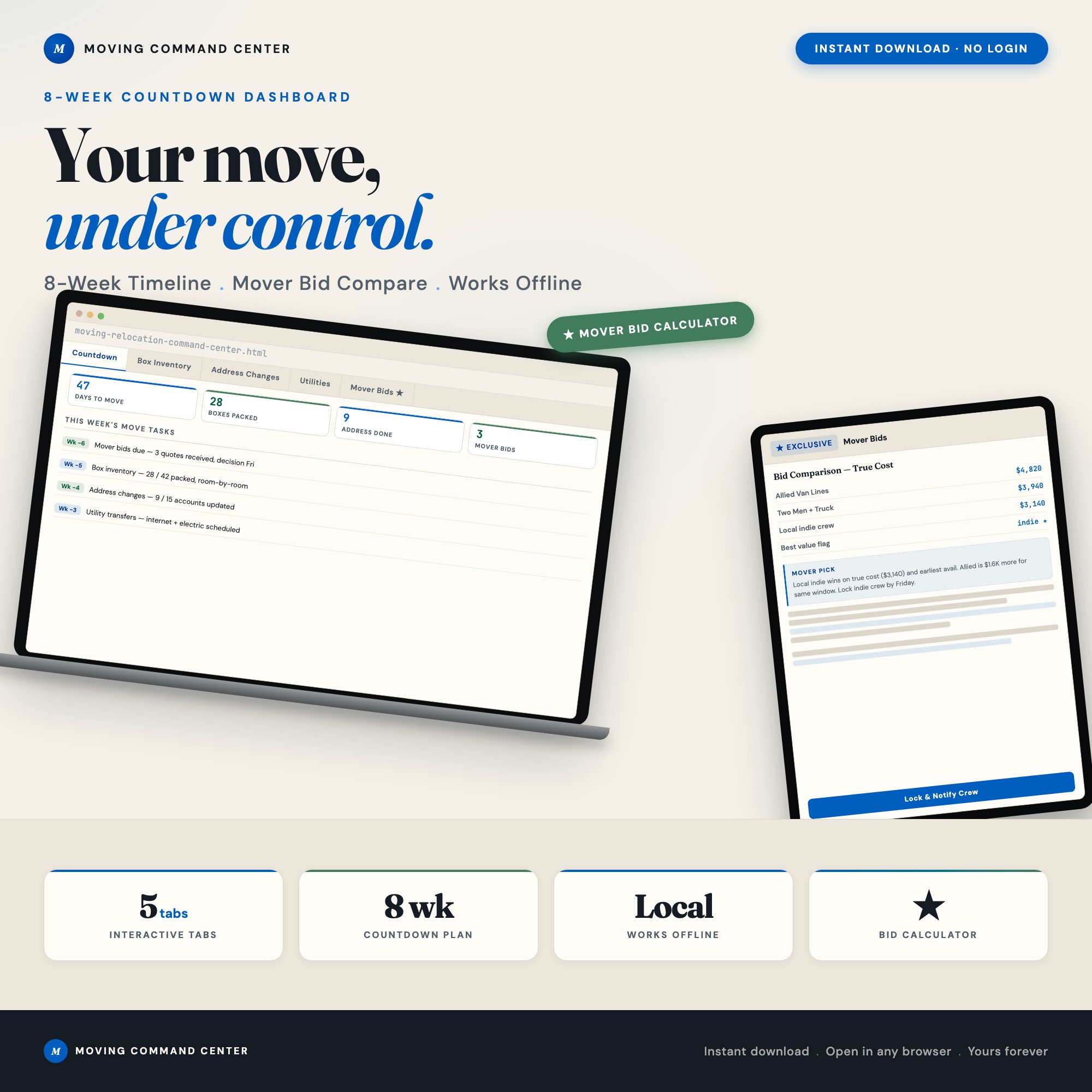
The Moving Relocation Command Center is a single offline HTML dashboard that tracks your 8-week countdown, box inventory, address change status (with checkboxes), utility transfers for both addresses, and a mover bid comparison calculator with a true-cost formula. Everything in one file, accessible offline, autosaved to your browser.
Available on Etsy for $22 — one-time download, works in any browser, no subscription required.
Frequently asked questions
- How far in advance should a family start planning a cross-city move?
- 8 weeks is the minimum for a smooth family relocation. That gives you time to get mover quotes, start the address change process, coordinate school enrollment, and handle utility transfers without everything compressing into the final two weeks.
- Do I need to spend a lot of money on tools?
- No. The Moving Relocation Command Center costs $22 as a one-time purchase — less than two months of most subscription tools. And it is purpose-built for your workflow.
- What makes an offline HTML dashboard better than a subscription app?
- Cost (one-time vs. monthly), privacy (your addresses and account numbers stay on your device), and reliability (works without internet). The Mover Bid Comparison calculator is also exclusive — no generic app includes it.
- How quickly can I get started with the Moving Relocation Command Center?
- Under 5 minutes. Download the file, open it in any browser, and start using it immediately. Everything autosaves automatically.
Featured dashboards from this list
Interactive HTML dashboards — one-time purchase, works offline, no subscription.
ListingResearchOS Shop
All dashboards — single file, yours forever
Interactive HTML. No subscription. Works offline in any browser.
Browse all dashboards →