
Marathon Pace Calculator: How to Set Realistic Race Goals
How to calculate your marathon pace from training data — project your finish time, set per-mile splits by heart-rate zone, and avoid the bonk at mile 20.
Published June 3, 2026
The most common marathon mistake isn’t going out too slow. It’s going out at a pace that feels comfortable in the first three miles and unsustainable by mile 19.
Most first-time marathoners and PR-chasers set their race pace goal based on a round number — “I want to run sub-4:00” — without checking whether their current training data actually supports that pace. The result is a positive split race where the second half is significantly slower than the first, and a finish time that looks nothing like the goal.
This guide explains how to use your training data to calculate a realistic race pace so your goal is grounded in evidence rather than aspiration.
How Marathon Pace Prediction Works
The most reliable marathon pace predictions use your recent training data — not a single race performance or an online calculator that only takes your 5K time.
Key inputs for an accurate pace prediction:
- Recent long run pace — your comfortable aerobic pace over 16–20 mile training runs
- Average easy run pace — the pace you maintain at conversational effort over multiple runs this cycle
- Heart rate at easy pace — your average HR during easy runs, used to establish your aerobic threshold
- Current weekly mileage peak — higher mileage training correlates with better race-day outcomes
- Race conditions — temperature and humidity affect pace by approximately 2–4% per 10 degrees Fahrenheit above 55F
The Jack Daniels VDOT formula, the Riegel formula, and Garmin’s HRV-based predictions all estimate marathon pace from training data. None of them are perfect, but all are more accurate than intuition.
A rough starting estimate: your marathon race pace is typically 60–90 seconds per mile slower than your current 10K pace, and 45–75 seconds per mile slower than your half marathon pace.
Build Your Per-Mile Split Sheet
A goal finish time isn’t a race strategy. A per-mile split plan is.
For a 4:00 marathon goal (26.2 miles):
- Average pace needed: 9:09/mile
- Miles 1–3: run 9:30–9:45 (let the crowd clear, resist going out fast)
- Miles 4–13: settle into 9:10–9:15 pace
- Miles 14–20: maintain 9:10 pace; this is where fitness — not effort — carries you
- Miles 21–26.2: effort increases, pace may stay or drift slightly; you can push harder here if you’ve banked easy miles early
Negative splitting — running the second half slightly faster than the first — is the strategy used by almost every sub-3:00 marathoner. For most recreational runners, even splitting is realistic. Going out faster than goal pace in the first 5 miles almost always produces a slower finish time.
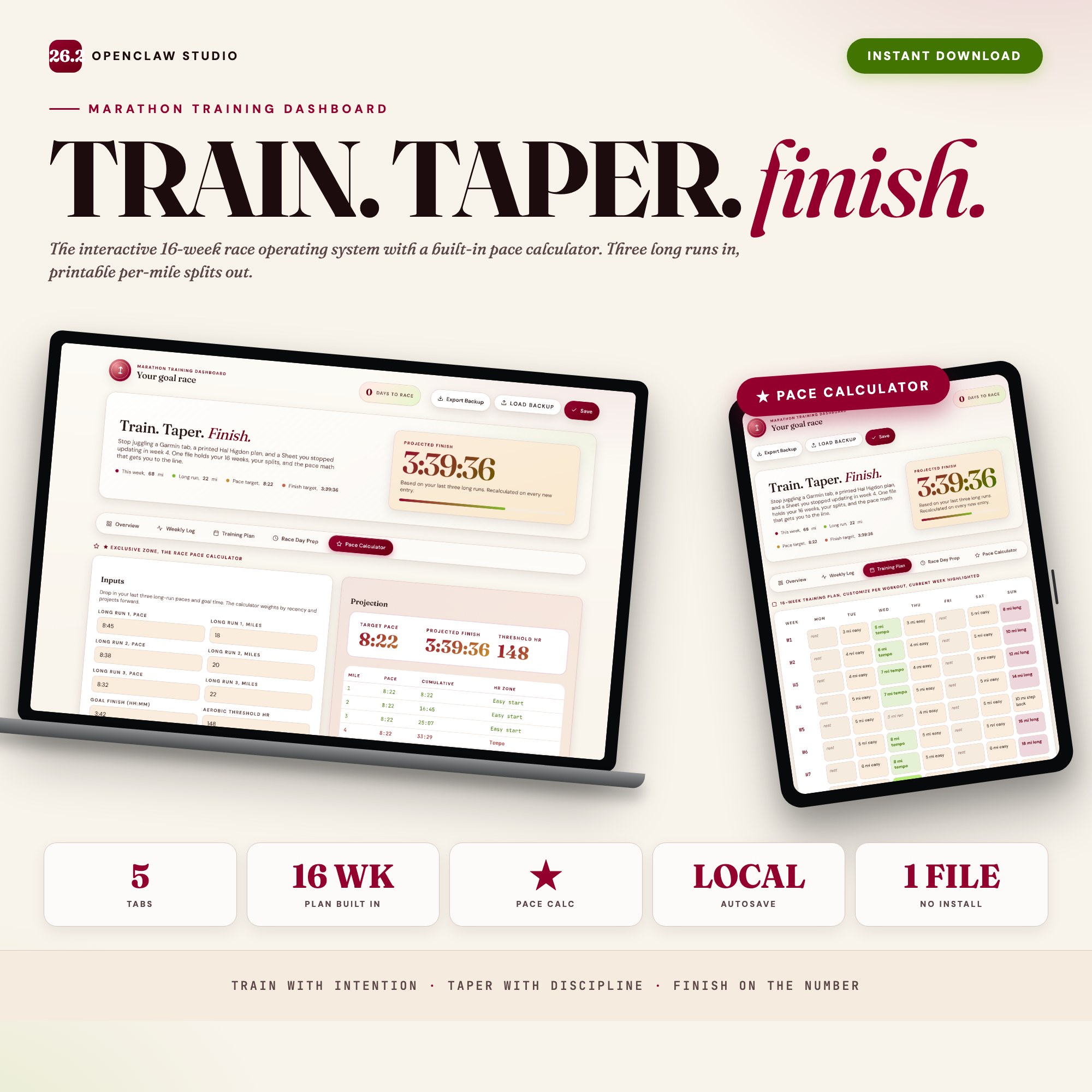
The Marathon Training Dashboard has a Race Pace Calculator that accepts your recent long run paces, goal time, and aerobic threshold HR, then outputs your target marathon pace, projected finish time, and recommended per-mile splits broken down by heart rate zone. It also generates a printable pace band — the wrist-worn split card you see serious marathon runners check at each mile marker.
Log Every Training Run to Build Usable Data
A pace calculator is only as good as the data you feed it. To get an accurate race pace prediction, you need at minimum:
- 3–4 recent long runs (16+ miles) with pace and average HR logged
- 6–8 recent easy runs with pace, HR, and RPE
- 1–2 tempo or race-pace runs if you’ve done them in this training cycle
For each run log:
- Date
- Distance and type (easy, tempo, long, recovery)
- Pace per mile
- Average heart rate
- RPE (rate of perceived exertion, 1–10)
- Shoe and surface — useful for analyzing whether road vs. trail changes your easy pace
- Notes — weather, how you felt, anything unusual
After 6–8 weeks of logged data, patterns emerge. Your easy pace has likely improved since week 1. Your heart rate at a given pace has likely dropped. Those trend lines tell you whether your fitness is responding to training and whether your race goal should be adjusted.
Taper Week: What Changes and What Doesn’t
Three weeks before race day, mileage drops significantly (taper). Your pace stays the same or picks up slightly — you’re not training yourself to go slower, you’re letting your legs recover.
During taper, many runners feel sluggish and undertrained. This is normal. The fitness you’ve built doesn’t disappear in two weeks of reduced mileage. The glycogen depletion, accumulated fatigue, and minor muscle damage from high-mileage training does.
Race week checklist:
- Gear: confirm shoes (nothing new on race day), socks, kit, GPS watch charged
- Nutrition: carbohydrate load in the 48–72 hours before the race (4–6 grams of carbs per pound of body weight per day)
- Logistics: packet pickup timing, transport to start, baggage check, corrals
- Pre-race breakfast: what you’ve practiced eating before long training runs — never try something new on race morning
- Pace band: printed from your pace calculator, worn on your wrist
The Marathon Training Dashboard has a Race Day Prep tab with a gear, nutrition, and logistics checklist alongside the taper-week protocol. The 16-week training plan loads pre-seeded with current week highlighted based on your race date.
One-time purchase at $24. Find the full collection at ListingResearchOS on Etsy.
Frequently asked questions
- Do I need special software to use an offline dashboard?
- No. An offline HTML dashboard like the Marathon Training Dashboard is a single file you open in any browser — Chrome, Edge, Safari, or Firefox. Nothing to install, no account to create.
- Is my data private if I use a browser-based dashboard?
- Yes, completely. Data stored in your browser's localStorage never leaves your device. There are no servers, no analytics, and no uploads of any kind.
- Can I back up my data?
- Yes. Every ListingResearchOS dashboard includes an Export Backup button that downloads a JSON file to your computer. Load Backup restores it on any device or browser.
- What makes an interactive HTML dashboard better than a spreadsheet?
- Spreadsheets require manual formula maintenance and lack purpose-built workflows. An interactive HTML dashboard has pre-built logic — like Race Pace Calculator that ingests recent training-run paces and projects finish time + per-mile splits by heart-rate zone — that a spreadsheet can't replicate without significant engineering work.
- How much does the Marathon Training Dashboard cost?
- It is a one-time purchase of $24 on Etsy. No monthly subscription. Once you buy it, it is yours forever.
Ready-made dashboards
Skip setup — grab an interactive dashboard built for this exact workflow.
ListingResearchOS Shop
All dashboards — one-time purchase, yours forever
Single HTML files. No subscriptions. No login. Works offline in any browser.
Browse all dashboards →