
How to Prepare for Your IBS Doctor Appointment With Real Symptom Data
How IBS patients prepare for a gastroenterologist appointment: tracking FODMAP triggers, finding symptom correlations, and bringing a doctor-ready report.
Published June 3, 2026
The follow-up gastroenterologist appointment after your initial IBS diagnosis is supposed to be the moment when you and your doctor make sense of what’s happening in your gut. In practice, it often goes like this: the doctor asks what symptoms you’ve been experiencing, you try to reconstruct six weeks of gut reactions from memory, and you leave the appointment with the same general dietary guidance you already had.
The problem isn’t the appointment — it’s the data. When you walk in with a vague account of “sometimes fructose seems to cause problems, but I’m not sure,” the conversation stays vague. When you walk in with a two-page summary showing that fructans caused a symptom score of 7/10 on three consecutive test days while galactooligosaccharides (GOS) triggered no response at all, the conversation becomes specific and actionable.
This guide covers how the low-FODMAP reintroduction phase works, what data to track to make your doctor appointment useful, and how to generate a structured summary your GI doctor can actually work with.
How the FODMAP Reintroduction Phase Works
After 2–6 weeks of strict low-FODMAP elimination (if symptoms improve, confirming that FODMAPs are a trigger), you enter the reintroduction phase. This is the diagnostic work: systematically testing each FODMAP group to identify which specific types are your personal triggers.
The five FODMAP groups are:
- Fructose (found in honey, mangoes, high-fructose corn syrup)
- Lactose (found in dairy)
- Fructans (found in wheat, garlic, onion)
- GOS — galactooligosaccharides (found in legumes)
- Polyols (found in stone fruits, artificial sweeteners — splits into sorbitol and mannitol)
The reintroduction protocol tests each group with a specific food over 3 days, with washout periods in between. Day 1 is a small test amount. Day 2 is a larger amount. Day 3 is a larger amount still. If symptoms appear, that group is likely a personal trigger. If no symptoms appear, that group is likely tolerable for you.
The critical thing to log during each test: the exact food eaten, the quantity, the time, your symptoms within 2–8 hours, and your bowel score (using the Bristol Stool Scale). This is the data that makes correlation possible.
Why Memory Doesn’t Work for FODMAP Correlation
IBS symptoms are delayed — they often appear 4–24 hours after the triggering food, not immediately. That delay makes intuitive pattern-recognition unreliable. You eat garlic at dinner Thursday night, feel fine Thursday, wake up feeling terrible Friday morning, and attribute it to something you ate Friday morning. Without logged timestamps, the connection to Thursday’s fructan load is invisible.
Six weeks of accurate logging creates the evidence base. Cross-referencing food logs against symptom logs across that timeline reveals patterns that memory alone cannot.
What a Useful Doctor Summary Contains
A GI doctor at a follow-up appointment needs to know:
- Which FODMAP groups you tested, in what order, with what results
- Your symptom responses to each group (severity, type, timing)
- Which groups you’ve identified as personal triggers and which are tolerable
- Your current safe food list based on reintroduction results
- Any anomalies — days where symptoms appeared without a clear FODMAP trigger
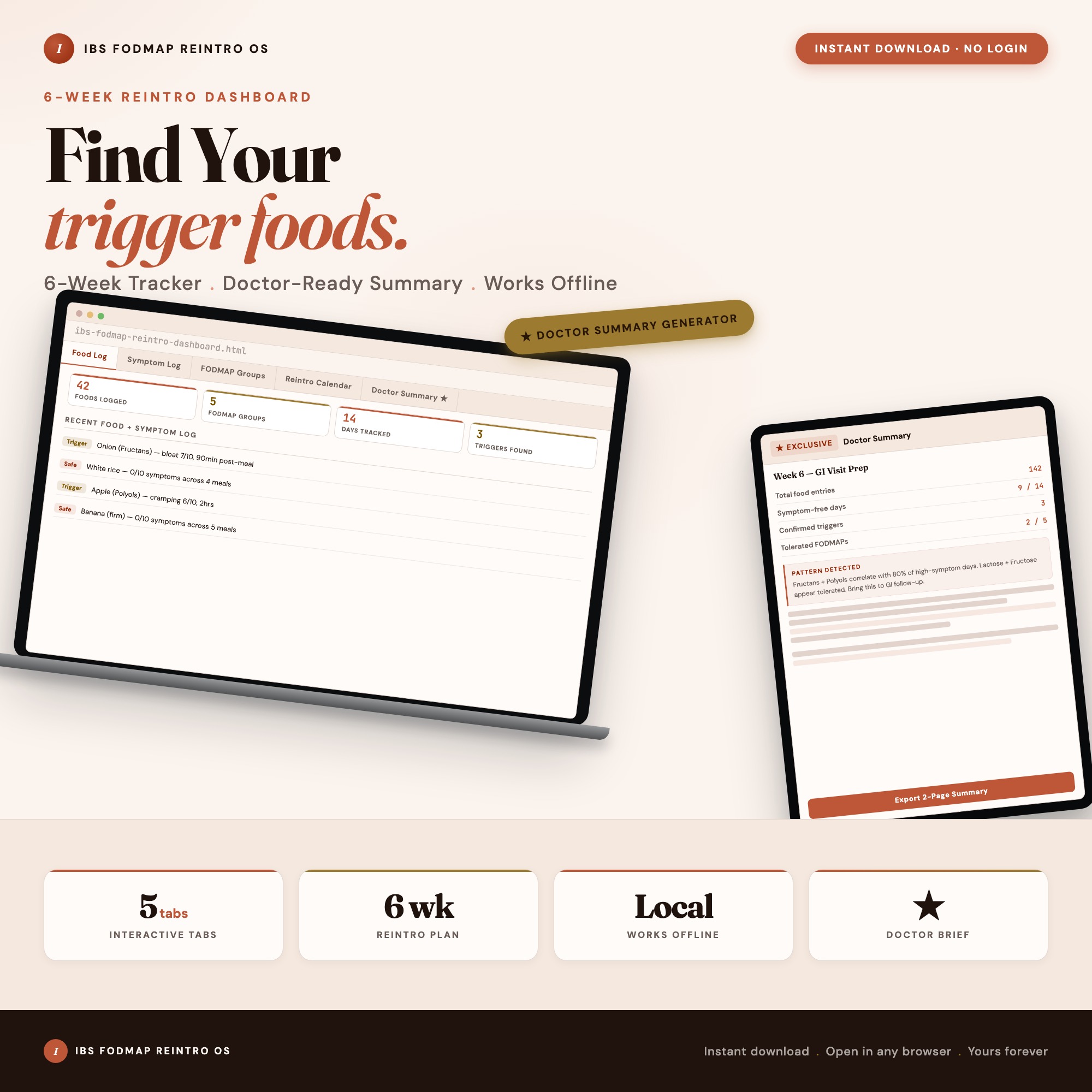
The IBS FODMAP Reintroduction Dashboard organizes this across five tabs: Food Log, Symptom and Bowel Log, FODMAP Groups (tolerance profile), Reintro Calendar (42-day tracking view), and Doctor Summary — the exclusive generator tab.
The Doctor Prep Summary Generator reads your food, symptom, and bowel log data from across all reintro days, computes FODMAP group correlations, and produces a formatted two-page doctor-ready summary. At one appointment, a patient’s GI doctor noted the summary shortened their follow-up from an hour to 20 minutes — the data was already organized.
Your gut health information is private and stays on your device. Nothing uploads anywhere. $22, one-time purchase.
Frequently asked questions
- Do I need special software to use an offline dashboard?
- No. An offline HTML dashboard like the IBS FODMAP Reintroduction Dashboard is a single file you open in any browser — Chrome, Edge, Safari, or Firefox. Nothing to install, no account to create.
- Is my data private if I use a browser-based dashboard?
- Yes, completely. Data stored in your browser's localStorage never leaves your device. There are no servers, no analytics, and no uploads of any kind.
- Can I back up my data?
- Yes. Every ListingResearchOS dashboard includes an Export Backup button that downloads a JSON file to your computer. Load Backup restores it on any device or browser.
- What makes an interactive HTML dashboard better than a spreadsheet?
- Spreadsheets require manual formula maintenance and lack purpose-built workflows. An interactive HTML dashboard has pre-built logic — like Doctor Prep Summary Generator — reads food/symptom/bowel logs across all reintro days, computes FODMAP group correlations, generates formatted 2-page doctor-ready summary — that a spreadsheet can't replicate without significant engineering work.
- How much does the IBS FODMAP Reintroduction Dashboard cost?
- It is a one-time purchase of $22 on Etsy. No monthly subscription. Once you buy it, it is yours forever.
Ready-made dashboards
Skip setup — grab an interactive dashboard built for this exact workflow.
ListingResearchOS Shop
All dashboards — one-time purchase, yours forever
Single HTML files. No subscriptions. No login. Works offline in any browser.
Browse all dashboards →