
How to Nail Your First 90 Days at a New Job
The 90-day new job playbook: build a stakeholder map, find quick wins, close knowledge gaps, and walk into your 30/60/90 review with a real record.
Published June 3, 2026
The first 90 days at a new job do more to define your trajectory at that company than any equivalent period afterward. Reputations form quickly and change slowly. The colleague who knew what was going on and shipped something visible by day 60 is remembered differently than the one who seemed capable but couldn’t quite get their footing.
The challenge is that most of the first-90-days advice focuses on the mindset — be humble, listen more than you talk, find the informal power players — without addressing the operational question: how do you actually track all of this across three months, and how do you turn it into a coherent narrative when the 30-day review arrives?
The Stakeholder Map: The Artifact You Actually Need
The most important thing you can build in your first two weeks is a stakeholder map. Not a mental note of who seems important, but a structured record of every person whose work intersects with yours.
For each stakeholder, you need:
- Name, role, and team
- Their influence level relative to your work (high, medium, indirect)
- Your touchpoints — what meetings do you share, what work crosses between you
- Current relationship health — initial impression, anything to watch
- Your “next conversation” goal — what do you want to understand or establish with this person in the next two weeks?
This artifact does two things. First, it prevents the common mistake of over-investing early attention in visible but low-influence people while underinvesting in the quieter stakeholders who actually determine your success. Second, when the 30-day review happens, you have evidence of intentional relationship-building.
The Learning Agenda: Five Domains You Must Cover
Most new employees learn reactively — absorbing whatever gets thrown at them. A deliberate learning agenda organizes what you need to master across five domains, so you know what you’re missing and can proactively close the gaps:
Product: What are you actually building or selling? What makes it differentiated? What are the known limitations?
Process: How does work actually get done here? Where are the formal processes and where does reality diverge from the documented version?
People: Who has informal authority? Who is respected for what kind of expertise? What relationships matter most?
Politics: What are the active tensions? Who is competing for what? What are the sacred cows?
Culture: What does “doing good work” actually mean here? What gets rewarded vs. what’s said to be rewarded?
Most new employees do fine on product and process and ignore people, politics, and culture — which is where the invisible landmines live. Tracking explicit progress across all five domains forces balance.
Quick Wins: The Credibility Engine
Days 30–60 are the window for visible, small-impact deliverables. The goal is not to take on a major project — it’s to identify things that can be shipped in one to two weeks that someone influential will notice and appreciate.
Good quick wins share a few properties: they solve an actual friction point someone has already expressed, they’re deliverable within your current authority and access, and they’re attributable (the right person knows you did it).
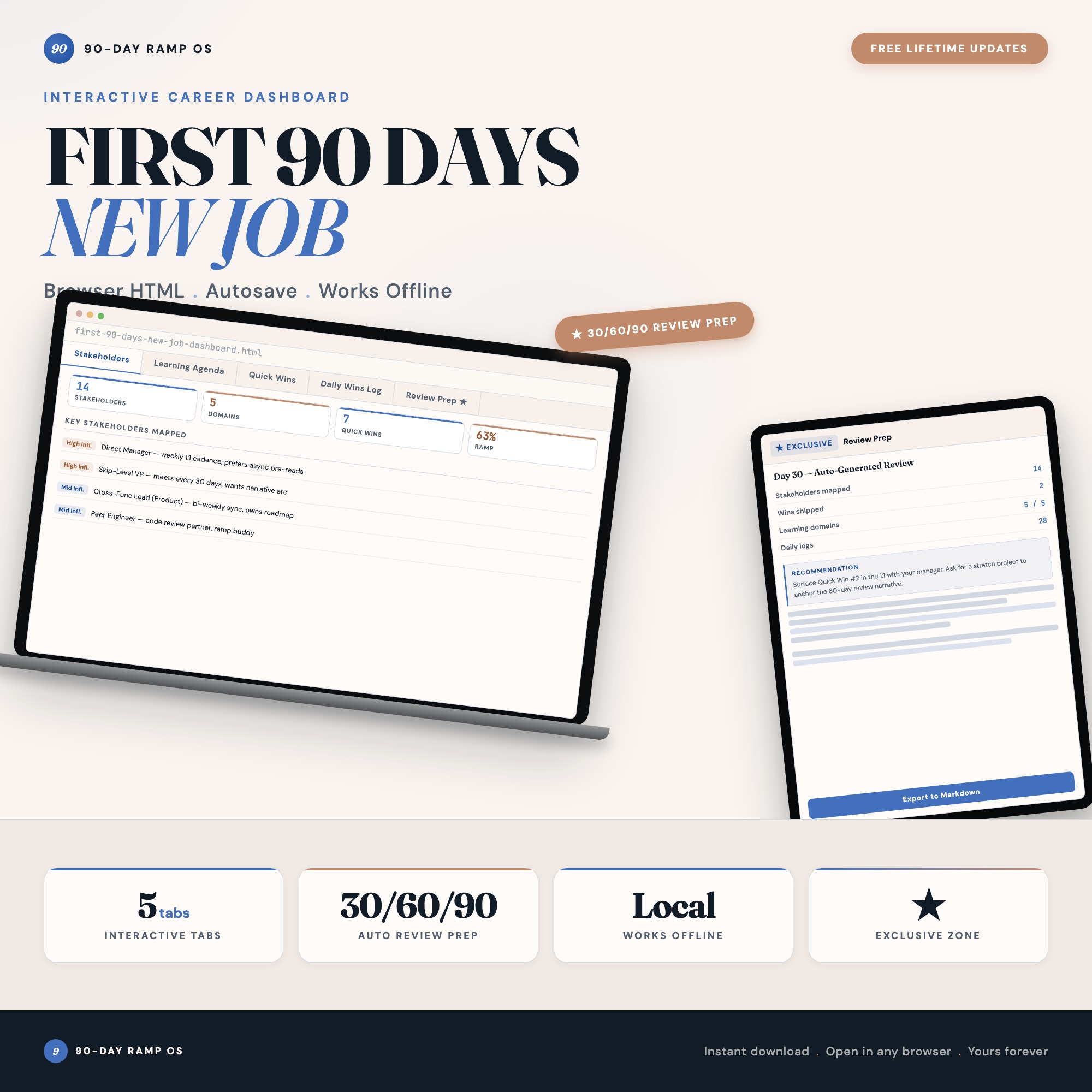
The Quick Wins kanban in the First 90 Days New Job Dashboard organizes these as cards tracking the idea, why it matters, who will notice, and current status (Idea / In Progress / Shipped). The “who will notice” field is what most people skip — but it’s what turns a completed task into a credibility moment.
Walking Into Your 30-Day Review With Receipts
The 30/60/90 Review Prep tab is the exclusive feature in the First 90 Days New Job Dashboard that no competitor ships. At the 30-day mark, click “Generate Review.” The dashboard reads your stakeholder notes, quick-wins log, learning agenda progress, and daily wins journal, then assembles a concise performance narrative formatted for a 1:1 with your manager. Export as markdown, paste into your notes app, or hand it across the table.
No other 90-day planner on Etsy generates from your actual data. Competitors ship PDF workbooks you fill out by hand. This tab turns your logged input into your talking points automatically.
The full dashboard covers: Stakeholders, Learning Agenda, Quick Wins kanban, Daily Wins Log (autosaved journal), and the 30/60/90 Review Prep generator. $25, one-time purchase, works offline in any browser.
Frequently asked questions
- Do I need special software to use an offline dashboard?
- No. An offline HTML dashboard like the First 90 Days New Job Dashboard is a single file you open in any browser — Chrome, Edge, Safari, or Firefox. Nothing to install, no account to create.
- Is my data private if I use a browser-based dashboard?
- Yes, completely. Data stored in your browser's localStorage never leaves your device. There are no servers, no analytics, and no uploads of any kind.
- Can I back up my data?
- Yes. Every ListingResearchOS dashboard includes an Export Backup button that downloads a JSON file to your computer. Load Backup restores it on any device or browser.
- What makes an interactive HTML dashboard better than a spreadsheet?
- Spreadsheets require manual formula maintenance and lack purpose-built workflows. An interactive HTML dashboard has pre-built logic — like 30/60/90 Review Prep tab: auto-generates a structured performance narrative from stakeholders, quick wins, learning progress, and daily journal entries — that a spreadsheet can't replicate without significant engineering work.
- How much does the First 90 Days New Job Dashboard cost?
- It is a one-time purchase of $25 on Etsy. No monthly subscription. Once you buy it, it is yours forever.
Ready-made dashboards
Skip setup — grab an interactive dashboard built for this exact workflow.
ListingResearchOS Shop
All dashboards — one-time purchase, yours forever
Single HTML files. No subscriptions. No login. Works offline in any browser.
Browse all dashboards →