
30-60-90 Day Plan for a New Job: What to Include and How to Use It
What a real 30-60-90 day plan includes, what each phase covers, and how to use it to walk into your first manager review with data instead of guesses.
Published June 3, 2026
The first 90 days in a new role set the trajectory for the next three years. That sounds like conventional wisdom, but there’s a mechanism behind it: the impressions you form and the ones you make in the first quarter are sticky. Getting it right isn’t about working harder than everyone else — it’s about having the right structure in place before you need it.
Here’s what a real 30-60-90 day plan includes, and how to actually use it.
The Structure of a 30-60-90 Plan
A 30-60-90 plan is not a document you create before starting and then file away. It’s a living system with four working components:
- A stakeholder map — every person who matters to your success, why they matter, and how the relationship is developing
- A learning agenda — the domains you need to master, organized by category, with progress tracked explicitly
- A quick wins list — small, visible deliverables you can ship in the first 60 days to build credibility before you’ve fully ramped
- A daily wins log — a running journal of what you shipped, who you talked to, and what you learned each day
These four inputs aren’t optional. They’re the evidence base for every performance review you’ll have at this company.
Days 1–30: Learn Before You Lead
The biggest mistake in the first month is trying to solve problems before you understand the landscape. Your first 30 days should be dominated by questions, not recommendations.
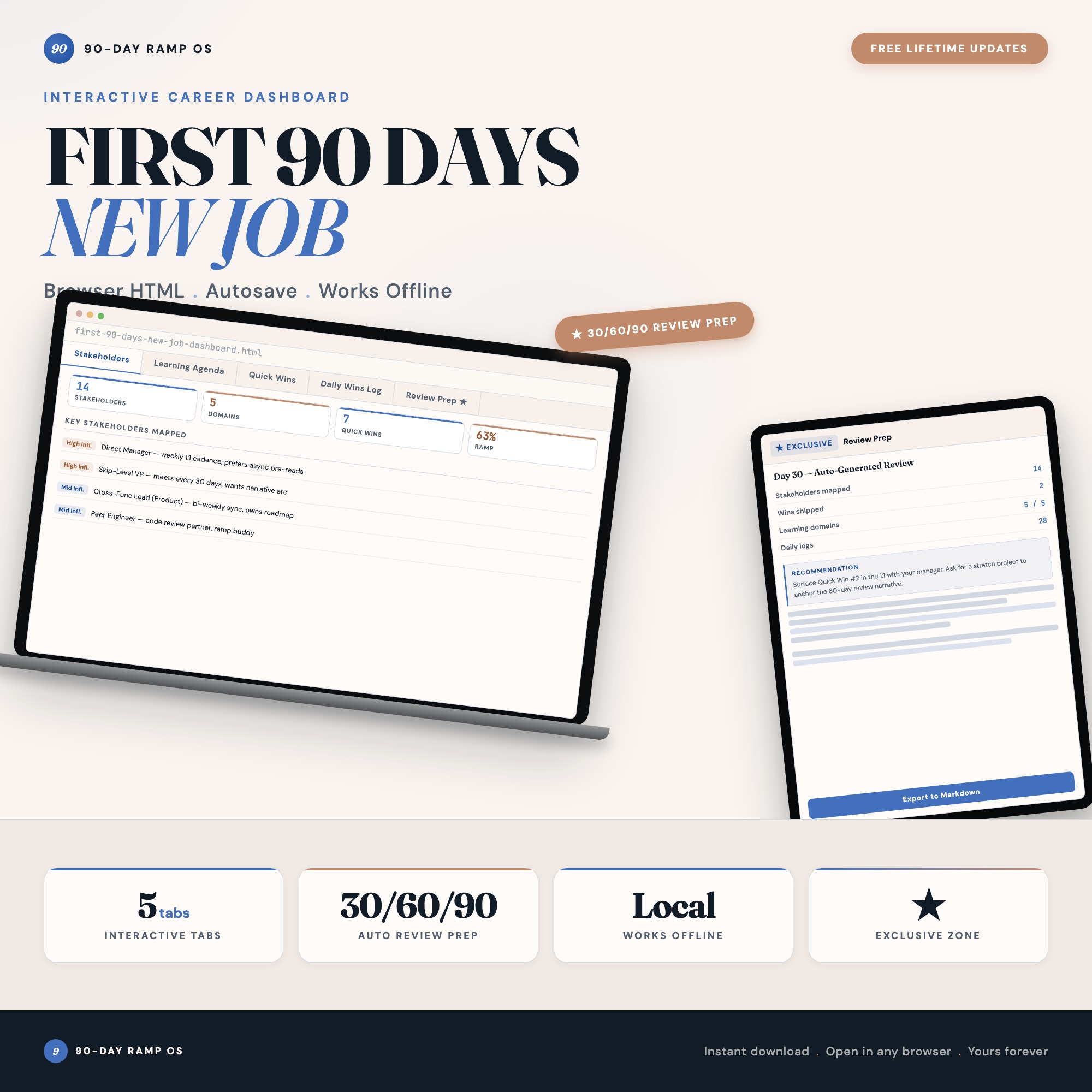
Build your stakeholder map in the first week. For each key person — your direct manager, your skip-level, your peers, and any cross-functional partners you’ll work with regularly — capture their role, their influence level, their current priorities, and what a good working relationship with them looks like. The First 90 Days New Job Dashboard’s Stakeholders tab has fields for all of this, plus a “relationship health” indicator you update as you build each relationship.
Organize your Learning Agenda across five domains: product (what you’re building or selling), process (how the company actually works), people (the informal org chart), politics (who has influence and why), and culture (what behaviors are rewarded vs. punished). Most new employees focus on product and ignore politics and culture — and then get blindsided in month four when they don’t understand why something isn’t moving.
At the end of week 4, you should be able to answer: Who are the three people I need to impress most? What is the one thing my manager most wants from me in 90 days? What is the team’s biggest current challenge, and do I have any early insight on it?
Days 31–60: Ship Something Visible
The Quick Wins phase. Your goal in the second month is to have at least two things that people noticed. Not transformative projects — small, visible deliverables that signal competence and initiative.
What makes a good quick win:
- Completable in one to two weeks, not a month
- Directly relevant to something your team cares about
- Visible to at least one key stakeholder
- Requires your specific skill set to deliver
The Quick Wins tab in the First 90 Days New Job Dashboard is a kanban board: Idea, In Progress, Shipped. Each card captures why the win matters and who will notice it. Keeping this list in front of you makes it a priority rather than a vague intention.
Your Daily Wins Log entries in this phase should start reflecting shipped work, not just learning. “Completed the competitive analysis” or “Ran the first stakeholder sync and got alignment on the Q3 goal” are Daily Log entries that will matter at your 60-day review.
Days 61–90: Take Ownership
By the third month, you should be able to operate without being led through every decision. The third phase is about taking visible ownership of something — a project, a process, or a relationship — and demonstrating that you’re in command of it.
Your manager review at Day 90 is where the planning pays off. If you’ve kept your stakeholder map, learning agenda, quick wins, and daily log current, you have 90 days of evidence sitting in your system. The review stops being an improvised conversation about “how things are going” and becomes a structured presentation of what you accomplished, what you learned, and what you’re taking ownership of next.
The 30/60/90 Review Prep Tab
The First 90 Days New Job Dashboard has a Review Prep tab that exists precisely for this moment. At the 30-day mark, click “Generate Review.” The dashboard reads your stakeholder notes, your quick-wins log, your learning agenda progress, and your daily wins journal, and assembles a manager-ready performance narrative. Export it as markdown, paste it into your notes app, or bring it to the meeting.
No other 90-day planner on Etsy ships this as an interactive generator. Every competitor is a static workbook or PDF template you fill out by hand the night before the meeting.
The full dashboard — Stakeholders, Learning Agenda, Quick Wins, Daily Wins Log, and Review Prep — is a single offline HTML file at $25 one-time.
Frequently asked questions
- What should a 30-60-90 day plan include for a new job?
- A solid 30-60-90 day plan has four components: a stakeholder map (who the key players are and what they care about), a learning agenda organized by domain (product, process, people, culture), a quick wins list of visible early deliverables, and a daily log you update continuously. Those four inputs feed your 30, 60, and 90-day manager reviews.
- How detailed should a 30-60-90 plan be on Day 1?
- Not very. On Day 1, your plan should be mostly questions, not answers. Fill in the stakeholder map and learning agenda structure, then let the first two weeks inform what goes into quick wins. Over-planning before you understand the real landscape is a common mistake.
- What is a quick win in the 30-day context?
- A quick win is a small, visible-impact deliverable you can complete in days 30–60 that builds credibility early. The key word is visible — it needs to be something people notice. Cleaning up an internal doc, fixing a broken process, shipping a small feature, or completing a report on time all count.
- How do I prepare for my 30-day review?
- Pull from your stakeholder notes, your quick wins log, your learning progress, and your daily wins journal. The 30/60/90 Review Prep tab in the First 90 Days New Job Dashboard reads all four sources and generates a structured performance narrative in one click — so you walk in with a formatted document, not improvised talking points.
- How much does the First 90 Days New Job Dashboard cost?
- One-time purchase of $25 on Etsy. No subscription required.
Ready-made dashboards
Skip setup — grab an interactive dashboard built for this exact workflow.
ListingResearchOS Shop
All dashboards — one-time purchase, yours forever
Single HTML files. No subscriptions. No login. Works offline in any browser.
Browse all dashboards →