
12 Week Year Implementation Guide: How to Actually Execute the Framework
The 12 Week Year framework is simple; execution is where it breaks. Here are the steps, tools, and weekly habits that make the system actually stick.
Published June 3, 2026
The 12 Week Year by Brian Moran is one of the most cited productivity frameworks in the last decade. The premise is clean: treat 12 weeks as a complete year, set one to three measurable outcomes, map the weekly actions that drive those outcomes, and score your execution every week. Most people read the book, feel the clarity, and then go back to their annual goals and their open-ended to-do lists.
This guide covers what it actually takes to run the framework — not just understand it.
Why People Don’t Execute It
The framework doesn’t fail because the ideas are wrong. It fails at three points: goal-writing that’s too vague to score, no system for weekly tactic check-ins, and no process for Week 13 that makes starting the next sprint feel possible.
Vague goals can’t be scored. “Get in better shape” has no execution score. “Complete four 45-minute strength sessions per week” does. The framework’s scoring system — which calculates your execution percentage weekly — only works if your tactics are concrete enough to mark done or not done.
No tactic table means no accountability. The lead measures are the engine of the system. A lead measure is the specific weekly action that drives a goal forward. If your goal is to close two new clients in 12 weeks, your lead measure might be “reach out to 10 prospects per week.” Without a tactics table mapping each goal to its lead measures, you have a vision board, not a sprint plan.
Week 13 is the reset most people skip. Most practitioners abandon the framework after sprint one because starting over feels hard. You close the sprint, feel the exhaustion, and tell yourself you’ll restart next month. Week 13 exists to prevent exactly that: a structured debrief that captures what worked and what blocked you, then seeds the next sprint from those inputs. Without it, every sprint starts from zero.
Setting Up Your First Sprint: Step by Step
Define Your Outcomes First
Before building any system, get the goal structure right. You need one to three twelve-week outcomes with measurable targets and a clear end state. For each outcome, ask: “How will I know, at the end of week 12, that I accomplished this?” If the answer requires judgment rather than measurement, rewrite it.
Example: “Grow my freelance revenue” is not a 12-week goal. “Close $15,000 in new client contracts by week 12” is.
Map Your Lead Measures Per Goal
For each goal, identify the weekly actions you control — not the results, the actions. Results are lagging indicators; lead measures are what you do each week. Set the specific number: not “reach out to prospects” but “send 8 cold outreach emails every Monday and Tuesday.”
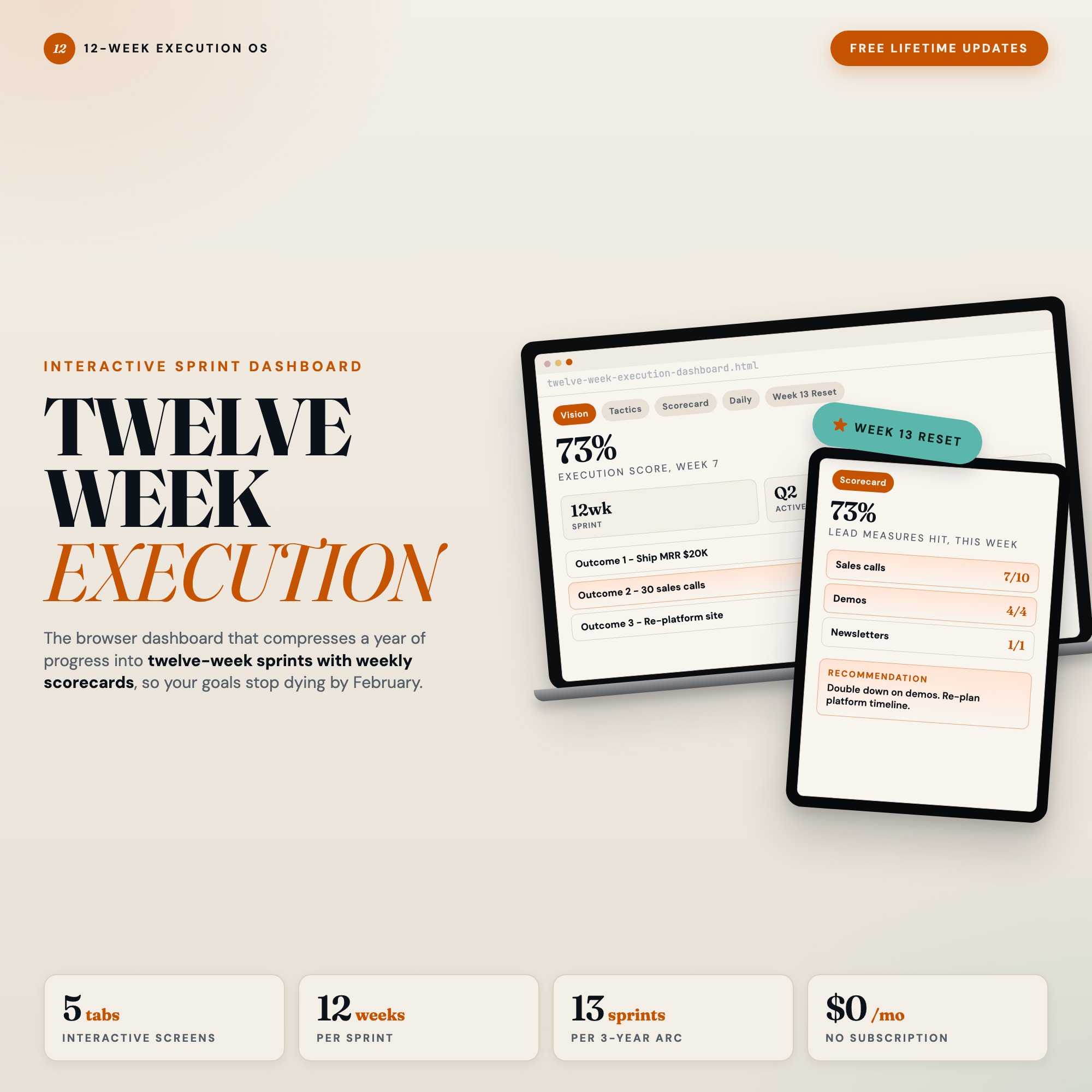
The 12 Week Execution Dashboard’s Tactics tab is a weekly lead-measure action table where each row links directly to one of your goals. When you check off tactics each week, your execution score calculates automatically. A score of 85% or higher is a successful execution week.
Use the Daily Check-In to Bridge Weeks
Most 12-week plans lose momentum between weekly reviews. The Daily Check-In tab addresses this: at the start of each day, you set your top three priorities and mark which lead-measure actions you’re completing today. This 2-minute ritual keeps the weekly tactics visible on a daily basis instead of something you review once on Monday and forget by Wednesday.
Score Weekly Without Excuses
At the end of each week, score your execution honestly. The number isn’t about judgment — it’s diagnostic. If you’re hitting 65% three weeks in a row, your tactic plan is overloaded. If you’re at 95%, you may be playing it too safe. The Weekly Scorecard tab in the 12 Week Execution Dashboard auto-calculates your score for the week and builds the 12-week trend grid so you can see momentum — or its absence — over time.
Run Week 13 as a Full Debrief
When week 12 ends, don’t start planning sprint 2 immediately. Spend Week 13 on the debrief: what wins can you document, what blocked you in specific terms (not “I got busy” — what specifically happened), what would you do differently, and what stop/start/continue decisions follow from that.
The Week 13 Reset tab in the 12 Week Execution Dashboard walks you through this structured review and then auto-seeds your next sprint from what you captured — pulling your stop/start/continue decisions directly into the next sprint’s Vision tab. No competitor ships this as an interactive feature. Other planners give you a template to fill in; this one reads your own data and sets up sprint two for you.
Common Execution Failures
Treating tactics as aspirational. If a tactic goes unfinished three weeks in a row, it’s not a tactic problem — it’s a scheduling problem. Tactics need calendar blocks, not just intentions.
Trying to run too many goals at once. Four goals with eight weekly tactics each means 96 actions to score per week. At that volume, the scoring becomes noise. Keep the sprint focused: three goals maximum, five or six weekly tactics total.
Reviewing weekly but never daily. The system compounds when you look at it daily, not just at the weekly review. The Daily Check-In is not optional — it’s what prevents the Sunday-night panic of realizing you completed zero tactics all week.
The Right Tool for Running This System
The 12 Week Execution Dashboard is a single offline HTML file with five tabs mapped directly to the framework: Vision (your goal canvas), Tactics (your lead-measure action table), Weekly Scorecard (auto-calculated execution score and trend grid), Daily Check-In (top three priorities plus tactic checklist), and Week 13 Reset (structured debrief that seeds the next sprint).
It runs in any browser. Everything autosaves to your device. No subscription, no login, no internet required after download. $22 one-time.
The framework is simple. The execution just needs the right infrastructure behind it.
Frequently asked questions
- What is the single most important thing to get right in the 12 Week Year?
- Your tactics table. Most people set the three 12-week goals but never map the weekly lead-measure actions that drive them. Without a tactics table linking each goal to weekly actions, you're running a quarterly vision board, not a sprint system.
- How many goals should I have in a 12-week sprint?
- Brian Moran's framework recommends one to three goals maximum. The scoring system — which calculates your execution percentage weekly — becomes meaningless if you're tracking six goals simultaneously. Three is the ceiling; one is fine if it's the right one.
- What does a good weekly execution score look like?
- The framework considers 85% execution or above a successful week. Below 65% consistently signals that your tactic plan is overloaded, not that you're failing at the goals themselves.
- What is Week 13 and why does it matter?
- Week 13 is not a bonus week — it's a structured debrief. You review wins, blockers, and lessons from the sprint, then use those inputs to seed the next 12-week plan. Skipping Week 13 is why most people abandon the framework after sprint one: starting over from a blank page is hard, so they don't start at all.
- What does the 12 Week Execution Dashboard cost?
- One-time purchase of $22 on Etsy. No subscription, no login required. Yours permanently.
Ready-made dashboards
Skip setup — grab an interactive dashboard built for this exact workflow.
ListingResearchOS Shop
All dashboards — one-time purchase, yours forever
Single HTML files. No subscriptions. No login. Works offline in any browser.
Browse all dashboards →