
Garmin vs. Strava vs. Offline Training Log: What Marathoners Actually Need
Comparing Garmin Connect, Strava, and an offline marathon training log: what each does for race-specific preparation versus general fitness tracking.
Published June 3, 2026
Our verdict
For first-marathoners and PR-chasers training 12-20 weeks for a specific race, the Marathon Training Dashboard at $24 one-time provides a 16-week training plan, mileage log, race-day prep checklist, and a Race Pace Calculator that converts recent training paces into target splits and a projected finish time.
Garmin and Strava are exceptional fitness tracking platforms. For a 16-week marathon build with a specific goal race, a specific pace target, and a taper to manage, they cover different ground than most marathoners realize. Here is the honest breakdown.
What Garmin Connect Does for Marathoners
Garmin Connect is primarily an activity recording and analysis platform for Garmin device users. It logs every run automatically — distance, pace, heart rate, cadence, elevation. The Race Predictor uses recent fitness data to project finish times for standard distances. Training plans are available and sync to your watch.
Where Garmin Connect falls short for dedicated marathon training: it is not race-specific prep infrastructure. There is no place to track your race-day logistics checklist, compare your current cycle’s long-run paces against your target pace, log taper notes and nutrition strategy, or plan your gear and course nutrition timing. It is excellent at recording what you did, weaker at planning what you need to do.
What Strava Does for Marathoners
Strava is a social fitness platform with strong community features — segments, club runs, kudos. The Summit tier adds training load analysis, fitness and freshness charts, and some race insights.
Strava’s training load analysis is useful for monitoring fatigue during a build. But Strava is designed for all athletes across all sports, not specifically for marathon race preparation. There is no 16-week training plan tracker, no taper week protocol, no race-day prep checklist, and no per-mile split calculator built for marathon goal pacing.
TrainingPeaks: Best for Coach-Athlete Collaboration
TrainingPeaks is the most sophisticated training analysis platform for endurance athletes. If you work with a coach, your coach likely prescribes workouts in TrainingPeaks. The CTL/ATL/TSB model is the most accurate way to manage training load for peak race performance.
For self-coached runners without a coach, the free tier is useful but limited. Premium at $19.99/month adds the features that matter. For a single 16-week marathon cycle, that is $80-$120 if you subscribe only during your training block.
The Marathon Training Dashboard: Race Prep in One File
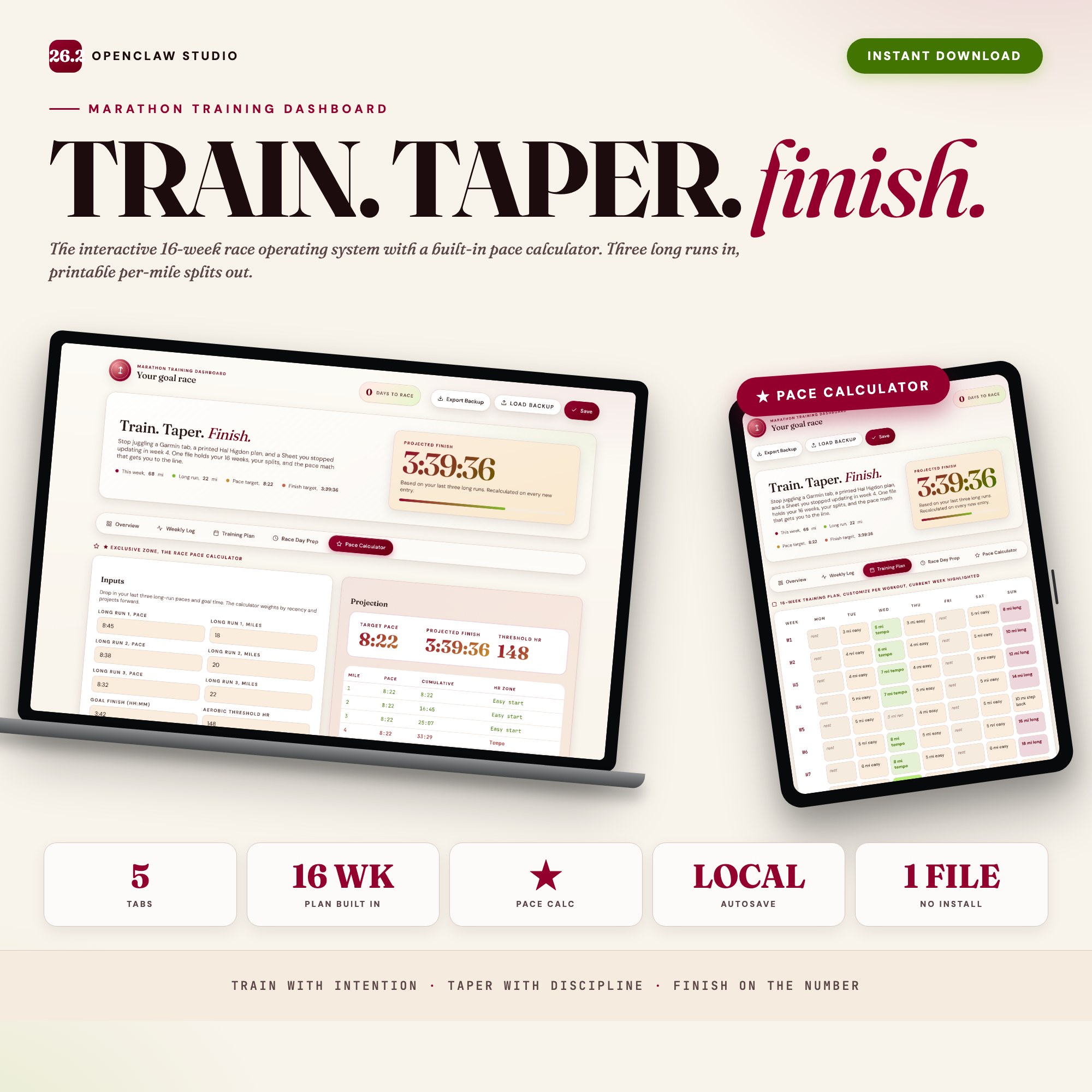
The Marathon Training Dashboard is a browser-native dashboard built for a single 16-week marathon training cycle, at $24 one-time.
Overview: Days to race, total weekly mileage, longest run this cycle, projected finish time — your race dashboard for 16 weeks.
Weekly Log: Date, miles, pace, route, shoe, surface, heart rate average, RPE, notes. Per-week mileage rollup. The streak engine that makes training visible.
Training Plan: 16 weeks pre-loaded with easy, tempo, long, recovery, race-pace, and rest days. Current week highlighted by your race date. Customizable per your fitness level.
Race Day Prep: Gear checklist, nutrition timing, taper-week protocol, course notes, sleep target, alarm time, pre-race breakfast. The checklist that survives taper-week anxiety.
Race Pace Calculator (exclusive): Input your three most recent long-run paces, goal time, and aerobic threshold HR. The dashboard outputs your target marathon pace, projected finish time, per-mile splits, and a printable wrist band by heart-rate zone. No static plan and no GPS platform ships this interactive pace projection built specifically for marathon goal-setting.
The Taper Week Gap
One area where every platform falls short for marathoners is taper management. The final 2-3 weeks before race day involve reducing mileage while maintaining intensity — a counterintuitive shift that causes most runners to panic and overtrain. There is no structured taper protocol in Garmin Connect or Strava. There is no reminder that week 15’s mileage should drop to 60% of your peak and week 16 to 40%. There is no race-week checklist covering the logistics, nutrition, and sleep elements that compound on race morning.
The Race Day Prep tab in the Marathon Training Dashboard includes a taper-week protocol with a specific mileage-reduction schedule for weeks 14-16 and a race-week checklist covering gear lay-out, dinner the night before, morning nutrition, warm-up routine, and pacing strategy for miles 1-6. Most runners who bonk in miles 20-26 made decisions in miles 1-6. The checklist addresses those early decisions explicitly.
What Each Platform Handles Best
| Garmin Connect | Strava Summit | TrainingPeaks | Marathon Training Dashboard | |
|---|---|---|---|---|
| Automatic GPS tracking | Yes (device required) | Yes | Yes | No (manual log) |
| Race-specific 16-week plan | Basic | No | With coach | Yes (pre-loaded) |
| Taper week protocol | No | No | Yes | Yes |
| Race-day prep checklist | No | No | No | Yes |
| Pace projection / split calculator | Basic predictor | Basic | Advanced | Yes (custom per your paces) |
| Cost | Free (device costs) | $12/mo or $80/yr | Free-$20/mo | $24 one-time |
Use Garmin or Strava for automatic run tracking. Use the Marathon Training Dashboard for race-specific planning, taper management, and the pace math that tells you the exact number to run at mile 13. Available at ListingResearchOS on Etsy.
Frequently asked questions
- Does Garmin Connect have a marathon training plan?
- Garmin Connect includes training plans for various distances, including marathon. The plans sync to your device and adjust for your fitness level. They work well if you run with a Garmin watch. They do not include a pace projection tool that accounts for your specific recent training paces.
- What does Strava Summit (Premium) cost for marathon training?
- Strava Summit is $11.99/month or $79.99/year. It adds training load analysis, fitness and freshness charts, and some race insights. For pure marathon race prep — plan tracking, taper management, and pace projection — Strava is more general fitness than race-specific.
- What is TrainingPeaks and who should use it?
- TrainingPeaks is the gold standard for coach-athlete collaboration. Athletes upload workouts, coaches review data and prescribe sessions, and the platform tracks CTL (chronic training load) and ATL (acute training load). If you train with a coach, TrainingPeaks is often required. For self-coached runners, the Basic plan is free; Premium is $19.99/month.
- How does the Race Pace Calculator work?
- Input your three most recent long-run paces, your goal finish time, and your aerobic threshold heart rate. The Marathon Training Dashboard computes your target marathon pace, projected finish time, recommended per-mile splits, and a printable pace band broken by heart-rate zone.
- Can I use this alongside my Garmin or Strava?
- Yes. Many runners use Garmin or Strava for automatic GPS tracking and sync, then use the Marathon Training Dashboard for race-specific planning, taper management, and pace projection. The two approaches complement each other rather than competing.
The winner: interactive dashboards
No spreadsheet. No subscription. One HTML file that runs offline in your browser.
ListingResearchOS Shop
Stop comparing — start using
Interactive dashboards. One-time purchase. No subscriptions. Works offline.
Browse all dashboards →