
12 Week Year vs. OKRs vs. Quarterly Goals: Which Planning System Wins?
Honest breakdown of 12 Week Year, OKRs, and quarterly planning: what each does well, where each fails, and when an offline dashboard outperforms all three.
Published June 3, 2026
Our verdict
For entrepreneurs and professionals who understand the 12-week sprint framework but need execution infrastructure, the 12 Week Execution Dashboard at $22 one-time is the strongest standalone option — purpose-built tabs, auto-scoring, and the only Week 13 Reset on the market.
Three planning frameworks, one honest verdict — and a real look at the execution question nobody answers.
The Core Difference Between These Three Frameworks
The 12 Week Year (Brian Moran’s framework) argues that a full year is too long a planning horizon to generate urgency. A 12-week “year” compresses the timeline so week 12 feels like December 31, not some distant future. The book is excellent. The gap between reading it and actually running the system is the whole problem most readers face.
OKRs (Objectives and Key Results) were developed at Intel and popularized by Google. You write an ambitious Objective and 3-5 measurable Key Results that signal success. Most teams run OKRs on a quarterly cycle — the same calendar span as a 12-week sprint, just framed differently. OKRs are stronger when you need team alignment. Solo practitioners often find them bureaucratic without a team sharing the objective.
Quarterly Goals is what most people actually do: a list of intentions written when a new quarter starts. It lacks the urgency mechanism of the 12-week framing and the measurability of OKRs. But it is also the least friction, which is why it remains the default.
Where Each Framework Breaks Down
The 12 Week Year fails most people not because the ideas are wrong but because there is no native execution layer. The book describes Vision, Tactics, Lead Measures, Execution Score, and Weekly Scorecard — but leaves you to build the tracking infrastructure yourself. Most people assemble a mediocre spreadsheet and stop updating it by week 4.
OKRs fail solo practitioners because the review cadence — quarterly OKR scoring, key result grading, retrospective sessions — makes sense when a team shares the objective but feels heavy for one person. Most OKR software is enterprise-priced: $15-$30 per seat monthly is real overhead for an individual.
Quarterly goals fail because they are just lists. A list without a weekly scoring mechanism and a structured debrief at the end compounds nothing. The same goals show up on Q1, Q2, Q3, and Q4 lists year after year.
What the 12 Week Execution Dashboard Provides
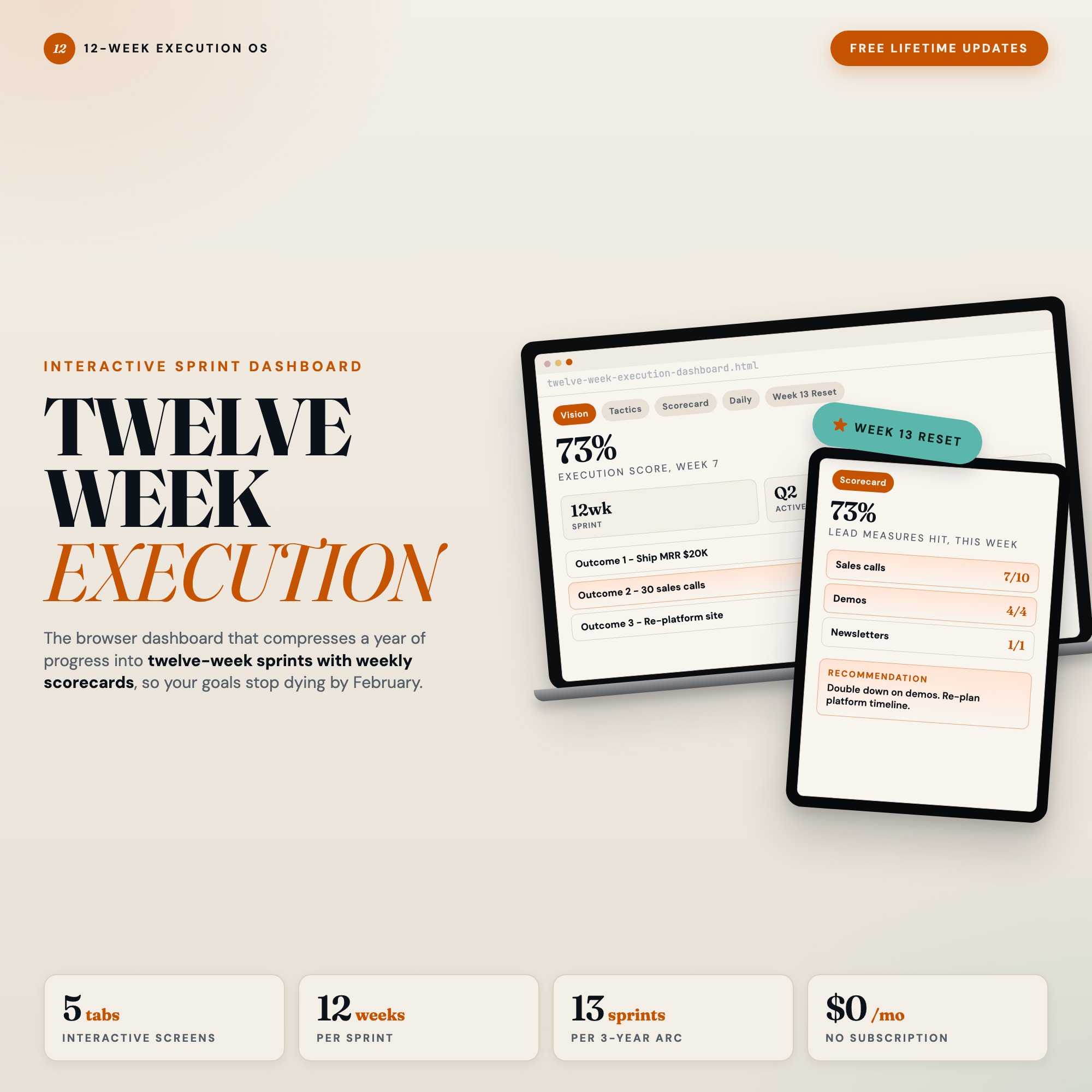
The 12 Week Execution Dashboard is a browser-native interactive tool built specifically for the 12-week sprint framework. Five tabs, $22 one-time.
Vision tab: Write your 1-3 twelve-week outcomes with measurable targets. Specific, scoreable commitments tied to a deadline.
Tactics tab: Map the weekly lead-measure actions that drive each goal. The engine of the framework: tactics completed equals goals achieved.
Weekly Scorecard: Your execution score calculates automatically each week. A 12-week trend chart builds in real time. You always know your sprint’s trajectory.
Daily Check-In: Each morning — top 3 priorities and today’s lead-measure actions. Focused execution, not open-ended task lists.
Week 13 Reset (exclusive): The post-sprint debrief tab that no other planner on the market ships. After your sprint ends, it walks through wins, blockers, and lessons — then auto-seeds the next sprint from what you captured. This is what turns a single sprint into a compounding system.
Framework Comparison at a Glance
| 12 Week Year (book alone) | OKRs (enterprise tools) | Quarterly Goals | 12 Week Execution Dashboard | |
|---|---|---|---|---|
| Execution scoring | None built-in | Depends on tool | None | Auto-calculated weekly |
| Tool cost | Book $15, then DIY | $15-$30/mo per seat | Free (doc) | $22 one-time |
| Works offline | N/A | Usually no | Yes | Fully offline |
| Next-sprint seeding | Manual | Manual | Manual | Automatic (Week 13 Reset) |
| Solo-use fit | Good (framework) | Better for teams | Good | Purpose-built for solo |
The Execution Score: What Makes the 12-Week Framework Different
The 12 Week Year’s core mechanism — the Execution Score — is what separates it from both OKRs and quarterly goal lists. Each week, you score yourself on whether you completed your planned tactics: did you do the weekly lead-measure actions or not. The score is a percentage: tactic completion rate. An execution score of 85% or higher typically produces goal achievement. Below 65%, the sprint is likely to fall short.
This feedback loop is what the framework’s founder, Brian Moran, calls the “lead measure discipline.” Most goal systems measure outcomes (did you achieve the result?) rather than lead measures (did you do the work that produces the result?). The problem with outcome measurement is that it gives feedback too late — you find out at week 12 that the goal was not achieved. Lead-measure scoring at the Weekly Scorecard gives you a signal every week. The 12 Week Execution Dashboard automates this calculation — you mark tactics complete, the score appears. No spreadsheet formula to maintain.
The Honest Verdict
Use the 12 Week Year framework if you want conceptual grounding and will build your own tracking system. Then use a dedicated execution tool — the book describes the system but cannot score your completion rate.
Use OKRs if you work with a team that needs shared visibility, or if you specifically want the Objective plus Key Results measurement structure. For solo work, the overhead is usually not worth it.
Use quarterly goals if you want minimal friction and trust yourself to review a simple document consistently every week. Some people can. Most cannot.
Use the 12 Week Execution Dashboard if you want to run the sprint framework with the infrastructure the book describes but does not provide. Auto-scoring, Daily Check-In, and a Week 13 Reset that makes sprint 2 better than sprint 1 — for $22, one-time, no account required. Available at ListingResearchOS on Etsy.
Frequently asked questions
- What is the key difference between 12 Week Year and OKRs?
- The 12 Week Year compresses a full year's urgency into 12 weeks. OKRs use the same calendar quarter but add Objectives and Key Results as a measurement layer. Both are planning philosophies — you need a separate execution tool for either.
- Can you run the 12 Week Year framework in a spreadsheet?
- Technically yes, but spreadsheets do not auto-calculate execution scores or prompt structured weekly reviews. The 12 Week Execution Dashboard does both, plus the Week 13 Reset auto-seeds your next sprint from your debrief data.
- What does the Week 13 Reset actually do?
- After your 12-week sprint ends, the Week 13 Reset tab prompts a structured debrief covering wins, blockers, and lessons, then uses your answers to pre-populate the Vision and Tactics tabs for the next sprint.
- Is the 12 Week Execution Dashboard a subscription?
- No. It is a one-time $22 download — a single HTML file you open in any browser. No login, no cloud account, no renewal. Everything saves to your browser's localStorage.
- What if I want to use OKRs instead of the 12 Week Year framework?
- The Weekly Scorecard and Vision tabs in the 12 Week Execution Dashboard are flexible enough to hold OKR-style objectives and key results. The auto-scoring logic still works because it tracks tactic completion regardless of framework.
The winner: interactive dashboards
No spreadsheet. No subscription. One HTML file that runs offline in your browser.
ListingResearchOS Shop
Stop comparing — start using
Interactive dashboards. One-time purchase. No subscriptions. Works offline.
Browse all dashboards →