
9 Records Every Foster Parent Must Track for Each Child
9 records foster parents must keep per child — CPS contacts, court hearing logs, visitation compliance — and how to produce them all on short notice.
Published June 3, 2026
Foster parents operate in one of the most paperwork-intensive environments in the social services system. Each child in placement comes with a CPS caseworker, a court case number, a school placement, medical providers, and often a therapist — and each of those relationships generates its own documentation requirements. When you are managing more than one placement, the record-keeping demands compound quickly.
The nine records below are the ones juvenile courts, CASA volunteers, and licensing agencies most commonly need — and the ones most foster parents are least organized to produce on short notice.
Child placement record with case numbers
Every child in your home has a unique case number, placement date, primary caseworker, and legal status. This information changes: caseworkers rotate, case numbers update with new filings, placement status shifts from emergency to licensed to permanency planning. A dedicated child record card with all of this information — updated each time something changes — is the foundation everything else builds on.
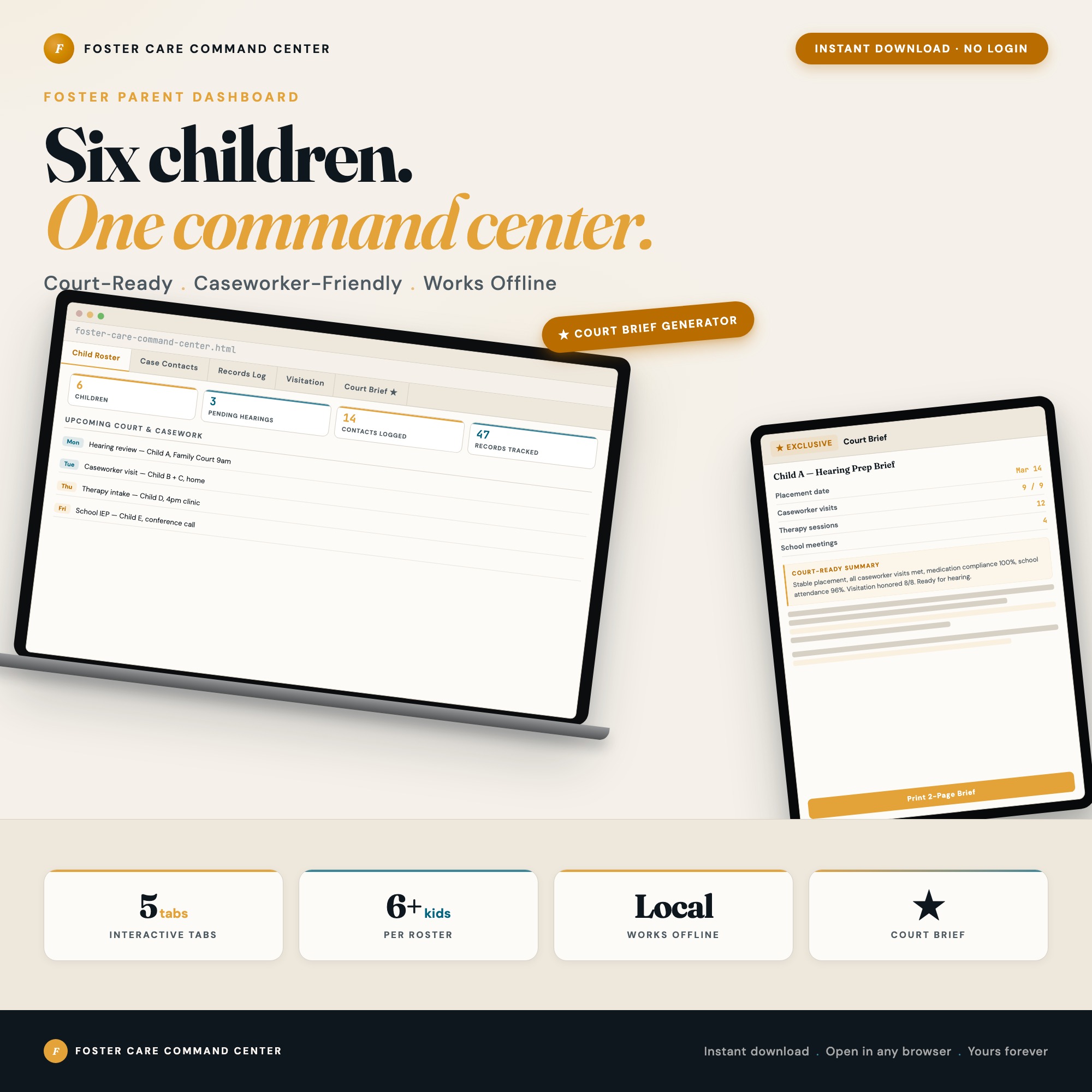
The Foster Care Command Center Child Roster tab holds up to 8 children with dedicated record cards per child.
Complete contact directory linked per child
CPS caseworkers, attorneys, CASA volunteers, therapists, teachers, and pediatricians — each child may have 6 to 10 people in their service network. When the caseworker changes or the therapist transfers to a new practice, you need to update the record for that specific child without disrupting the records for other children in your home. A contact directory that links each person to the specific child they serve, with role, direct phone, and notes, is the organizational foundation that makes every other coordination task possible.
Chronological records log with outcome fields
Every medical appointment, school meeting, therapy session, court appearance, caseworker visit, and significant home event should be logged with a date, type, notes, and outcome. This log is not primarily for your own reference — it feeds your court hearing prep, your licensing renewal, and any investigations or transitions that require a case history.
The Foster Care Command Center Records Log tab filters by child, event type, and date range, and every entry has both a notes field and an outcome field.
Visitation log with attendance and behavioral notes
Documented visitation compliance matters in court. Missed visits, late cancellations, and child behavioral patterns before and after visits are all relevant to reunification assessments and parental rights proceedings. A visitation log with attendance, hours, location, who was present, child behavior before and after, and CASA notes turns what would otherwise be anecdotal testimony into documented evidence.
Medical record summary with current provider and last appointment
Emergency rooms and specialists do not have access to your child’s prior foster care medical history. A medical summary that includes current diagnoses, active medications, allergies, immunization status, insurance ID, and the name and phone number of the primary pediatrician can be shared in minutes rather than assembled under pressure.
School placement record with current enrollment details
School changes are common in foster care, and the record of where a child has been enrolled — and how they performed — is relevant to educational stability assessments. A school placement record with current school name, grade, teacher contact, enrollment date, and any IEP or 504 status ensures you have what a new school needs when a placement change requires immediate re-enrollment.
Therapy and mental health provider notes
Therapy provider contacts, diagnosis, treatment goals, session frequency, and appointment dates form a treatment record that should travel with the child. When a therapist changes, or a court needs evidence of mental health services provided, this record is what you hand over.
Court hearing history with dates and outcomes
Every hearing has a date, a judge, a brief summary of what was addressed, and an outcome (continued, services ordered, hearings scheduled, etc.). Foster parents who can walk into a juvenile court appearance with documented hearing history are taken more seriously than those relying on memory.
A court hearing prep brief generated from your own records
This is the record type that no binder system can replicate. The exclusive feature in the Foster Care Command Center is the Court Hearing Prep Brief generator in Tab 5: select a child and a hearing date, and the dashboard reads that child’s active contacts, recent records log, current school and medical status, and visitation history — then outputs a formatted 2-page brief covering case players, status since the last hearing, outstanding concerns, and a chronological event summary. Download as text, print it, hand it to your attorney. No other foster care tool on Etsy ships this. No static PDF can generate it.
One Dashboard for Every Child, Every Case
The Foster Care Command Center covers Child Roster, Case Contacts, Records Log, Visitation Tracker, and Court Hearing Brief in one HTML file for $27. Data stays on your device — no cloud, no account, no subscription.
Frequently asked questions
- What records do foster parents need to bring to a court hearing?
- The foster parent's documented observations of the child's daily life, current school and medical provider contacts, a log of visitations and any missed visits, and a summary of significant events since the last hearing. The Foster Care Command Center generates a structured 2-page brief from your own logged data.
- What happens when a CPS caseworker changes mid-case?
- All contact information, case history, and service authorizations must be rebuilt with the new worker. A complete contact directory that links every provider to the specific child they serve makes this transition faster and reduces gaps in service coordination.
- Do I need to spend a lot of money on tools?
- No. The Foster Care Command Center costs $27 as a one-time purchase — built for foster parents managing multiple children's records across CPS caseworkers, juvenile court, therapy, school, and medical providers.
- How quickly can I get started with the Foster Care Command Center?
- Under 5 minutes. Download the file, open it in any browser, and start using it immediately. Everything autosaves automatically.
Featured dashboards from this list
Interactive HTML dashboards — one-time purchase, works offline, no subscription.
ListingResearchOS Shop
All dashboards — single file, yours forever
Interactive HTML. No subscription. Works offline in any browser.
Browse all dashboards →