
8 Things NICU Parents Need to Track Every Day
8 things NICU parents should log daily — vitals, feed volumes, milestone dates, family updates, and an evidence-based discharge readiness checklist.
Published June 3, 2026
NICU stays generate enormous amounts of information. Nurses give round updates, doctors discuss plans, weight trends shift daily, breathing support levels change. Most NICU parents try to hold it in their head or scribble it in a notebook. By week 3, the notebook has gaps and the timeline is blurry.
Tracking the right things daily, in a structured system, does two things: it reduces anxiety by giving you clarity about where your baby actually stands, and it makes you a more informed participant in your baby’s care. Here are the eight things worth tracking every day.
Round notes and key medical decisions
At every nursing shift change and attending round, there are updates: weight this morning, feeding plan adjustment, respiratory support level, new medication, expected next step. These are the data points that compound over weeks into a picture of your baby’s progress. Log the date, the provider, the key update, and any decision made — even informally.
The NICU Parent OS Daily Log tab pre-structures this with fields for who you spoke to, what was decided, and any photos you captured, with a full history view.
Weight trend with daily measurements
NICU weight is not measured to satisfy parental curiosity — it is the single most watched number in determining discharge readiness. A preemie below 1700g is not ready to go home regardless of how well they are otherwise doing. Logging daily weights and watching the trend over two or three weeks tells you whether growth is consistent or has stalled.
Oral feeding volume and feeding method
Transitioning from gavage to full oral feeds is one of the last milestones before discharge. “Getting there” is not a useful status. Logging the volume offered, the volume taken orally, the method (bottle, breast, NG tube supplement), and the feed duration gives you data to bring to feeding therapy conversations and to track whether the 48-hour sustained oral feeding window is within reach.
Breathing support level and apnea count
Whether your baby is on a ventilator, CPAP, high-flow, low-flow, or room air is not a static status — it can change in either direction. Logging the current support level each day and noting any apnea episodes (number, duration, intervention required) creates the continuity that tells you whether the breathing trajectory is improving.
Temperature stability in open crib
Moving from an isolette to an open crib requires the baby to maintain body temperature independently. This transition is often attempted, then reversed, then attempted again. Logging when each crib trial happened, the duration, and the result (stable/unstable) tracks this milestone accurately rather than leaving it as a vague impression.
Milestone dates with timestamps
First kangaroo care. First oral feed. Off the ventilator. Off CPAP. First open crib. Passed the car seat test. These are the 12 standard preemie milestones, and the date of each one matters — both for your own memory and for the discharge summary your pediatrician will use. The NICU Parent OS Milestones tab lets you check each one with a date stamp as it happens.
Discharge readiness across all five criteria
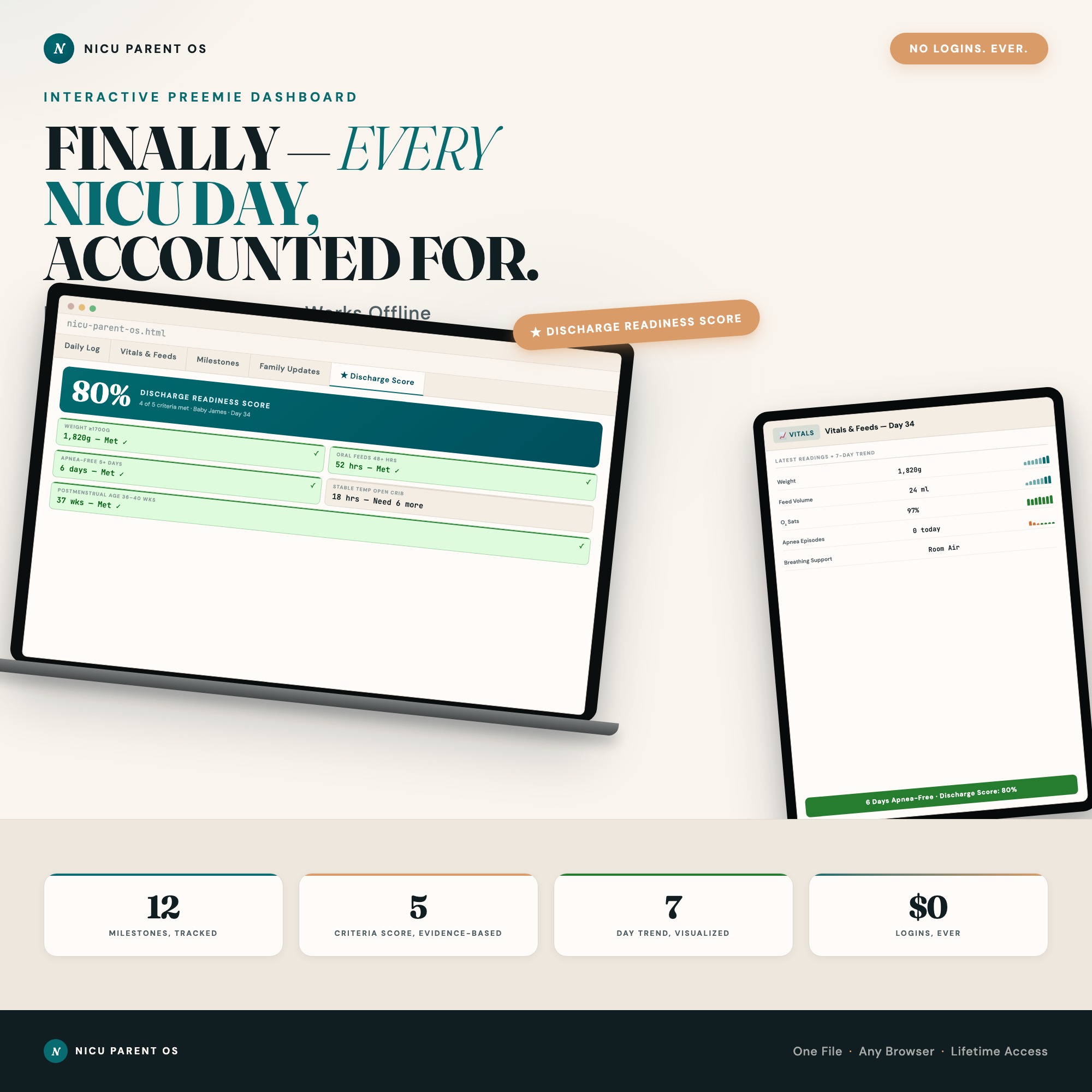
Parents often ask “when can we go home?” and receive an answer like “getting closer” or “a few more things to clear.” What they need is a structured view of exactly which criteria are met and which are still pending — with specifics. The exclusive feature in the NICU Parent OS is the Discharge Readiness Score in Tab 5: enter your baby’s current weight, feeding status, apnea history, respiratory rate, and postmenstrual age, and the dashboard returns a percentage score with a clear breakdown of which of the five evidence-based criteria are met versus pending. No other NICU tool on Etsy ships this — the current market is dominated by printable journals.
Family update communication
NICU families spend enormous energy fielding the same questions from grandparents, siblings, and friends. The Family Updates tab in the NICU Parent OS auto-generates a daily group-chat message from your logged vitals and milestone hits — you fill in the data once, and the update writes itself. One copy, paste, send.
Everything in One File, On Your Device
The NICU Parent OS is $19 one-time. Five tabs: Daily Log, Vitals and Feeds, Milestones, Family Updates, and Discharge Score. Works offline in any browser — no login, no server, no subscription.
Frequently asked questions
- What are the evidence-based discharge criteria for NICU babies?
- The five standard criteria are: weight at or above 1700g, full oral feeding maintained for 48 or more hours, no apnea episodes for 5 to 7 days, respiratory rate below 60 breaths per minute and stable, and stable body temperature in an open crib at 36 to 40 weeks postmenstrual age. The NICU Parent OS scores each criterion and returns a readiness percentage.
- How should I share daily NICU updates with family without retelling everything from scratch?
- Log your vitals and milestone hits in the dashboard first. The Family Updates tab auto-generates a copy-paste daily group-chat message from your logged data — one action, sent to everyone.
- Is it safe to keep my baby's medical data in an app?
- The NICU Parent OS stores everything in your browser's localStorage — nothing goes to any server, no account is required, and your data never leaves your device.
- How quickly can I get started with the NICU Parent OS?
- Under 5 minutes. Download the file, open it in any browser, and start using it immediately. Everything autosaves automatically.
Featured dashboards from this list
Interactive HTML dashboards — one-time purchase, works offline, no subscription.
ListingResearchOS Shop
All dashboards — single file, yours forever
Interactive HTML. No subscription. Works offline in any browser.
Browse all dashboards →