
6 Things to Track If You Want a Promotion This Year
Six things professionals who earn promotions track and everyone else skips: wins, skill gaps, and manager feedback, turned into a case your boss can use.
Published June 3, 2026
Promotions do not go to the hardest workers. They go to the professionals whose managers can articulate a clear business case for the promotion when the committee meets. The gap between good performance and promoted performance is almost always documentation and communication — not output volume.
Here are the six things professionals who actually get promoted track throughout the year.
1. Quantified Wins, Logged as They Happen
This is the most important and most neglected practice. Every time you deliver something with measurable impact — shipped a feature that reduced churn, closed a deal above target, implemented a process that saved 4 hours per week — log it immediately with the metric.
Six months later, when your manager asks you to build your promotion case, you will have 30-40 concrete, quantified wins. The professional who did not track will be trying to reconstruct impact from memory and will undercount by half.
Log the win, the impact (in percentage, dollars, time, or risk), and the date. That is all you need at the moment of entry.
2. Your Skill Gap Against the Target Role
Promotions require evidence of operating at the next level, not just excelling at your current one. Most companies have defined competency frameworks for each level — and most professionals do not study them carefully until right before review season.
Pull up the competency framework for your target role. Honestly rate yourself 1-5 on each dimension. Identify the 2-3 areas where you are furthest below the target level. These become your development priorities for the year.
Tracking this quarterly shows your manager a trajectory of growth, not just a snapshot of where you are.
3. Manager Feedback from Every 1:1
Managers give feedback in 1:1s that they assume you are acting on. Most professionals leave the meeting with a general sense of the conversation but no written record. By the next 1:1, half of it is gone.
Take 5 minutes after every 1:1 to log: the feedback given, the explicit and implicit expectations, the commitments you made, and any open action items. This record does three things: it ensures you follow through on commitments (which managers notice), it gives you the raw material to show growth over time, and it protects you if feedback later becomes ambiguous.
4. The Promotion Skills You Are Actively Building
There is a difference between skill development that happens passively (you got better at something by doing it) and skill development that is intentional and visible to your manager.
For each skill gap you identified in item 2, define a specific action: a course, a project, a stretch assignment, or a leadership opportunity. Log progress quarterly. When your manager asks “what are you doing to develop toward the next level,” this is your answer.
5. Your Manager’s Assessment of Your Promotion Readiness
This one requires directness: ask your manager explicitly, at least twice a year, “What would it take for you to feel comfortable recommending me for promotion, and what evidence would you need to see?” Then log their answer verbatim.
Most managers give vague answers the first time (they are not used to being asked directly). The second time, with a quarter of track record behind you, the answer gets more specific. Each conversation gives you feedback you can act on.
6. Your Promotion Narrative
When your manager goes to the committee to advocate for your promotion, they need a concise story: this person operated at the next level in these ways, demonstrated these competencies, and has this evidence. If you have not built that narrative for them, they will build a weaker version from memory.
Draft your own promotion narrative quarterly from your logged wins, skill progress, and manager feedback. Keep it to one page. Share it with your manager before review season so they can use it or refine it.
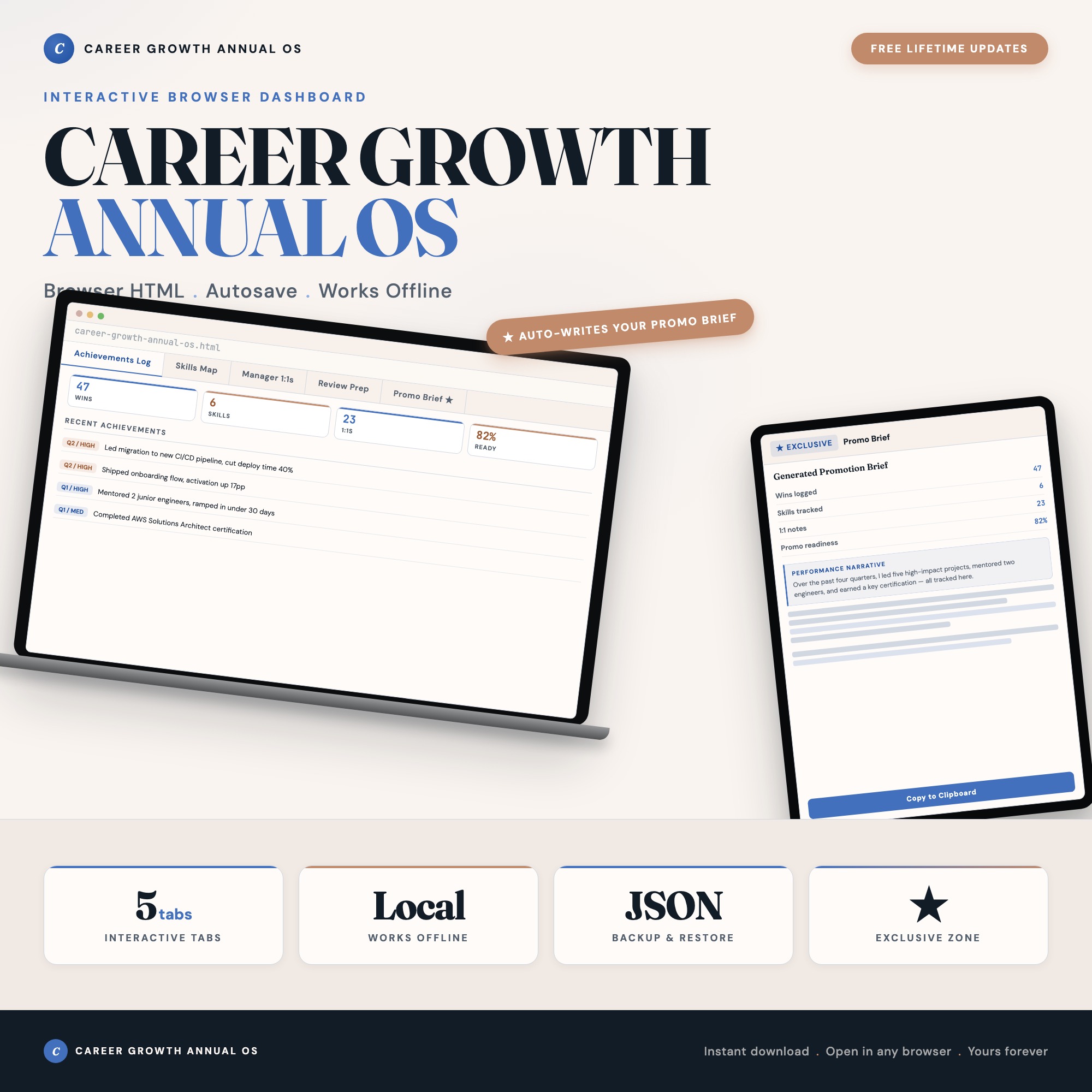
Tracking all six of these consistently requires a system that connects daily wins to quarterly narrative. The Career Growth Dashboard is a browser-based dashboard with tabs for Achievements Log, Skills Map, Manager 1:1 notes, Review Prep, and a Promotion Brief Auto-Generator that reads your logged data across all four tabs and assembles a formatted 1-page promotion case on demand. No other Etsy tool ships this.
At $25 one-time, no cloud, no subscription, your career data stays on your device. Available on Etsy.
Frequently asked questions
- When should I start tracking for a promotion?
- Now, regardless of when your review cycle is. Promotion cases are built from months of documented wins, not from a weekend of scrambling before review season. The earlier you start, the stronger your evidence.
- Do I need to spend a lot of money on tools?
- No. The Career Growth Dashboard costs $25 as a one-time purchase — less than two months of most subscription tools. And it is purpose-built for your workflow.
- What makes an offline HTML dashboard better than a subscription app?
- Privacy (your career data stays on your device, not in a cloud you do not control), specificity (it is built for promotion tracking, not generic project management), and the Promotion Brief Auto-Generator that writes your case from your logged data.
- How quickly can I get started with the Career Growth Dashboard?
- Under 5 minutes. Download the file, open it in any browser, and start using it immediately. Everything autosaves automatically.
Featured dashboards from this list
Interactive HTML dashboards — one-time purchase, works offline, no subscription.
ListingResearchOS Shop
All dashboards — single file, yours forever
Interactive HTML. No subscription. Works offline in any browser.
Browse all dashboards →