
10 Tasks Every Estate Executor Must Complete in the First 90 Days
The 10 probate tasks that carry legal deadlines in the first 90 days of estate administration — what each is, why it matters, and when to do it.
Published June 3, 2026
Being named executor of an estate is not a role people train for. Most executors are adult children or surviving spouses who have never administered an estate, are doing it while grieving, and have no clear map of what needs to happen and in what order.
The first 90 days carry the most critical statutory deadlines. Here are the 10 tasks that cannot wait.
1. Obtain Multiple Copies of the Death Certificate
You will need more copies of the death certificate than you expect — typically 10-15. Financial institutions, insurance companies, government agencies, and real estate transactions each require an original certified copy. Order them from the funeral home or county vital records office within the first week.
Running out of certified copies mid-process adds weeks of delay to account closures and insurance claims.
2. File the Will with the Probate Court
If the decedent had a will, it goes to the probate court in the county where they lived. States set their own deadlines for this: in California, whoever holds the will must deliver it to the court clerk within 30 days of learning of the death (Prob. Code §8200); in Florida, within 10 days of learning of it (Fla. Stat. §732.901). Filing the will opens the estate for administration.
If there is no will (intestate succession), you still need to open probate to receive appointment as administrator.
3. Apply for Letters Testamentary
Letters Testamentary (or Letters of Administration for intestate estates) are the court-issued documents that give you legal authority to act on behalf of the estate. Banks, brokerages, and transfer agents will not speak with you without them.
Apply for these at the same time you file the will. Depending on your state and court, this process takes 1-6 weeks.
4. Open an Estate Bank Account
The estate’s assets and expenses should flow through a dedicated estate checking account, not your personal account. You will use this account to collect income owed to the estate, pay valid creditor claims, cover funeral and administration expenses, and ultimately distribute assets to beneficiaries.
Open this account as soon as you have Letters Testamentary in hand. An executor letter to the bank asks each bank for date-of-death balances and to close or retitle the decedent’s accounts.
5. Notify Known Creditors
States require notice to creditors in different forms and on different clocks. California requires notice of administration to known creditors within four months after letters issue (Prob. Code §9051); Texas requires newspaper notice within one month after letters (Estates Code §308.051). The notice starts the period in which creditors can make claims against the estate. A probate letter to creditors gets each creditor’s balance on the date of death.
Known creditors include credit card companies, mortgage servicers, medical providers, and anyone the decedent owed money to.
6. Compile the Asset Inventory
The deadline for the court inventory depends on the state: 90 days after the executor qualifies in Texas (Estates Code §309.051), 60 days after letters in Florida (Fla. Prob. R. 5.340), four months after letters in California (Prob. Code §8800(b)). This includes all real property, financial accounts, vehicles, investment accounts, life insurance with estate as beneficiary, and personal property of value.
Start this immediately. Locating all accounts can take weeks, especially if the decedent did not leave organized records.
7. Cancel or Transfer Subscriptions and Recurring Accounts
Credit cards, subscriptions, utilities, and services in the decedent’s name continue accruing charges until they are explicitly cancelled. Some are easy (Netflix, gym memberships). Others require death certificates and formal processing (mortgages, car loans).
Make a full list and systematically close or transfer each account. This protects the estate’s assets and prevents debt accumulation.
8. Notify Government Agencies
Notify the Social Security Administration promptly — benefits paid after a death may have to be returned, and SSA will tell you which. The final income tax return, and an estate tax return if one is required, are separate filings with their own deadlines; ask the estate’s tax preparer which apply.
Veterans benefits, Medicare, Medicaid, and any state pension programs also require notification. Do not wait on these — overpayments become liabilities.
9. Secure and Maintain Estate Property
Real property (homes, rental units) that is now owned by the estate must be secured, insured, and maintained. Homeowners insurance policies typically terminate or change upon death. Contact the insurance carrier immediately to convert the policy to an estate coverage policy.
If the property is vacant, check on it regularly. Vandalism, weather damage, or squatters can create significant estate liability.
10. Communicate Regularly with Beneficiaries
Some states require formal notice to beneficiaries — Texas, for example, within 60 days after the order admitting the will (Estates Code §308.002). Beyond what the law requires, silence — even when you are working diligently — is what turns beneficiaries into adversaries. An executor letter to beneficiaries is the easy first one.
A simple monthly update (by email or letter) covering what has been completed, what is pending, and the estimated timeline reduces nearly all beneficiary friction.
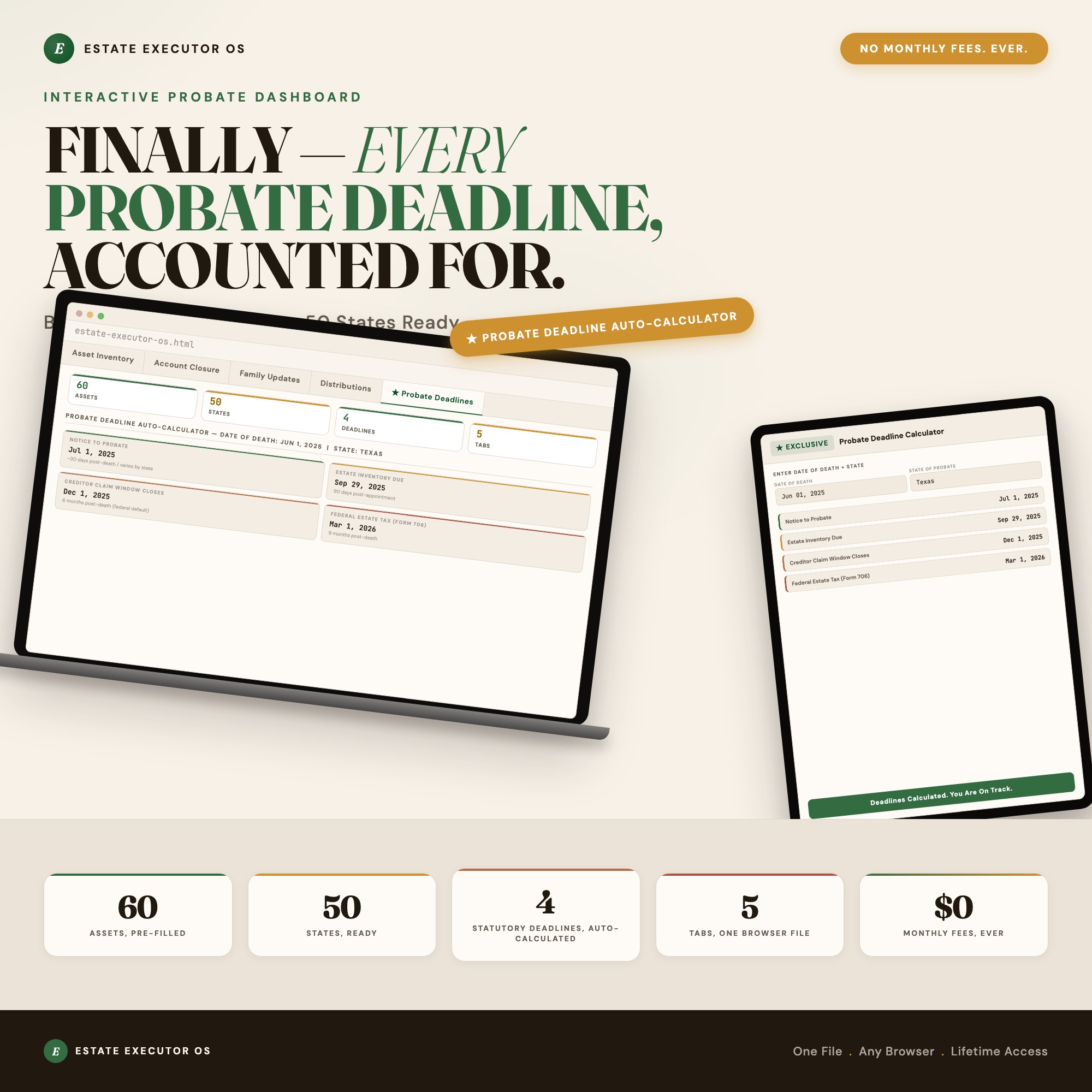
The Estate Executor OS is a browser-based dashboard with tabs for asset inventory, account closure tracking, beneficiary communications, and a Probate Deadline Auto-Calculator that takes your dates and state and lays out the statutory deadlines. No competitor on Etsy ships this.
At $29 one-time, it brings 6 months of overwhelming probate administration into a single organized file — private, offline, yours forever.
Available on Etsy.
Frequently asked questions
- What happens if an executor misses a probate deadline?
- It depends on the state and the deadline. At best it delays the estate; at worst the court or the beneficiaries hold the executor responsible. Inventory filings and creditor notices are the ones that come up first — ask a probate attorney as soon as you think one has been missed.
- Do I need to spend a lot of money on tools?
- No. The Estate Executor OS costs $29 as a one-time purchase — less than two months of most subscription tools. And it is purpose-built for your workflow.
- What makes an offline HTML dashboard better than a subscription app?
- Privacy (your family's financial data stays on your device), specificity (it is built for estate administration, not generic project management), and the Probate Deadline Auto-Calculator, which lays out the statutory deadlines from your dates and state.
- How quickly can I get started with the Estate Executor OS?
- Under 5 minutes. Download the file, open it in any browser, and start using it immediately. Everything autosaves automatically.
Featured dashboards from this list
Interactive HTML dashboards — one-time purchase, works offline, no subscription.
ListingResearchOS Shop
All dashboards — single file, yours forever
Interactive HTML. No subscription. Works offline in any browser.
Browse all dashboards →