
Probate Deadlines: What Every Executor Must Know and Track
Key probate deadlines every executor must track — estate inventory, creditor windows, estate tax filing, and the statutory timeline from date of death.
Published June 3, 2026
Being named executor of an estate is one of the most consequential administrative roles most people will ever take on. It arrives without training, usually during a period of grief, and carries legal deadlines that start counting whether or not you know what they are — some from the date of death, most from the day the court appoints you.
Missing a probate deadline doesn’t just slow down the process — it can leave the executor answering to the court or the beneficiaries for the delay. This guide covers the core statutory deadlines every executor needs to track and how to build a system for managing them.
Important note: Probate law is set by each state, and the deadlines differ — not just in length, but in which date they count from. Below are the deadlines for Texas, Florida and California, each read from the statute or court rule and cited. For any other state, ask the probate court clerk or a probate attorney; don’t rely on a “typical” number.
The deadlines, and what they run from
There are four dates that most clocks count from: the date of death, the day the court issues your letters (appoints you), in Texas the order admitting the will, and in Florida the first publication of the notice to creditors. Write all four down as soon as you have them.
Filing the will
- California: whoever holds the will delivers it to the court clerk within 30 days of learning of the death (Prob. Code §8200).
- Florida: whoever holds the original will deposits it with the clerk within 10 days of learning of the death (Fla. Stat. §732.901).
- Texas: a will generally has to be admitted to probate within four years of the death (Estates Code §256.003).
The inventory
- Texas: within 90 days after the executor qualifies, unless the court extends it (Estates Code §309.051).
- Florida: within 60 days after letters issue (Fla. Prob. R. 5.340).
- California: within four months after letters issue (Prob. Code §8800(b)).
Creditors
- Texas: publish notice to creditors in a newspaper within one month after letters issue (Estates Code §308.051), and notify secured creditors within two months (§308.053).
- Florida: the claims period closes three months after the notice to creditors is first published — for a creditor served with the notice, the later of that date or 30 days after service (Fla. Stat. §733.702). Separately, claims are cut off two years after the death (§733.710).
- California: give notice of administration to known creditors within four months after letters issue (Prob. Code §9051); the claims period closes four months after letters issue, or 60 days after a creditor’s notice if later (§9100).
Beneficiaries and closing the estate
- Texas: send notice to each beneficiary named in the will within 60 days after the order admitting it (Estates Code §308.002), and file the affidavit that notices went out within 90 days (§308.004).
- Florida: file the final accounting and petition for discharge within 12 months after letters issue when no federal estate tax return is required (Fla. Prob. R. 5.400(c)).
- California: petition for final distribution, or file a status report, within one year after letters issue — 18 months if a federal estate tax return is required (Prob. Code §12200).
Every one of these, dated from your own dates: Texas, Florida, California, or the probate timeline calculator. There is also a free printable checklist for all three states.
Tax returns
The person who died may owe a final income tax return, the estate may owe its own income tax return while it is open, and a large estate may owe a federal estate tax return. Each has its own IRS deadline, and some states add an estate or inheritance tax. Ask the estate’s tax preparer which apply and when they are due.
Build Your Asset Inventory Before It Is Due
The estate inventory is the foundation of everything that follows: paying creditors, calculating taxes, and making distributions. A disorganized inventory creates delays at every stage.
For each asset, record:
- Asset type — real property, financial account, vehicle, personal property, business interest
- Description — enough detail to identify the asset uniquely
- Estimated value — as of date of death
- Location — where the physical asset is, or where the account is held
- Account number or parcel number — the identifier needed for transfer or closure
- Status — Not started / In process / Closed/Transferred
For financial accounts specifically, you’ll need the account number, the institution, the date-of-death balance, and whether the account has a beneficiary designation or joint owner (if so, it likely passes outside probate).
Track Account Closures Systematically
Closing, canceling, or transferring every account and subscription is the operational core of estate administration. A typical estate involves:
- Bank accounts
- Credit cards
- Investment accounts
- Insurance policies
- Utilities and housing
- Subscriptions (streaming services, memberships, newsletters)
- Social media accounts
- Email accounts
For each, track the status: not started, cancellation requested, pending transfer, closed. Some require death certificates. Some require Letters Testamentary (official court documentation of your executor authority). Some have specific timing requirements.
Communicate with Beneficiaries on a Documented Schedule
Beneficiary conflicts during estate administration are common. The most reliable prevention is proactive, documented communication. Log every substantive beneficiary update: what you communicated, to which beneficiaries, and on what date.
This log serves as evidence that all beneficiaries were kept reasonably informed — an important protection if a beneficiary later claims they were excluded from the process.
Calculate Distributions After Creditors Are Paid
Distributions to beneficiaries cannot happen until the creditor window has closed and all valid claims have been paid. The estate may also need to satisfy state and federal tax obligations before distributions can flow.
For each distribution, document:
- The beneficiary’s name
- Their share percentage per the will or intestate statute
- The calculated dollar amount
- The date the distribution was made
- Receipt confirmation — a signed acknowledgment from the beneficiary
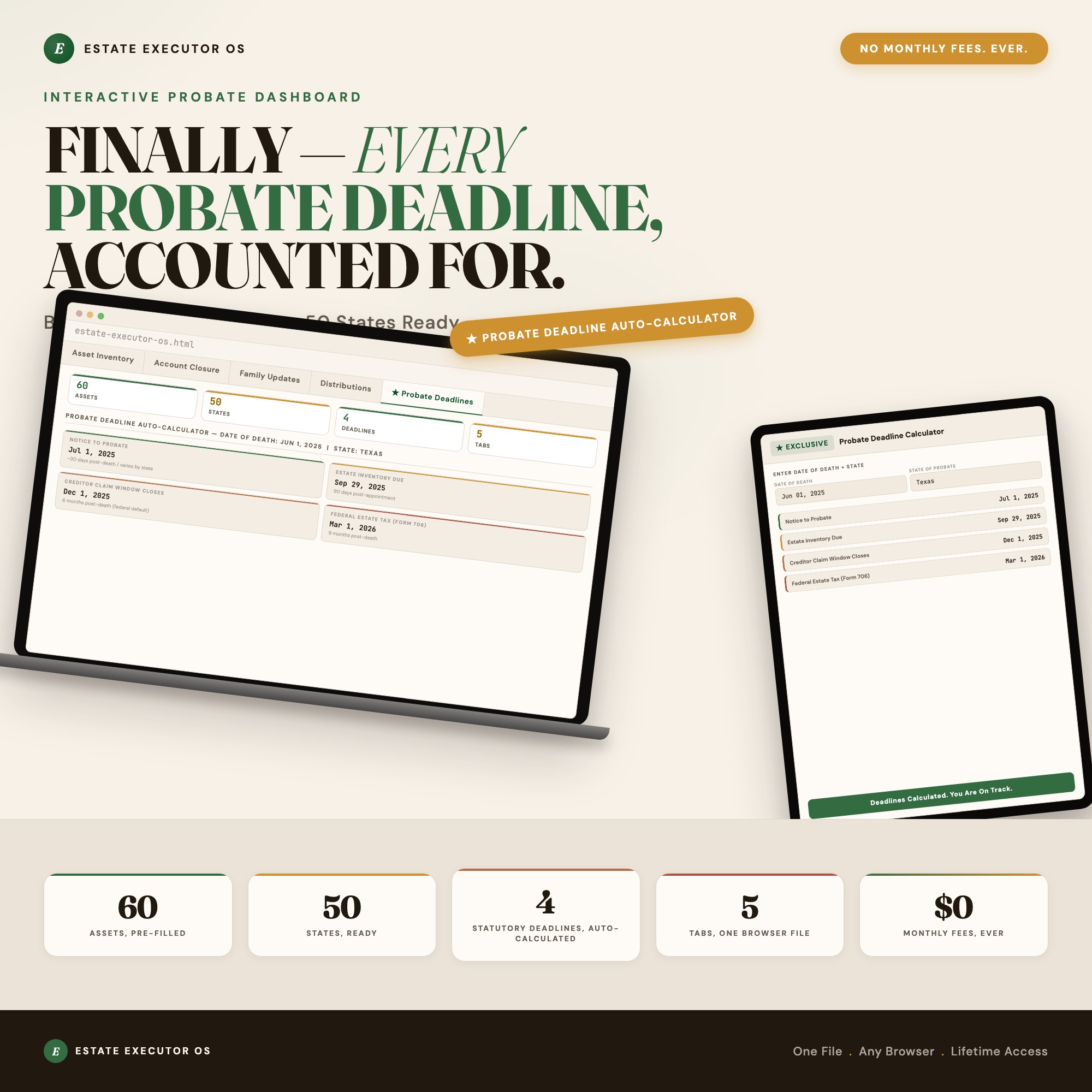
The Estate Executor OS includes a Probate Deadline Auto-Calculator that takes the date of death and state, then returns the full statutory timeline as a dated checklist. No competitor on Etsy ships this as an interactive feature — every other executor tool is a static spreadsheet or PDF. One-time purchase at $29.
For the statutory dates in your state right now, use the free probate timeline calculator, or read the full deadline lists for Texas, Florida and California.
Frequently asked questions
- Do I need special software to use an offline dashboard?
- No. An offline HTML dashboard like the Estate Executor OS is a single file you open in any browser — Chrome, Edge, Safari, or Firefox. Nothing to install, no account to create.
- Is my data private if I use a browser-based dashboard?
- Yes, completely. Data stored in your browser's localStorage never leaves your device. There are no servers, no analytics, and no uploads of any kind.
- Can I back up my data?
- Yes. Every ListingResearchOS dashboard includes an Export Backup button that downloads a JSON file to your computer. Load Backup restores it on any device or browser.
- What makes an interactive HTML dashboard better than a spreadsheet?
- Spreadsheets require manual formula maintenance and lack purpose-built workflows. An interactive HTML dashboard has pre-built logic — like a probate deadline calculator that takes your dates and your state and returns the statutory timeline, each deadline cited — that a spreadsheet can't replicate without significant engineering work.
- How much does the Estate Executor OS cost?
- It is a one-time purchase of $29 on Etsy. No monthly subscription. Once you buy it, it is yours forever.
Ready-made dashboards
Skip setup — grab an interactive dashboard built for this exact workflow.
ListingResearchOS Shop
All dashboards — one-time purchase, yours forever
Single HTML files. No subscriptions. No login. Works offline in any browser.
Browse all dashboards →