
The NaNoWriMo Planning System That Survives Past November
A NaNoWriMo planning system built to survive the mid-month slump: chapter cards, daily targets, and structure that carries the novel past November.
Published June 3, 2026
NaNoWriMo participants fail in two predictable waves. The first hits around day 8 when the initial enthusiasm fades and the daily habit isn’t yet established. The second hits around chapter 14 — the “soggy middle” of the story where the opening setup is complete but the climax feels impossibly far away.
Both failure modes have the same root cause: no visible structure connecting today’s writing session to the finished novel. This guide explains how to build a NaNoWriMo planning system with enough structure to carry you through November and into the revision phase beyond it.
Pre-November: The Planning Work That Matters
The writers who finish NaNoWriMo aren’t necessarily faster typists or more disciplined people. They tend to have more planned before November 1. Specifically:
- An outline, even a loose one. You don’t need every scene mapped. But knowing the rough arc of your three acts, the midpoint reversal, and the climax sequence means that when you sit down on November 14 with no momentum, you have a road to walk rather than fog to peer into.
- A chapter card per planned chapter. Not necessarily every chapter, but your anchor chapters — the inciting incident, the midpoint, the dark night of the soul, the climax. Even 6–8 cards gives you visible structure.
- Character references ready. The most time you waste during a NaNoWriMo session is when you stop mid-scene to remember whether your protagonist’s sister is named Elise or Elena, or what car your antagonist drives.
The pre-November planning investment pays out daily during the month. Writers who outline at least their major plot beats before November 1 have significantly higher completion rates.
The Daily Log Habit That Builds Momentum
NaNoWriMo requires writing 50,000 words in 30 days — roughly 1,667 words per day. Most participants don’t achieve that target consistently. What matters is whether you’re close enough to make up the gap.
A daily log lets you calculate that gap in real time:
- If you’re at 22,000 words on day 14, you should be at 23,338 to stay on pace
- You’re 1,338 words behind — recoverable with one strong session
- If you’re at 14,000 words on day 14, you need 9,338 words in 16 days — about 584 extra words per day beyond target
Knowing your actual position removes the vague anxiety and replaces it with a concrete math problem. Most writers find the concrete problem more motivating than the feeling of being “behind.”
Log each session with:
- Date
- Words written today
- Cumulative word count
- Chapter or scene worked on
- Mood and session notes — for your own reflection, not the official tracker
Maintain Your Chapter Board Throughout the Month
A chapter board is distinct from your daily log. The log tracks your output. The board tracks your story.
For each chapter, maintain:
- Chapter number and working title
- Status: Outlined / Drafted / Skipped (to return to)
- One-line scene summary — what actually happens in this chapter
- Target word count vs. actual word count
The “Skipped” status is essential. When you’re stuck on chapter 9, you don’t need to stop and solve it today. Mark it skipped, write a one-line placeholder summary, and keep moving. NaNoWriMo is about completing a draft — you can fix chapter 9 in December. The chapter board makes it safe to skip because you can see every gap at a glance.
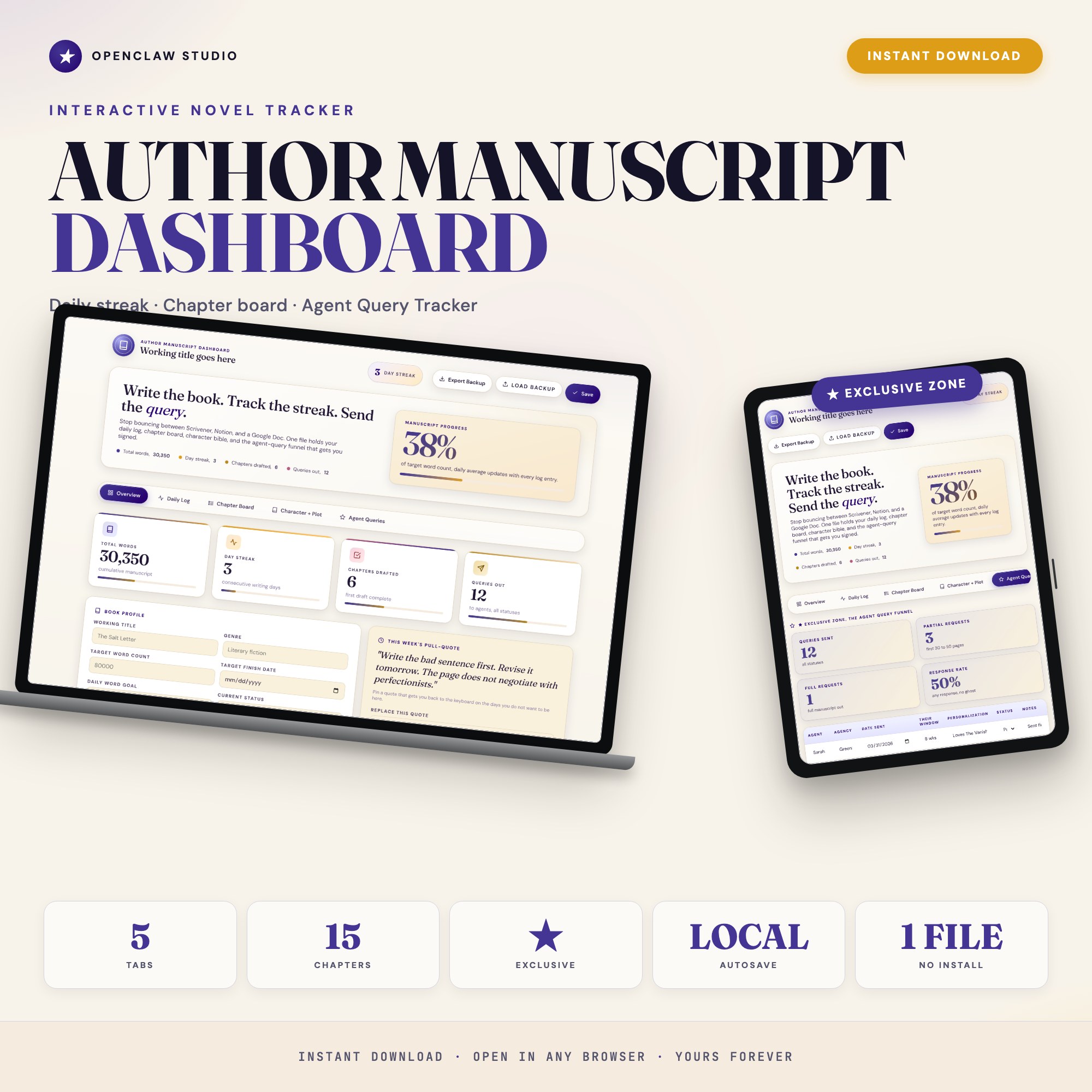
The Author Manuscript Dashboard has a Chapter Board tab with exactly these fields plus status dropdowns per chapter. It sits alongside the Daily Log tab so your session progress and story structure are always visible in the same file.
After November: The System That Survives
Most NaNoWriMo participants who “win” end the month with a 50,000-word rough draft that stops cold on December 1. The structure that got them through the month disappears.
The manuscripts that become finished novels are the ones where the writer maintains a system through revision:
- The chapter board moves from “Drafted” to “Revised” to “Final” for each chapter
- The character + plot reference stays current as the story changes in revision
- New chapters that were added or scenes that were reorganized get logged
If you’re aiming to query literary agents after revision, the Agent Query Tracker in the Author Manuscript Dashboard handles the submission phase — agent name, agency, date sent, response window, status — with a response-rate rollup that shows whether your query letter is working. This is the reason it exists: a system that goes from first draft in November through queries in Q2 of the following year without requiring you to rebuild from scratch.
Handling the Mid-Month Slump Specifically
Chapter 14 is where NaNoWriMo fails for most writers not because of a word-count deficit but because of a structural one. The opening act is complete, the characters are established, and the protagonist is somewhere in the middle of act two — which was less planned than act one.
When momentum stalls, the instinct is to re-read and revise what you’ve written. This is the most reliable way to not finish NaNoWriMo. Re-reading in November is word-count negative — you’re consuming time without generating new words, and you’re inviting the inner critic in at exactly the wrong moment.
Instead, when you’re stuck mid-chapter, write a bracketed placeholder: [SCENE WHERE MAYA DECIDES TO GO BACK TO THE HOUSE — figure out why later] and keep moving. Your chapter board’s “Skipped” status is permission to leave a gap and fill it in December. The draft doesn’t need to be complete — it needs to be forward-moving.
The writers who finish NaNoWriMo are the ones who treat the first draft as a permission slip to write badly on purpose.
One-time purchase at $22. Browse the full collection at ListingResearchOS on Etsy.
Frequently asked questions
- Do I need special software to use an offline dashboard?
- No. An offline HTML dashboard like the Author Manuscript Dashboard is a single file you open in any browser — Chrome, Edge, Safari, or Firefox. Nothing to install, no account to create.
- Is my data private if I use a browser-based dashboard?
- Yes, completely. Data stored in your browser's localStorage never leaves your device. There are no servers, no analytics, and no uploads of any kind.
- Can I back up my data?
- Yes. Every ListingResearchOS dashboard includes an Export Backup button that downloads a JSON file to your computer. Load Backup restores it on any device or browser.
- What makes an interactive HTML dashboard better than a spreadsheet?
- Spreadsheets require manual formula maintenance and lack purpose-built workflows. An interactive HTML dashboard has pre-built logic — like Built-in Agent Query Tracker capturing agent, agency, date sent, response window, status (no response / form pass / partial / full / offer of rep), with personalized response-rate rollup — that a spreadsheet can't replicate without significant engineering work.
- How much does the Author Manuscript Dashboard cost?
- It is a one-time purchase of $22 on Etsy. No monthly subscription. Once you buy it, it is yours forever.
Ready-made dashboards
Skip setup — grab an interactive dashboard built for this exact workflow.
ListingResearchOS Shop
All dashboards — one-time purchase, yours forever
Single HTML files. No subscriptions. No login. Works offline in any browser.
Browse all dashboards →