
How to Manage an Estate as Executor: A Step-by-Step Guide
A step-by-step executor guide: asset inventory, account closures, beneficiary updates, distributions, and the statutory probate deadlines you must track.
Published June 3, 2026
Being named executor of an estate is one of those responsibilities that arrives before you’ve had time to prepare for it. Most executors are adult children or surviving spouses who have never done this before, are grieving while working, and are facing legal deadlines they may not even know exist yet.
This guide is a practical walkthrough of the executor’s job: what needs to happen, in what order, over the first six to twelve months. It’s not legal advice — consult a probate attorney for anything jurisdiction-specific — but it gives you the operational framework so you can ask the right questions and track what’s been done.
The First Two Weeks: Immediate Priorities
The days immediately following a death require several actions in parallel, some of which have hard deadlines.
Obtain certified death certificates. You’ll need multiple — typically 8–12. Banks, insurance companies, transfer agents, and the probate court each require an original. Order more than you think you need. Shortage is a common delay.
Locate the will and any trust documents. The will may be in a home safe, at the attorney’s office, or filed with the probate court. Trusts may supersede portions of the will. If you can’t locate the original will, the estate may be treated as intestate (no will), which significantly changes the distribution rules.
Identify and secure estate assets. This means taking an inventory of everything owned: bank and investment accounts, real property, vehicles, insurance policies, digital assets, personal property of value. This list forms the foundation of the estate inventory you’ll file with the probate court.
Start the probate case. States set limits on how long you can wait — Texas, for example, generally allows four years from the death to admit a will to probate (Estates Code §256.003) — but most of the other clocks only start once you are appointed, so there is no benefit in waiting. A probate attorney usually files the petition, and the court’s order appointing you is what banks and creditors will ask to see.
The Statutory Deadline Problem
Probate is deadline-driven, and the deadlines are different in every state. A few examples, each read from the statute or court rule:
- Notice to creditors: in Texas, published in a newspaper within one month after letters are issued (Estates Code §308.051).
- Inventory: due within 90 days after the executor qualifies in Texas (Estates Code §309.051), 60 days after letters in Florida (Fla. Prob. R. 5.340), and four months after letters in California (Prob. Code §8800(b)).
- Creditor claims: in Florida the period closes three months after the notice to creditors is first published (Fla. Stat. §733.702); in California, four months after letters issue (Prob. Code §9100).
- Tax returns: the estate and the person who died may each owe federal and state returns with their own IRS and state deadlines — ask the estate’s tax preparer which apply.
These deadlines don’t pause because you’re overwhelmed. They run on calendar time. Every verified deadline, dated from your own dates: Texas, Florida, California, or the probate timeline calculator.
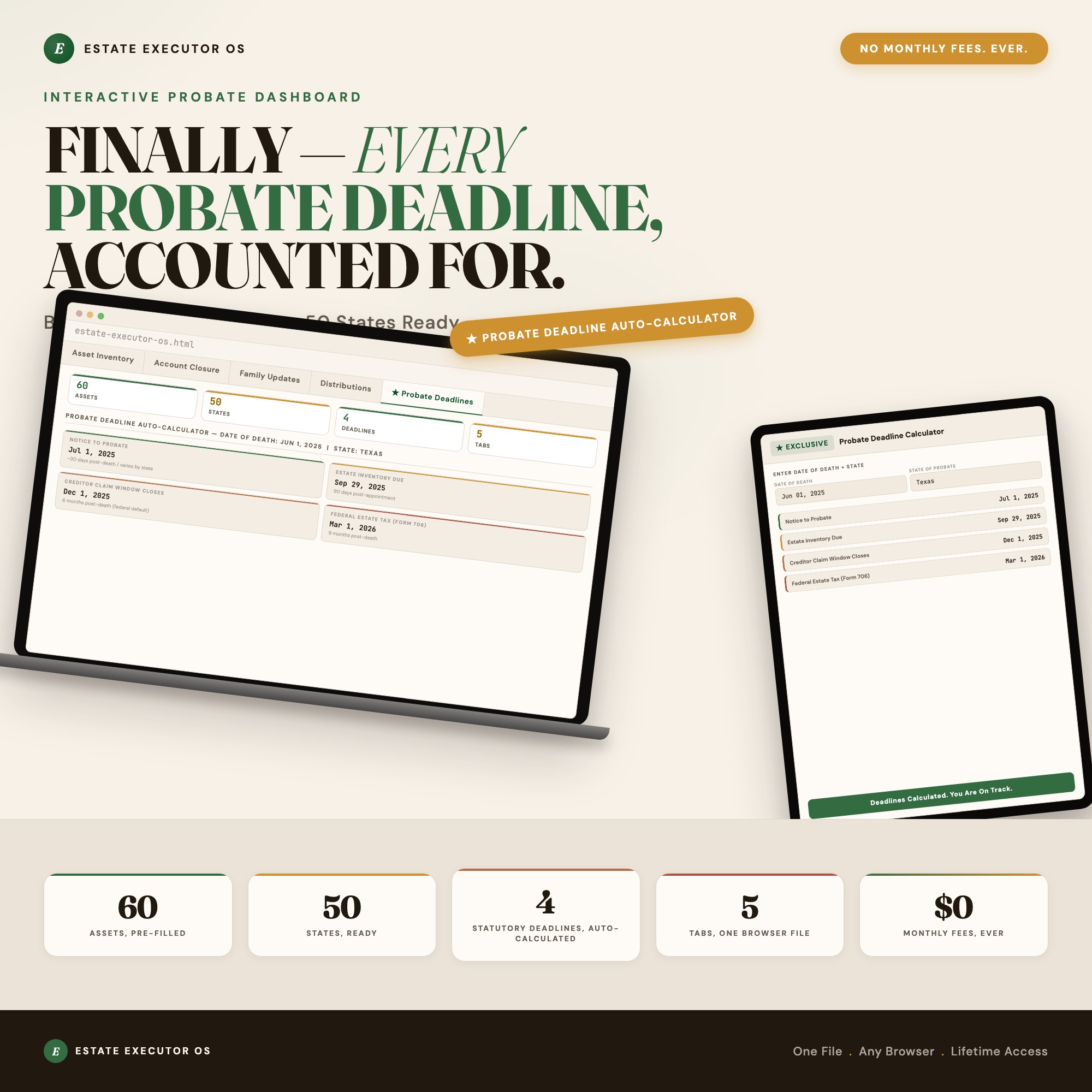
The Probate Deadlines tab in the Estate Executor OS takes the date of death and the state of probate, and returns the full statutory timeline automatically. No Etsy competitor ships this as an interactive calculator — every other option is a static spreadsheet where you calculate the dates manually.
Managing the Five Core Executor Tasks
Asset Inventory: Log every account, property, vehicle, insurance policy, and digital asset. The inventory tab holds up to 60 rows with status tracking. This is both your organizational tool and the document you’ll file with the court.
Account Closure Pipeline: Every bank account, credit card, utility, and subscription needs to be cancelled or transferred. Tracking the status — open / in process / closed — across 20–40 accounts is where things fall through the cracks without a dedicated system.
Beneficiary Communication: One of the most emotionally fraught parts of being executor is managing family expectations. The Family Updates tab logs what you told which beneficiary, when, with notes. This isn’t just for your own reference — it’s documentation if questions arise later about whether beneficiaries were kept informed.
Distributions Ledger: When the time comes to distribute estate assets, you need to calculate each beneficiary’s share, record the payment date, and capture a signed receipt. The Distributions Ledger handles this in one place.
Probate Deadlines: Described above.
Free templates for the paperwork
Most of an executor’s first months are letters. These free templates fill in as you type, then copy or print:
- Executor letter to beneficiaries — who you are, how you were appointed, and what happens next.
- Executor letter to the bank — date-of-death balances, and closing or retitling each account.
- Probate letter to creditors — notice of death and a balance request, without promising payment.
- Final estate accounting template — the summary of account when you are done.
- Executor fee calculator — the statutory commission in five states.
The Estate Executor OS costs $29, one time. It’s the only interactive executor dashboard on Etsy with built-in probate deadline calculation. Works offline in any browser — important for the frequent situations where you’re at a bank or attorney’s office without reliable internet.
Frequently asked questions
- Do I need special software to use an offline dashboard?
- No. An offline HTML dashboard like the Estate Executor OS is a single file you open in any browser — Chrome, Edge, Safari, or Firefox. Nothing to install, no account to create.
- Is my data private if I use a browser-based dashboard?
- Yes, completely. Data stored in your browser's localStorage never leaves your device. There are no servers, no analytics, and no uploads of any kind.
- Can I back up my data?
- Yes. Every ListingResearchOS dashboard includes an Export Backup button that downloads a JSON file to your computer. Load Backup restores it on any device or browser.
- What makes an interactive HTML dashboard better than a spreadsheet?
- Spreadsheets require manual formula maintenance and lack purpose-built workflows. An interactive HTML dashboard has pre-built logic — like a probate deadline calculator that takes your dates and your state and returns the statutory timeline — that a spreadsheet can't replicate without significant engineering work.
- How much does the Estate Executor OS cost?
- It is a one-time purchase of $29 on Etsy. No monthly subscription. Once you buy it, it is yours forever.
Ready-made dashboards
Skip setup — grab an interactive dashboard built for this exact workflow.
ListingResearchOS Shop
All dashboards — one-time purchase, yours forever
Single HTML files. No subscriptions. No login. Works offline in any browser.
Browse all dashboards →